

- HomeHome
- DREMDREM
-
Statistical InformationStatistical Information
-
Economic
- Government
- Agriculture, Forestry and Fishing
- Construction and housing
- Trade
- Economic Accounts
- Enterprises
- Industry and energy
- Innovation and knowledge
- Prices
- Monetary and Financial Sector
- Short-term trends
- Transports and Communications
- Tourism
-
Social
- Culture, Sport and Recreation
- Education
- Health
- Justice
- Labour market
- Population and Social Standards
- Social protection
- Territory
- Multithemes
- Indicators System
-
Economic
- Dissemination CalendarDissemination Calendar
- MetadataMetadata
- LinksLinks
- Site MapSite Map
- Press release
- Dashboards
- Contact usContact us









Notícias (GB)
DREM releases the final results of the 2025 Tourism Statistics and updates the corresponding Time Series (1976-2025) (Read more...)
In 2025, the main obstacles to reconciling work and family life were long working hours and unpredictable or atypical working hours (Read more...)
In 2025, the number of inoculations administered in the Region increased by 2.5% (Read more...)
In June 2026, the Confidence Indicator in Manufacturing Industry and Services increased, while in Construction and Public Works and in Trade there was a decrease (Read more...)
DREM publishes a new edition of the Quarterly Statistical Bulletin covering the 1st quarter of 2026 (Read more...)
In May 2026, the passenger movement at the airports of the Autonomous Region of Madeira recorded a year-on-year growth of 5.5% (Read more...)
In the 1st quarter of 2026, the median rent for new lease agreements increased by 16.0% and the number of new agreements fell by 8.6% year-on-year (Read more...)
In 2024/2025, the 2nd cycle of Primary Education recorded the highest progression/completion rate (Read more...)
In May 2026, the median value of bank appraisals for housing in the Autonomous Region of Madeira stood at 2 598 euros per square metre (Read more...)
In 2025, the Region's only mobile pharmacy outlet was closed (Read more...)
Notícias (GB)
DREM releases the final results of the 2025 Tourism Statistics and updates the corresponding Time Series (1976-2025) (Read more...)
In 2025, the main obstacles to reconciling work and family life were long working hours and unpredictable or atypical working hours (Read more...)
In 2025, the number of inoculations administered in the Region increased by 2.5% (Read more...)
In June 2026, the Confidence Indicator in Manufacturing Industry and Services increased, while in Construction and Public Works and in Trade there was a decrease (Read more...)
DREM publishes a new edition of the Quarterly Statistical Bulletin covering the 1st quarter of 2026 (Read more...)
In May 2026, the passenger movement at the airports of the Autonomous Region of Madeira recorded a year-on-year growth of 5.5% (Read more...)
In the 1st quarter of 2026, the median rent for new lease agreements increased by 16.0% and the number of new agreements fell by 8.6% year-on-year (Read more...)
In 2024/2025, the 2nd cycle of Primary Education recorded the highest progression/completion rate (Read more...)
In May 2026, the median value of bank appraisals for housing in the Autonomous Region of Madeira stood at 2 598 euros per square metre (Read more...)
In 2025, the Region's only mobile pharmacy outlet was closed (Read more...)
Newsletters
Subscribe to our newsletter and get statistical data as soon as it is available!...
In 2019
Regional Development Composite Index for the Autonomous Region of Madeira improved
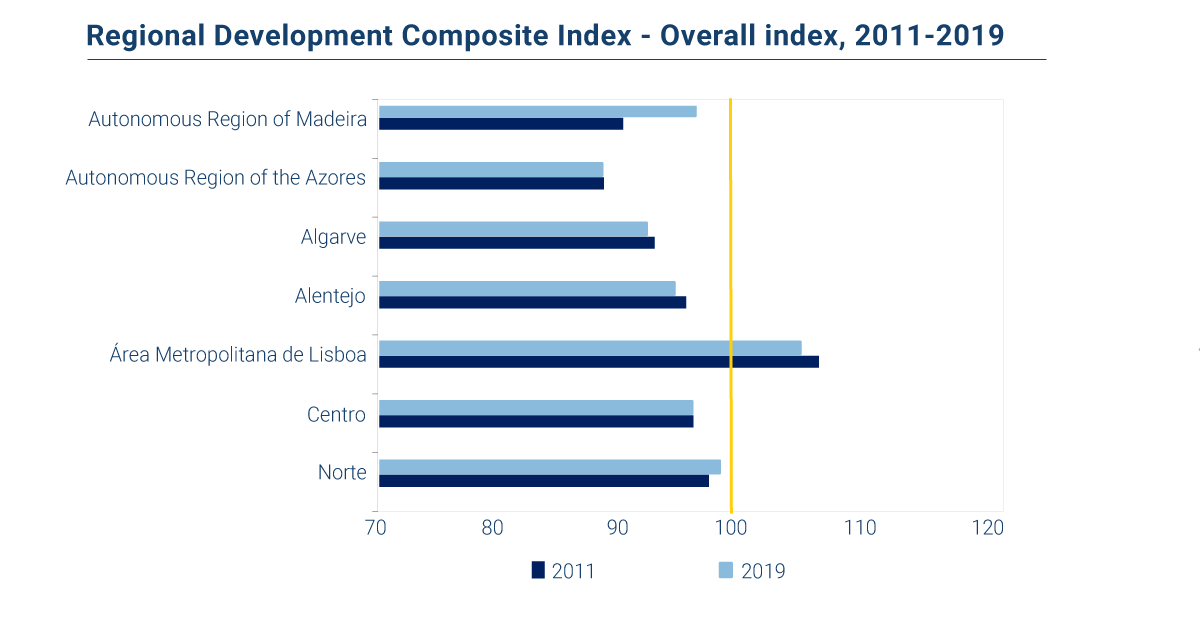
The Regional Development Composite Index (RDCI) results for 2019 released today by Statistics Portugal (INE) show that Área Metropolitana de Lisboa remains as the only region above the country’s average regarding the overall index (an aggregate of the competitiveness, cohesion and environmental quality indexes) with this indicator reaching 106,37 (a minimum of the time series which starts in 2011). In the Autonomous Region of Madeira the index stood at 97.29 in 2019, increasing from 2018 (95.10) and standing as a new maximum. The Autonomous Region of Azores scored 89.24, the lowest value among NUTS2 regions.
The competitiveness index was also higher in Área Metropolitana de Lisboa (113.66), once again the only region above the country’s average. The Autonomous Regions of the Azores and Madeira have the worse results, with Madeira scoring a value of 90.88 in 2019 (89.49 in 2018) and Azores 82.24.
The values of the cohesion index are more balanced than the previous index at least for mainland Portugal. The Autonomous Region of the Azores has the lowest cohesion index (80.01), while Madeira scored 88.95 in this indicator.
The Autonomous Region of Madeira was the leading NUTS2 region (and also NUTS3 region) in the environmental quality index in the year 2019 (113.15), ahead of the Autonomous Region of the Azores (106.68).
It should be noted that in any of the three indexes, the Autonomous Region of Madeira, in 2019, registers, as in the case of the overall index, the maximum of the series (which start in 2011). Comparing the years of 2011 and 2019, the only two regions which have an increase of the overall index are the Autonomous Region of Madeira and Norte, far greater in the first (6.23) than in the second case (0.91).
International Statistical Cooperation
 |
International Statistical Cooperation
|
Statistical Literacy
 |
Statistical Literacy
|
|
|
|
|
 |
 |
|


 |
|
|
 |

Copyright © 2026 Direção Regional de Estatística da Madeira. All rights reserved.
Address: Calçada de Santa Clara 38, 9004-545 Funchal, Madeira Island
Phone: +351 291 145 126 (National landline call)