











Newsletters
Subscribe to our newsletter and get statistical data as soon as it is available!...
DREM updates the time series on Tax Revenue Statistics with data for 2025
The Regional Directorate of Statistics of Madeira (DREM) today updates the "Tax Revenue Statistics" time series covering the period 2006-2025, with data for 2024 and 2025 being of a provisional and preliminary nature, respectively.
This series was compiled by Statistics Portugal (INE) within the scope of preparing the national "Tax Revenue Statistics", and results mainly from information provided by the Regional Directorate of Budget and Treasury (DROT) to DREM, for the production of INE's quarterly and annual Public Administration Statistics (and also within the scope of the Excessive Deficit Procedure), supplemented with other data collected by INE from Central Administration.
It is important to note that these data refer exclusively to taxes that constitute revenue for the Regional Government of Madeira and are presented in national accounting terms rather than public accounting terms. Consequently, the figures published by DREM and those by DROT will reveal divergences for certain taxes. These discrepancies are justified by specific adjustments made by Statistics Portugal during the transition from public accounts to national accounts.
It should also be stressed that the information made available today does not allow calculation of the "tax burden", i.e. the sum of all taxes and effective social contributions levied on taxpayers with their tax residence in the Autonomous Region of Madeira, as the scope of this analysis is limited to the Regional Administration of Madeira (RAM), with some taxes (and social contributions) paid by taxpayers resident in the ARM constituting revenue of Central Government and also of Local Government. Another factor preventing a rigorous calculation of the "tax burden" relates to Value Added Tax (VAT), as revenue from this tax derives from the application of a formula and does not correspond to the actual collection of the tax made in the Region.
In addition to DROT, DREM also extends its thanks to the Tax and Customs Authority of Madeira (AT-RAM) and to the Customs Office of Funchal for the information provided, which made it possible to deepen the analysis of the trend in each tax.
In 2025, the tax revenue in the Region stabilised at 1 324.0 million euros
According to preliminary data for 2025, the Region's tax revenue, measured in national accounting terms, amounted to 1 324.0 million euros, showing a very modest change compared to the previous year, with growth of only 567 thousand euros. In relative terms, the increase in regional tax revenue was effectively nil, while across General Government as a whole for the country, tax revenue grew by +6.7%.
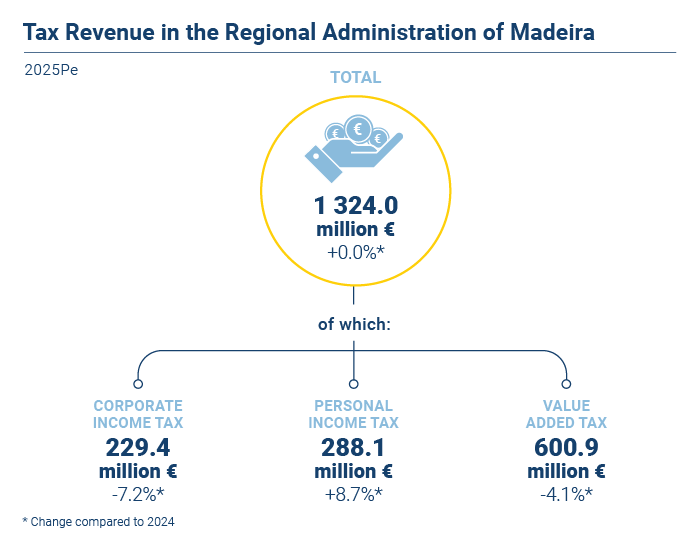
In 2025, Personal Income Tax (IRS) revenue stood at around 288.1 million euros, +8.7% compared to the previous year, representing 55.4% of total direct taxes constituting ARM revenue (51.5% in the previous year). IRS revenue rose despite the tax relief measures introduced by the change to the IRS rate reduction regime (Regional Legislative Decree No. 3/2025/M), reflecting, above all, the dynamism of the regional economy. Indeed, DREM's Regional Economic Activity Indicator (IRAE) suggests an increase in economic activity in 2025, with effects on the labour market, reflected in growth in the employed population (+3.5%) and in average earnings per worker (+5.1%).
According to tax collection data from the Tax and Customs Authority, payment notices (+39.8%), property income (+8.4%) and income from business and professional earnings (+8.1%) contributed positively to the IRS balance. It should be noted, however, that there was a decrease in revenue from withholding tax on employment income (-3.1%) and from pension income (-2.6%), explained by the entry into force of the new withholding tax tables, with a reduction in effective IRS rates. Across General Government for the country as a whole, IRS revenue grew by 8.8%.
In the case of Corporate Income Tax (IRC), revenue in 2025 stood at around 229.4 million euros, recording a decrease of 7.2% compared to 2024. By component, the decrease in IRC revenue was driven by the decline in payment notices (-72.7% compared to the previous year) and in coercive collection revenue (-71.3% compared to 2024). Conversely, self-assessments (the amount payable following submission of the IRC return - Form 22), payments on account (which depend on the IRC paid in the previous year), and additional payments on account (advance payment of the state surtax) showed an upward trend, of +39.7%, +14.0% and +40.5%, respectively. Across General Government for the country as a whole, IRC revenue decreased by 3.8%.
Over the period 2006-2025, Value Added Tax (VAT) established itself as the tax generating the most revenue for the Regional Government, representing 74.8% of indirect taxes in 2025 (77.5% in 2024) and corresponding to 600.9 million euros. In 2025, VAT allocated to the ARM decreased by 4.1%, reflecting the change to the reduced VAT rate in the Region (Regional Legislative Decree No. 6/2024/M) that took place in the 4th quarter of 2024, as well as adjustments compared to previous years. Across General Government for the country as a whole, VAT grew by 7.2%.
Among the remaining taxes, it is worth highlighting the tax on oil and energy products (ISP), whose revenue was 59.1 million euros in 2025, returning to the collection levels generally seen between 2011 and 2021, after lower values, just above 40 million euros, were recorded between 2022 and 2024. Tobacco tax (IT) revenue, meanwhile, stood at around 48.2 million euros, recording growth of 2.4%. Stamp duty (IS) reached 40.6 million euros in 2025, with revenue increasing by 7.0% compared to the previous year. As for the tax on alcohol and alcoholic beverages (IABA), this stood at around 11.5 million euros in the reference year, -5.6% compared to the previous year, while vehicle tax (ISV) grew by 0.4% compared to 2024, reaching 7.2 million euros in 2025.
For further information, please consult:
International Statistical Cooperation
 |
International Statistical Cooperation
|
Statistical Literacy
 |
Statistical Literacy
|
|
|
|
|
 |
 |
|


 |
|
|
 |

Copyright © 2026 Direção Regional de Estatística da Madeira. All rights reserved.
Address: Calçada de Santa Clara 38, 9004-545 Funchal, Madeira Island
Phone: +351 291 145 126 (National landline call)