











Newsletters
Subscribe to our newsletter and get statistical data as soon as it is available!...
In 2024,
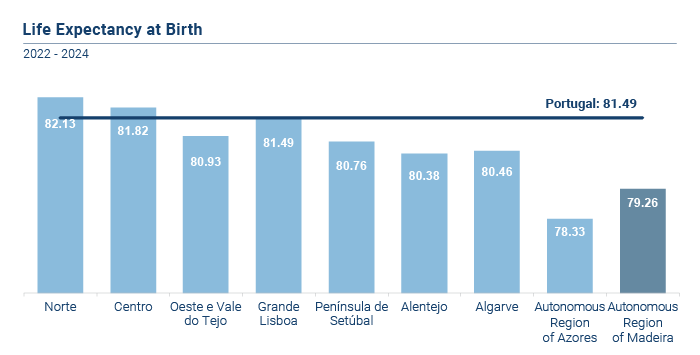
Life expectancy at birth in the Autonomous Region of Madeira was estimated to be 79.26 years
Statistics Portugal released today the life tables by NUTS 2 region, for the three-year period 2022-2024.
For the three-year period 2022-2024, life expectancy at birth for the resident population in the Region was estimated to be 79.26 years, with 75.87 years for men and 82.08 years for women. This indicates that women may expect to live six years longer than men. Compared to 2021-2023, life expectancy increased by 0.19 years (about two months), with an increase of 0.43 years (five months) for men and 0.16 years (two months) for women. It is noteworthy that life tables for 2020-2002 to 2022-2024 incorporate population estimates based on the final results of the 2021 Census and are therefore not comparable with those of previous three-year periods.
For the country as a whole, life expectancy at birth was estimated to be 81.49 years (2.23 years higher than the estimated for the Region), having increased by 0.32 years (four months) compared with the previous three-year period. The results further indicate that, nationally, women can expect to live 83.96 years and men 78.73 years. Norte has the highest longevity (82.13 years), in contrast to the Autonomous Region of the Azores, where life expectancy at birth is the lowest in the country (78.33 years).
In the Autonomous Region of Madeira, life expectancy at age 65 reached 18.56 years in the three-year period 2022-2024. Men aged 65 are expected to live an average of 16.19 years, while women may live an additional 20.14 years, resulting in a difference of 3.95 years between males and females.
Life expectancy at age 65 for the total Portuguese population stood at 20.02 years (1.46 years higher than in the Region): 18.30 years for men and 21.35 years for women. It is in Norte where the highest longevity at age 65 is observed (20.42 years), and in the Autonomous Region of the Azores, the lowest (17.83 years).
From the survival function of the complete life table for the Region, broken down by sex, for the three-year period 2022-2024, it is evident that women survive in greater numbers to older ages compared to men. For example, it is estimated that 82.0% of male newborns and 91.4% of female newborns will survive to the age of 65 if, throughout their lives, they are subject to the specific age-specific mortality probabilities observed during the 2022-2024 period.
For more information, please click on:
- Publications (Portuguese only)
- Time series - Life Tables
- Short series of Demography
- Long series of Demography
International Statistical Cooperation
 |
International Statistical Cooperation
|
Statistical Literacy
 |
Statistical Literacy
|
|
|
|
|
 |
 |
|


 |
|
|
 |

Copyright © 2026 Direção Regional de Estatística da Madeira. All rights reserved.
Address: Calçada de Santa Clara 38, 9004-545 Funchal, Madeira Island
Phone: +351 291 145 126 (National landline call)