







Newsletters
Subscribe to our newsletter and get statistical data as soon as it is available!...
In the school year 2019/2020
Retention and desistance rates at primary and lower secondary education decreased and the transition/completion rate at upper secondary education increased
The Regional Directorate of Statistics of Madeira (DREM) releases the "Education Time Series of the Autonomous Region of Madeira" updated with information from the 2019/2020 school year, provided by the Education Observatory of the Autonomous Region of Madeira (OERAM), as a organisational unit of the Regional Directorate of School Administration (DRAE), of the Regional Secretariat of Education, Science and Technology. It should be noted that this series now contains (in addition to the new information already released last year on the number of students living in the Autonomous Region of Madeira enrolled in higher education in Portugal, for the period 2015/2016-2018/2019, made available by the Directorate General of Education and Science Statistics (DGEEC), new indicators on students and graduates in higher education, teaching staff, non-teaching staff and other indicators related to schooling rates for primary and lower secondary education, upper secondary education and tertiary education.
In the 2019/2020 school year, 117 establishments provided pre-primary education in the Autonomous Region of Madeira (120 in the previous school year), setting the number of early childhood educators at 645 (766 in 2018/2019). The number of enrolled students increased by 134 children compared to the previous school year (+2.4%), reaching 5.8 thousand. For the second consecutive year, since 2010/2011, there is again an increase in the number of children enrolled in pre-primary education. It should be recalled that in the 2017/2018 school year the minimum number of enrolled students was recorded (5.6 thousand students), with the maximum having occurred in the 2006/2007 school year (8.1 thousand students).
In 2019/2020 there were 25 thousand pupils enrolled in primary education, representing a fall of 3.5% (-903 pupils) when compared with the previous school year. There was a fall of 3.6% in the 1st cycle, 7.8% in the 2nd cycle and 0.8% in lower secondary education. The total number of students in primary education corresponds to the lowest value observed since the beginning of the series, in 1999/2000, which was the school year with the highest number of students enrolled, approximately 38.2 thousand. The difference between these extreme values of the series corresponds to a drop of 13.2 thousand students.
In secondary education there were about 11.0 thousand students enrolled, - 1.3% (-144 students) than in the previous school year, thus returning to the downward trend that began in the 2015/2016 school year, with an exception in the 2018/2019 school year. It should be noted that in 2005/2006 this indicator reached the highest value of the series (11.9 thousand pupils) and in 2000/2001 the lowest value (8.2 thousand).
In overall terms (from pre-school to secondary education), in the 2019/2020 school year, 41.8 thousand students were enrolled in the Autonomous Region of Madeira, which represents a decrease of 2.1% (-913 students) when compared to the previous school year. Students enrolled in the 1st cycle have been decreasing since 2007/2008, students in the 2nd cycle since 2011/2012 and students in the lower secondary education since 2013/2014. It should be underlined that the total number of pupils is the lowest since the beginning of the series. Of the 41.8 thousand students, public education concentrates 79.6% of the enrolments and private education 20.4%.
Concerning teaching staff assigned to pre-school, primary and secondary education (including vocational education), 6.0 thousand teachers were in service, down by 14 (-0.2%) from the 2018/2019 school year. It should be noted that this decrease resulted solely from the reduction in teaching staff in pre-school education (-121 people) since the other levels of education saw increases, which totalled 107 people.
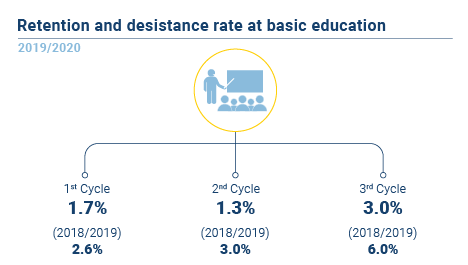
The retention and desistance rates at primary and lower secondary education in the Autonomous Region of Madeira decreased to 2.1%, - 1.8 percentage points (pp) than in 2018/2019, corresponding to the lowest value of the series. The transition/completion rate at upper secondary education according to the trend observed since 2013/2014 continued to increase, now standing at 89.5% (+4.5 pp than in the previous school year).
Early school leaving rate decreased again in 2020
According to information from the Employment Survey, in the Autonomous Region of Madeira, the rate of early leavers from education and training (expressed as a 3-year moving average) decreased again, from 13.7% in 2019 to 11.2% in 2020. This variable has been decreasing steadily since 2013, the year in which it reached 28.0%, and in seven years it decreased by 16.8 pp.
In 2020, the lifelong learning rate was 7.9%, down by 1.0 p.p. than in 2019, and it is more significant among women (9.0%) than men (6.6%). The effects of the pandemic in 2020 and the limitation of mobility of the population may account for this reduction.
In turn, the tertiary education level schooling rate of the population living in the Autonomous Region of Madeira aged between 30 and 34 years (3-year moving average) was set at 33.4% in 2020 (39.8% in women and 27.2% in men), the highest value since 2013 (1st year of the series).
Regarding the rate of young people aged 15 to 34 years, unemployed, who are not in education or training, it rose from 13.1% in 2019 to 17.2% in 2020, after 6 years of successive falls, that began in 2014. The highest value of the series was observed in 2013, whose value amounted to 25.0%.
In 2019/2020 nearly 4,800 Madeirans were studying in mainland Portugal in tertiary education
In the school year in question, in the 8 establishments providing tertiary education in the Autonomous Region of Madeira, there were 3.4 thousand students (116 more students than in the previous school year) and 396 teaching staff members (10 more than in the previous school year). Of the total number of students enrolled, 86.0% were in public education and 14.0% in private education.
According to the data provided by DGEEC, in the 2019/2020 school year, 7.9 thousand students were enrolled in the Autonomous Region of Madeira studying in tertiary education establishments in Portugal. Since 2015/2016, this indicator has maintained an increasing trend. Of the total number of students enrolled, 39.5% were studying in educational establishments in the Autonomous Region of Madeira, 29.6% in the Lisbon Metropolitan Area, 14.1% in Norte, 12.4% in Centro, 2.7% in Alentejo, 1.2% in Algarve and only 0.5% in the Autonomous Region of the Azores.
By type of course/cycle of study, in 2019/2020, 61.1% of the students were enrolled in a 1st cycle undergraduate degree, 16.7% in an integrated master's degree, 13.1% in a 2nd cycle master's degree, 4.3% in a professional higher technical course and 2.8% in a 3rd cycle doctoral degree. Of these students, 89.1% were enrolled in public education and 10.9% in private education.
International Statistical Cooperation
 |
International Statistical Cooperation
|
Statistical Literacy
 |
Statistical Literacy
|
|
|
|
|
 |
 |
|


 |
|
|
 |

Copyright © 2026 Direção Regional de Estatística da Madeira. All rights reserved.
Address: Calçada de Santa Clara 38, 9004-545 Funchal, Madeira Island
Phone: +351 291 145 126 (National landline call)