











Newsletters
Subscribe to our newsletter and get statistical data as soon as it is available!...
DREM releases education indicators from the Labour Force Survey 2021 and updates tertiary education data for the academic year 2020/2021
As in previous years, the Regional Directorate of Statistics of Madeira (DREM) releases some indicators regarding Education in the Autonomous Region of Madeira, resulting from the Labour Force Survey (LFS), as well as data regarding tertiary education for the academic year 2020/2021.
The data revision of the LFS from 2011 to 2020 adjusted to the new series which began in the 1st quarter of 2021, focused only on the data that is used to define the employment status, since persons engaged in agricultural and fishing activities for self-consumption were no longer considered as employed. Also, the active population refers only to the age group 16 to 89 years. The studies carried out by Statistics Portugal led to the conclusion that other changes made do not result in any statistically significant disturbances that would justify additional adjustments in the previous series (IE2011) to have the former series consistent with the new series. Therefore, estimates related to education and training in the previous time series remain the same as those released at that time, i.e. they were not revised.
Thus, in addition to updating the information for the year 2021, DREM makes available today the revised estimates within the scope of the reconciliation exercise with the 2021 time series, for the period 2011-2020, of the indicators related to "Youth aged 16-34 not employed who are not in education or training".
Early school leavers rate continues to drop
In the Autonomous Region of Madeira, the early school leavers rate in 2021 (expressed as a 3-year moving average) was 10.2%, a 1.0 percentage points (pp) drop over the previous year. This variable has been continuously decreasing since 2013 (the first year of the time series), when it stood at 28.0%, having declined by 17.8 pp in eight years. Although the regional school leavers rate is higher than the national rate, the values are converging. While in 2013, this gap was 7.2 pp, in 2021 it did not exceed 1.7 pp. Note that in 2021, as in the previous eight years, the rate in question is higher for men (12.6% ) than for women (7.6%). However, the difference between the two rates is shrinking, decreasing from 16.5 pp in 2013 to 5.0 pp in 2021.
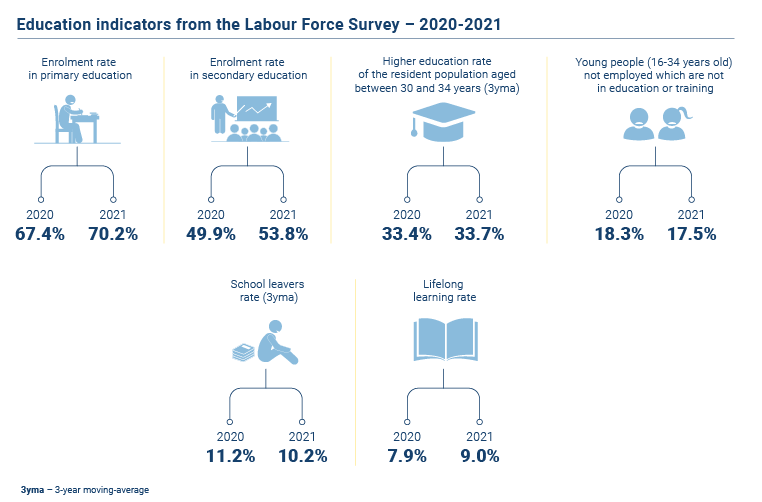
In 2021, the lifelong learning rate stood at 9.0%, up by 1.1 pp over 2020, being higher among women (9.7%) than men (8.3%). The trend of this rate changed over 2011-2021, with a peak in 2018 (9.4%) before declining to 8.9% in 2019, decreasing again in 2020 to 7.9%, and increasing to 9.0% in 2021, as mentioned before. In the country, this rate also increased by 2.9 pp, but it stood above the value for the Autonomous Region of Madeira by 3.9 pp, meaning a wider gap between the Region and the country than in the prior year (2.1 pp).
The schooling rates for the primary education level and secondary education level have been increasing between 2011 and 2021. In the primary education, the indicator reflects the proportion of the resident population aged between 20 and 64 years with at least the lower secondary education, in the total resident population of the same age group, reaching 70.2% in the last year (48.3% in 2011 and 67.4% in 2020). The secondary education rate, which represents the proportion of the resident population that has completed secondary education, in the total resident population aged 20-64, increased from 31.6% in 2011 to 53.8% in 2021 (49.9% in 2020). Considering only the 20-24 age group, in 2021, the rate reached 80.8% in the ARM. At a national level, the schooling rates, in 2021, were 80.1% for primary education and 62.3% for secondary education.
The tertiary education rate of the resident population aged between 30 and 34 years residing in the Autonomous Region of Madeira (3-year moving average) was 33.7% in 2021 (41.8% for women and 26.0% for men). Although this percentage remains below national average (39.8%), still it is the highest value since 2013 (1st year of the time series).
17.5% of young people were not employed, nor in education or training
After the minimum (14.0%) recorded in 2019, the percentage of young people (16-34 years) not employed who are neither in education nor training (NEET) grew by 4.3 pp in 2020, reaching 18.3%. In 2021, this percentage decreased by 0.8 pp, to 17.5%. It should be noted that the change of this indicator was similar in the age groups 16-24 years and 25-34 years. Apart from 2011, the percentage of young people NEET was always higher in the 25-34 age group, reaching 20.9% in 2021, not exceeding 13.7% in the 16-24 age group. In 2021, the rate of women aged 16-34 years who are neither in education nor training (19.2%) was higher than that of men (15.8%). Regarding NEET, in 2021 the percentage was 17.5%, the equivalent to 10.5 thousand young people, of whom 55.2% were inactive (5.8 thousand) and 44.8% unemployed (4.7 thousand).
At a national level, the rates of the three age groups under analysis were always lower than in the Region. Between 2020 and 2021, there was also a decrease , going from 12.2% in 2020 to 10.7% in 2021 for the 16-34 age group (-1.5 pp). In the last year, the difference between men and women is not very significant, being 10.8% and 10.6%, respectively. By age group, in 2021, the rate of young NEET aged between 16 and 24 years was 8.4% and in the age group between 25 and 34 years was 12.7%.
Enrolment rate in tertiary education set at 13.4% in 2020/2021
In the academic year under question (2020/2021), in the 8 establishments providing tertiary education in the Autonomous Region of Madeira, there were 3.7 thousand students (up by 368 students over the previous academic year) and 401 teachers (increasing by 5 over the previous academic year). Of the total number of students enrolled, 86.8% were in public education and 13.2% in private education.
The enrolment rate in tertiary education was 13.4% in 2020/2021 (11.8% in the previous academic year), the highest value since 2003/2004.
According to data released (provided by the General Directorate of Education and Science Statistics - DGEEC), in the academic year 2020/2021, 8.6 thousand students with residence in the Autonomous Region of Madeira were enrolled in tertiary education establishments in Portugal. Since 2015/2016, this indicator has maintained an increasing trend. Of the total number of students enrolled, 41.3% were studying in establishments in the Autonomous Region of Madeira, 27.9% in Área Metropolitana de Lisboa, 13.7% in Norte, 12.8% in Centro, 2.7% in Alentejo, 1.1% in the Algarve and only 0.5% in the Autonomous Region of the Azores.
By type of course/cycle of study, in the academic year 2020/2021, 60.8% of the students were enrolled in a 1st cycle undergraduate degree, 15.4% in an integrated master's degree, 12.9% in a 2nd cycle master's degree, 5.7% in a professional higher technical course and 2.8% in a 3rd cycle doctoral degree. Of these students, 89.9% were enrolled in public education and 10.1% in private education.
International Statistical Cooperation
 |
International Statistical Cooperation
|
Statistical Literacy
 |
Statistical Literacy
|
|
|
|
|
 |
 |
|


 |
|
|
 |

Copyright © 2026 Direção Regional de Estatística da Madeira. All rights reserved.
Address: Calçada de Santa Clara 38, 9004-545 Funchal, Madeira Island
Phone: +351 291 145 126 (National landline call)