










Newsletters
Subscribe to our newsletter and get statistical data as soon as it is available!...
In 2024/2025
2nd cycle of Primary Education recorded the highest progression/completion rate
The Regional Directorate of Statistics of Madeira (DREM) updates the "Time Series on Education of the Autonomous Region of Madeira", with the final Non-Higher Education data for the 2024/2025 school year. The data were made available by the Education Observatory of the Autonomous Region of Madeira (OERAM), as a core unit of the Regional Directorate of School Administration (DRAE), of the Regional Secretariat for Education, Science and Technology.
In the 2024/2025 school year, the number of educational establishments providing Pre-school Education and the 1st Cycle of Primary Education decreased compared to the previous school year (down 2 in both, as a result of school mergers), remaining unchanged in the 2nd and 3rd Cycles of Primary Education and in Secondary Education.
A total of 37 103 students were enrolled in the 2024/2025 school year, from Pre-school Education to Secondary Education, representing a decrease of 2.0% compared to the previous school year. Taking institutional type into account, public education accounted for 77.1% of enrolments and private education for 22.9%.
The number of students enrolled in Pre-school Education decreased by 2.8% compared to the previous school year (173 fewer enrolments), covering 6 094 children.
In courses geared towards young persons, 29 493 students were recorded, from the 1st cycle of Primary Education to Secondary Education, 406 fewer students than in the previous school year (-1.4%), respectively.
In 2024/2025, 21 720 students were enrolled in Primary Education: 9 579 in the 1st cycle, 4 214 in the 2nd cycle and 7 927 in the 3rd cycle. Compared to the previous school year, the 1st cycle of Primary Education recorded an increase of 2.9% (273 more students), while the number of students enrolled in the 2nd and 3rd cycles decreased by 6.4% and 1.9%, respectively. In the school year under review, Secondary Education had 9 289 enrolled students, 4.1% fewer than in the previous school year.
In turn, the number of students participating in courses geared towards adults, which includes recurrent education, Adult Education and Training (EFA) courses, modular training, and processes for the recognition, validation and certification of competences (RVCC), totalled 1 516 students. In particular, the number of adults participating in EFA courses fell by 9.5% (83 fewer persons) and the number of those involved in RVCC processes decreased by 11.0% compared to the previous school year (20 fewer persons).
The progression/completion rate for the 2nd cycle of Primary Education was the highest, reaching 98.5%, a figure 0.2 percentage points (pp) higher than that recorded in 2023/2024. In the 1st cycle, the rate stood at 98.4%, representing a decrease of 0.1 pp. In the 3rd cycle, a rate of 94.2% was recorded (-0.2 pp.), while in Secondary Education the rate was 89.2%, reflecting an increase of 0.2 pp.
In the 2024/2025 school year, 5 706 teachers were in post (teaching and non-teaching duties) from Pre-school Education to Secondary Education, including Vocational Schools, 54 fewer teachers than in the previous school year. Only in Vocational Schools did the proportion of teachers under 40 years of age exceed the proportion of teachers aged 60 or over, accounting for 19.2% and 8.6% of teachers, respectively. Of the total number of teachers, 5 087 belonged to public schools, 91.0% of whom held permanent posts.
Non-teaching staff in non-higher education numbered 3 868 persons, up by 2.2% over the 2023/2024 school year.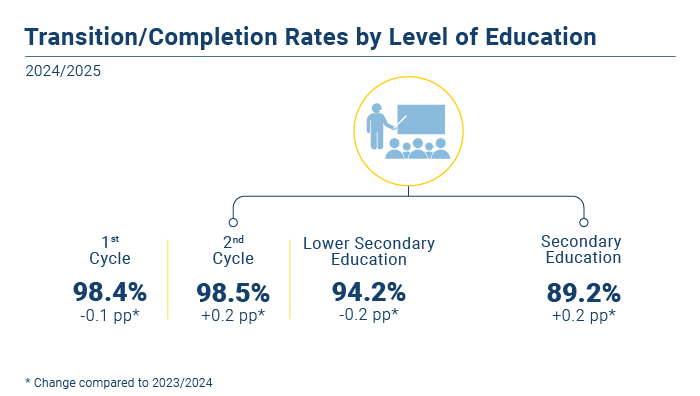
For more information, please click on:
International Statistical Cooperation
 |
International Statistical Cooperation
|
Statistical Literacy
 |
Statistical Literacy
|
|
|
|
|
 |
 |
|


 |
|
|
 |

Copyright © 2026 Direção Regional de Estatística da Madeira. All rights reserved.
Address: Calçada de Santa Clara 38, 9004-545 Funchal, Madeira Island
Phone: +351 291 145 126 (National landline call)