











Newsletters
Subscribe to our newsletter and get statistical data as soon as it is available!...
Average expenditure on electricity in households increased over the last decade, constituting 68.7% of the energy expenditure in households
The Regional Directorate of Statistics of Madeira (DREM) makes available today on its website a set of statistical data with the final results of the Survey on Energy Consumption in Households (ICESD).
ICESD allowed to obtain detailed and updated information on energy consumption and expenditure in the domestic sector in the Region: accommodation (and respective equipment) and transport for individual use of residents in the household. Data refer to the period from October 2019 to September 2020.
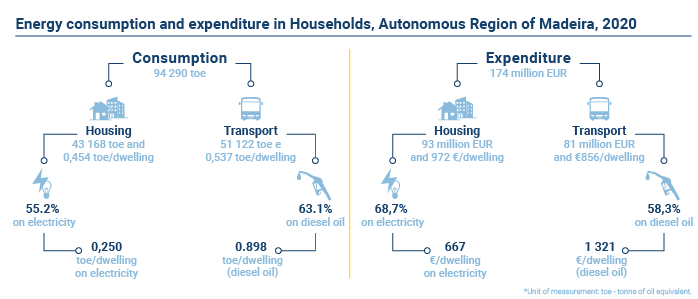
Energy consumption - In 10 years, the average energy consumption per household (accommodation and transport) decreased by 17.6%
In 2020, the total energy consumption in the household sector in the Region was 94,290 tonnes oil equivalent (toe), including consumption with energy in vehicles used for individual transport of household residents and consumption with energy in households: 51,122 toe (54.2%) and 43,168 toe (45.8%), respectively. After a decade, energy consumption decreased, and in 2010 it was 52,753 toe in transport and 44,431 toe in accommodation.
The average energy consumption per household in the Region was 0.991 toe, 0.537 toe in vehicles and 0.454 toe in accommodation. In 10 years, the average energy consumption regarding vehicles and accommodation decreased from 1.202 to 0.991 toe/household, representing a decrease of 17.6% from 2010.
Energy expenditure - Between 2010 and 2020, the average energy expenditure (accommodation and transport) increased from 1,639 €/household to 1,828 €/household
Despite the decrease in energy consumption in the domestic sector in the last decade, the total energy expenditure increased from around 132 million euros to 174 million euros. In 2020, the highest energy burden went exclusively to accommodation (53.2%, 93 million euros; 62 million in 2010).
On average, per household, 1,828 euros was spent on energy in 2020 (1,639 euros in 2010): 972 euros on energy consumed exclusively in the dwelling and 856 euros on fuel used in vehicles. While the average expenditure on the dwelling increased between 2010 and 2020 (763 €/household in 2010), the average expenditure on fuel decreased slightly (876 €/household in 2010).
Accommodation - In 2020, an average of €667 per household was spent on electricity, considerably higher than the estimated €382 per household in 2010
The decrease in total energy consumption in household, according to the last 10 years, is mostly due to the reduction in consumption of LPG (17,319 toe in 2010 and 12,265 toe in 2020) and biomass (2,785 toe in 2010 and 2,186 toe in 2020), since the consumption of electricity and LPG increased by 16.1% and 27.7%, respectively.
In 2020, the total energy consumption exclusively in households was mostly for electricity (55.2%), with an increase in the electricity regarding the total energy consumption in households compared to 2010 (9.0 pp). On the contrary, the energy sources from LPG and biomass lost relevance in the last decade, with their share decreasing from 39.0% and 6.3% in 2010 to 28.4% and 5.1% in 2020, respectively.
Regarding the expenditure on energy exclusively in households, a total expenditure of 92.5 million euros was calculated for 2020. The highest energy expenditure in households was on electricity, representing 68.7% of the total spent on energy, followed by LPG (23.7%), piped LPG (6.5%) and biomass (1.2%). On average, 667 euros per household was spent on electricity in 2020, considerably higher than the 382 euros estimated in 2010, indicating that in 10 years the average annual expenditure on electricity increased by 285 euros.
Considering the type of end-use, the survey results show that more energy was consumed in cooking, having this average consumption fallen over the last decade: 0.229 toe/household in 2010 and 0.195 toe/household in 2020. The second highest average energy consumption was for water heating (0.115 toe/household) and, finally, for space heating (0.007 toe/household).
While in the total energy consumption in the kitchen, electricity had the highest share (52.8%), in heating water, LPG in bottles stood out (54.8%) and in space heating, the biomass source - firewood, pellets and briquettes or charcoal - 77.5%.
Considering only electricity, consumption and expenditure with this energy source were higher in the use of electrical appliances, constituting 50.1% of total consumption and 50.9% of total expenditure with electricity. The second highest consumption and expenditure was due to the use of electricity in the kitchen, representing 41.1% of the total consumption and 40.1% of the total expenditure on electricity.
In household lighting, it is noteworthy that LED bulbs were used in 73.0% of households in the Region (0.7% in 2010). Despite the generalized transition to low consumption with light bulbs in the last decade, the Region continues to be the region of the country with the lowest adherence to this type of bulb (80.1% in Portugal).
Transport - In 2020, 1,321 €/housing were spent on diesel and 997 €/housing on petrol
Diesel was the most used fuel in vehicles used by residents in the main households in the Region, both in 2010 and 2020, and its weight in total fuel consumption has increased over the last decade (57.8% in 2010 and 63.1% in 2020).
Between 2010 and 2020, the share of diesel, in the total expenditure on fuel used in vehicles used by residents in households, increased from 50.7% to 58.3% and the weight of gasoline decreased from 49.3% to 41.7%.
On average, in 2020, 1,321 euros per household was spent on diesel and 997 euros per household on gasoline, indicating a decrease in the average expenditure on diesel and an increase in the average expenditure on gasoline in the last 10 years (1,338 €/ household and 942 €/ household in 2010, respectively).
The Region's households whose household's net monthly income is below the minimum monthly guaranteed income (RMMG) – 635 euros in 2020 - on average spent 82.4 euros per month on fuel (diesel or petrol). The average expenditure tends to increase in line with the income class of the household. However, in the Region, this increase is not linear since the average monthly expenditure per household on fuel is lower in the last income class (115.4 euros per month in the class “4,000 euros or more”) than in the immediately preceding classes.
For more information, please click on:
International Statistical Cooperation
 |
International Statistical Cooperation
|
Statistical Literacy
 |
Statistical Literacy
|
|
|
|
|
 |
 |
|


 |
|
|
 |

Copyright © 2026 Direção Regional de Estatística da Madeira. All rights reserved.
Address: Calçada de Santa Clara 38, 9004-545 Funchal, Madeira Island
Phone: +351 291 145 126 (National landline call)