










Newsletters
Subscribe to our newsletter and get statistical data as soon as it is available!...
DREM marks Workers' s Day with an analysis of the regional labour market
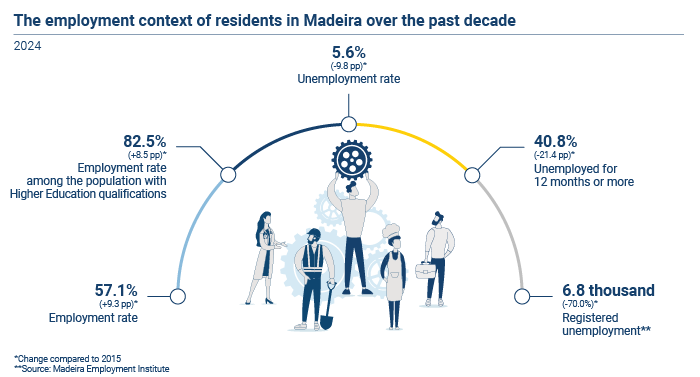
On Workers' s Day, the Regional Directorate of Statistics of Madeira (DREM) reviews the regional labour market over the past decade, using a set of indicators drawn from the Labour Force Survey. In addition, figures on registered unemployment, based on data provided by the Madeira Employment Institute (IEM), are also made available.
Key indicators include:
-
-
-
- In 2024, the Autonomous Region of Madeira (ARM) recorded 126.4 thousand employed persons, corresponding to an employment rate of 57.1%. This was the highest figure in the last ten years.
-
-
-
-
-
- Over the past decade, the male employment rate increased by 10.6 percentage points (pp), while the female rate rose by 8.2 pp, reaching 61.3% and 53.4%, respectively, in 2024. The male employment rate has consistently remained higher than that of females, peaking in 2023 with a gap of 10.6 pp between the two.
-
-
-
-
-
- Residents with higher levels of completed education tend to exhibit higher employment rates. Over the last ten years, around four in every five residents holding a "Higher Education" qualification were employed. In 2024, the employment rate for these persons stood at 82.5%, up by 8.5 pp compared to 2015.
-
-
-
-
-
- In 2024, 89.4% of the employed population were employees, of whom 7.5% had a part-time contract - a reduction of 0.9 pp from 2015.
-
-
-
-
-
- The year 2019 recorded the highest number of employed persons with a secondary activity in the past decade, with 6.2 thousand persons (5.4% of those employed) holding more than one job. In 2024, this proportion is estimated to have declined to 4.5%.
-
-
-
-
-
- Regarding the main occupation in 2024, men accounted for more than half of those employed in the group "Representatives of the legislative and executive bodies, directors, officers and executive managers” (67.3%). Meanwhile, women represented the majority among professionals in "Specialists in intellectual and scientific activities" (64.4%).
-
-
-
-
-
- In line with historical trends, the number of unemployed persons in 2024 did not exceed 7.6 thousand - the lowest figure in the past decade. That year, the unemployment rate dropped below 6% for the first time, reaching 5.6% of the active population.
-
-
-
-
-
- In 2024, for every 100 employed persons, there were 97.5 inactive persons - a figure significantly lower than in 2015, when the ratio stood at 133.6.
-
-
-
-
-
- Young persons aged 16 to 34 who were not in employment, education or training (NEET) represented around 10.9% of that age group, amounting to 5.7 thousand persons. A substantial reduction in the number of NEETs was observed over the last decade, with a 57.8% decrease.
-
-
-
-
-
- In 2024, approximately 31.1% of those registered as job seekers had, at most, completed only the "2nd Cycle of Primary Education". Throughout the past ten years, the structure of registered unemployment has consistently shown a predominance of persons with lower levels of educational attainment.
-
-
For further information, please refer to:
International Statistical Cooperation
 |
International Statistical Cooperation
|
Statistical Literacy
 |
Statistical Literacy
|
|
|
|
|
 |
 |
|


 |
|
|
 |

Copyright © 2026 Direção Regional de Estatística da Madeira. All rights reserved.
Address: Calçada de Santa Clara 38, 9004-545 Funchal, Madeira Island
Phone: +351 291 145 126 (National landline call)