











Newsletters
Subscribe to our newsletter and get statistical data as soon as it is available!...
In 2025
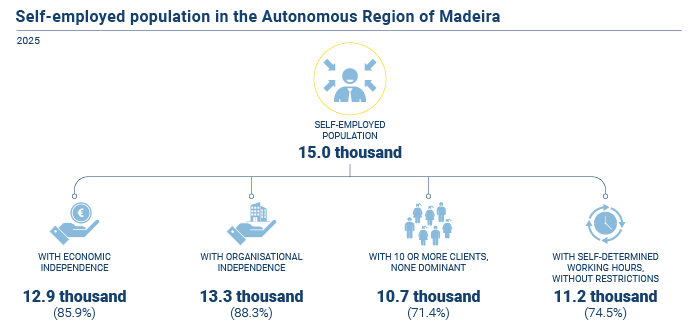
85.9% of self-employed workers in the Region had economic independence and 88.3% had organisational independence
The Regional Directorate of Statistics of Madeira (DREM) publishes data today from the Employment Survey, referring to 2025, on the assessment of the impact of clients (understood here as customers, buyers, users, patients, service users, etc.) on the activity of self-employed workers in the Autonomous Region of Madeira (ARM). The economic and organisational dependence of self-employed workers, the impact of clients on their activity and the possibility of these workers defining their own working hours are analysed. Data are also published on the frequency of education or training activities among the population aged between 16 and 74 years, as well as information on the self-assessed health status and the existence of limitations due to health problems among the employed population aged 16 to 89 years.
In 2025, it is estimated that approximately 15.0 thousand self-employed workers (SEW) resided in the ARM, accounting for 11.5% of the employed population. Compared to the previous year, this proportion increased by 1.1 percentage points (pp), the highest value since 2021.
Considering the number of clients a self-employed worker has, "Economic dependence" is considered to exist when the worker has only one client or, having two or more clients, one is dominant (individually representing 75% or more of the worker's activity income — after tax deductions). On the other hand, although a high level of flexibility in the determination of working hours by self-employed workers is expected, this is not always the case, as clients often determined the worker's working hours. In this case, in the analysis of the impact of clients on the activity of self-employed workers with regard to the determination of daily working hours, organisational dependence is considered to exist.
In 2025, the percentage of self-employed workers with "Economic independence" was 85.9%. Compared to 2021, a growth of 10.9 pp was observed in the proportion of workers in these conditions, whilst compared to 2024, a decrease of 1.5 pp was recorded. In 2025, 71.4% of self-employed workers had 10 or more clients and no dominant client (62.5% in 2021), corresponding to an increase of 0.2 pp compared to the 2024 proportion. In the case of organisational independence, which covered approximately 88.3% of self-employed workers in 2025, the value was 6.2 pp below that estimated for 2021 (94.5%), but above that recorded in 2024 (86.2%).
In 2025, 74.5% of workers considered that they determined their own working hours without restrictions, a percentage below that of 2021, which stood at 75.3%, but above that of 2024 (70.0%).
Decrease in formal education attendance and increase in non-formal education and training activities
The Employment Survey data collection also includes a set of questions on the participation of persons aged between 16 and 74 years in education and training activities over the last 12 months. It should be noted that formal education activities (those that confer a level of schooling) and non-formal education activities (those that, despite being institutionalised and planned, confer only a certificate of attendance but not a level of schooling, constituting an addition and/or complement to formal education in the context of lifelong learning, for example an English course at a language institute) are both considered.
In 2025, according to the Resident Population estimates calculated specifically for the Employment Survey, it is estimated that 203.6 thousand persons aged between 16 and 74 years resided in the Region. Of these, 31.3% indicated having attended education and training activities in the last 12 months, a percentage 1.5 pp above that of 2024.
Formal education attendance decreased in the reference period, falling from 10.2% in 2024 to 9.8% in 2025. In contrast, attendance at non-formal education activities increased by 2.0 pp, rising from 22.9% in 2024 to 24.9% in 2025.
Self-assessment of health status and limitations due to health problems is positive
The Employment Survey includes a health module, collected quarterly since 2024, with the aim of assessing the general health status of persons and existing inequalities in this area, relating them to the labour market, as well as healthcare needs at the population level. The questions are directed at all persons aged between 16 and 89 years, requesting a self-assessment of their physical, social and emotional health, an indication of the existence of limitations due to health problems for at least 6 months (daily difficulties experienced by the person in carrying out a given activity) and the duration thereof. It should be noted that the self-assessment of health status measures the perception of health status, not necessarily reflecting the true state of health, but indicating health needs felt by the population.
In 2025, 61.1% of the employed population aged between 16 and 89 years self-assessed their health status as "Very Good" (13.9%) or "Good" (47.2%), corresponding to 18.2 thousand and 61.8 thousand persons, respectively. A total of 34.6% of the employed population (45.3 thousand persons) classified themselves in the "Fair" category.
Regarding limitations in carrying out activities due to health problems for at least 6 months, 12.7% of the employed population indicated being "Limited, but not severely" and 85.8% of persons indicated being "Not limited at all".
For more information, please click on:
International Statistical Cooperation
 |
International Statistical Cooperation
|
Statistical Literacy
 |
Statistical Literacy
|
|
|
|
|
 |
 |
|


 |
|
|
 |

Copyright © 2026 Direção Regional de Estatística da Madeira. All rights reserved.
Address: Calçada de Santa Clara 38, 9004-545 Funchal, Madeira Island
Phone: +351 291 145 126 (National landline call)