









Newsletters
Subscribe to our newsletter and get statistical data as soon as it is available!...
In 2025
Food donations in the Autonomous Region of Madeira increased by 31.5% compared with 2024, reaching 949.0 tonnes
The Regional Directorate of Statistics of Madeira (DREM) today updates the time series of statistics on food donations received and distributed by the Food Bank of the Autonomous Region of Madeira, incorporating data for 2025. This information is made available by Statistics Portugal (INE) based on data from the Portuguese Federation of Food Banks, complemented with information provided by the Food Bank of the Autonomous Region of Madeira.
Receipt of food donations strengthened in 2025
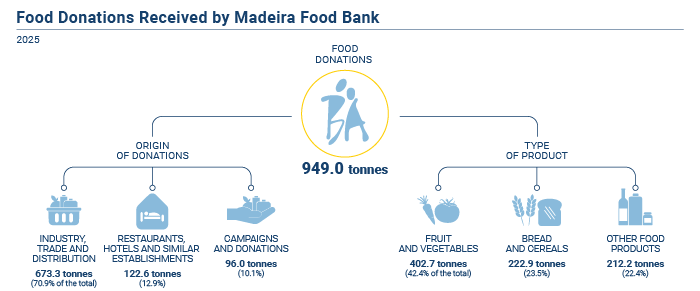
In 2025, the Food Bank of the Autonomous Region of Madeira received 949.0 tonnes of food donations, representing an increase of 31.5% compared with 2024.
"Fruit and vegetables" constituted the main category of donated products, with 402.7 tonnes, corresponding to 42.4% of the total. Despite maintaining a dominant share in the structure of donations, this category recorded moderate growth of 16.6% compared with the previous year. "Bread and cereals" took second place, with 222.9 tonnes (23.5% of the total), having increased by 14.5% compared with 2024. In turn, "Other food products" showed the largest growth among all categories, reaching 212.2 tonnes (22.4% of the total), corresponding to a marked rise of 249.6% compared with the previous year. This increase accounts for a significant part of the overall evolution of donations in 2025.
Of the total donations received in 2025, 70.9% originated from the "Industry, trade and distribution" sector, largely as a result of collections carried out at supermarkets, pastry shops and other distribution establishments. At a lower level came donations from "Catering, hospitality and similar activities" (12.9% of the total) and "Campaigns and donations" (10.1%). It can thus be concluded that, through the daily work carried out with commercial premises, the Food Bank of the Autonomous Region of Madeira collects food surpluses, which represent more than 83% of total donations received, also contributing to the reduction of food waste.
It should also be noted that, among donations from "Industry, trade and distribution", "Fruit and vegetables" (56.9% of the total of these donations) and "Bread and cereals" (23.5%) predominated, while among donations from "Catering, hospitality and similar activities", "Other food products" accounted for practically the entire volume of goods received (99.8%). It can thus be seen that donations from the catering sector were strengthened in 2025, with the channelling of take-away surpluses to social solidarity institutions having been coordinated, according to information reported by the Food Bank.
Food donations per inhabitant above the national average in 2025
In 2025, the ratio between food donations and the number of inhabitants stood at 3.58 kg/inhabitant/year in the Autonomous Region of Madeira (ARM), a value above the national average (2.21 kg/inhabitant/year). Among the nine NUTS 2 regions, Algarve recorded the highest value (4.46 kg/inhabitant/year), followed by the ARM (3.58 kg/inhabitant/year) and Peninsula de Setúbal (3.12 kg/inhabitant/year). Grande Lisboa ranked fourth (3.03 kg/inhabitant/year), followed by Norte (2.07 kg/inhabitant/year), the Autonomous Region of the Azores (1.40 kg/inhabitant/year), Oeste e Vale do Tejo (1.13 kg/inhabitant/year), Centro (1.00 kg/inhabitant/year) and Alentejo (0.91 kg/inhabitant/year).
In 2025, food donations delivered grew by 28.8%
According to information gathered by DREM from the Food Bank of the Autonomous Region of Madeira, and taking into account the total number of persons supported through this entity's partner institutions, each beneficiary received, on average, approximately 144 kg of food over the course of 2025, representing an increase of 38.6% compared with 2024.
With regard to distribution, food banks do not deliver food directly to persons experiencing food insecurity, but do so through partner social solidarity institutions, which distribute it to their beneficiaries or users. These entities, which include IPSS (private social solidarity institutions), Misericórdias (Portuguese charitable institutions), socio-charitable groups, foundations and Casas do Povo with IPSS status, among others, totalled 52 institutions supported in 2025, spread across seven municipalities of the Region.
In 2025, the volume of food donations delivered amounted to 936.2 tonnes, representing an increase of 209.5 tonnes compared with 2024 (+28.8%), when 726.7 tonnes had been distributed.
It should be noted that the slight difference observed between the values of donations received (949.0 tonnes) and donations delivered (936.2 tonnes) is due to stock management by the Food Bank.
For further information, please visit:
International Statistical Cooperation
 |
International Statistical Cooperation
|
Statistical Literacy
 |
Statistical Literacy
|
|
|
|
|
 |
 |
|



 |
|
|
 |

Copyright © 2026 Direção Regional de Estatística da Madeira. All rights reserved.
Address: Calçada de Santa Clara 38, 9004-545 Funchal, Madeira Island
Phone: +351 291 145 110 (National landline call)