










Newsletters
Subscribe to our newsletter and get statistical data as soon as it is available!...
In the 2nd half of 2025
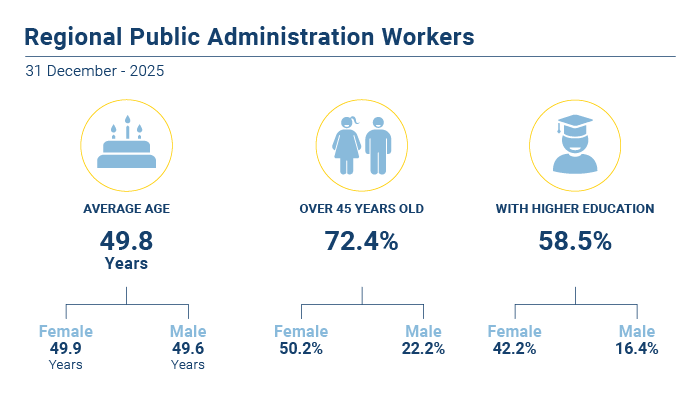
72.4% of Public Administration workers in the Autonomous Region of Madeira were aged 45 or over
The Regional Directorate of Statistics of Madeira (DREM) releases the first edition of the Regional Public Employment Bulletin, which comprises, among other data, information on employment in the Public Administration of the Autonomous Region of Madeira and in public enterprises not reclassified within the General Government perimeter, broken down by age group, sex and level of education, for the period beginning in December 2011 and ending in December 2025.
Indeed, the Directorate-General for Administration and Public Employment (DGAEP) – the entity responsible for compiling information on the human resources of State administration bodies and services at the national level – published, on 25 June, the Statistical Bulletin of Public Employment (BOEP) for the 2nd half of 2025, which complements the information released in the Statistical Summary of Public Employment (SIEP), whose most recent edition refers to the 1st quarter of 2026 and was released on 15 May.
DREM will thus, following DGAEP's example, produce a Regional and Local Public Employment Summary on a quarterly basis and a Regional Public Employment Bulletin on a half-yearly basis.
The data and indicators are presented for the entire series in accordance with the organic structure of the XVI Regional Government of Madeira, as set out in Regional Regulatory Decree No. 5/2025/M, of 5 May, as amended by Regional Regulatory Decree No. 15/2025/M, of 1 October.
The data analysis shows that, with regard to qualifications, more than half (58.5%) of the 21 084 workers of the Regional Administration of Madeira (ARM) hold higher education qualifications, 20.8% hold secondary education, and the remaining 20.7% hold only primary education. Approximately 7.4% held an education level above a bachelor's degree (7.1% with a master's degree and 0.3% with a doctorate).
Between December 2011 and December 2025, in the ARM, there were increases of 4.5 pp and 4.3 pp in workers with higher and secondary education, respectively, and a decrease of 8.8 pp in workers with primary education.
The skill level of employment in the ARM, measured by the proportion of workers with higher education, is high, standing 30.7 pp above the figure for the employed population as a whole in the 4th quarter of 2025, as determined by the INE/DREM Labour Force Survey (27.8%).
It should be noted that women constitute the majority at the "secondary education" (70.7%), bachelor's degree/degree (72.5%) and bachelor (80.9%) education levels, reflecting the high feminisation rate (69.0%) and the fact that nearly seven in every ten workers are women.
In the three occupational categories with the greatest representation in ARM employment, the most prevalent education levels are primary education (69.6%) among operational assistants/manual workers/auxiliary staff, higher education (99.6%) among kindergarten teachers and primary and secondary education teachers, and secondary education (76.5%) among technical/administrative assistants.
The estimated average age of ARM workers was, in December 2025, 49.8 years, slightly higher than that recorded in the same period of the previous year (49.5 years).
Between December 2011 and December 2025, the average age of ARM workers increased by 6.8 years (43.0 years of age in December 2011).
The occupational categories of registry and notary officials (56.2 years), senior managers (53.3 years), and technical and administrative assistants (51.9 years) show the highest average ages, while the categories of scientific research staff (37.5 years), medical staff (40.1 years) and diagnostic and therapeutic technicians (44.2 years) have the lowest average ages.
The 55 to 64 age group was the most represented among the 1 963 workers in public enterprises and other public-sector entities owned by the Public Administration of the Autonomous Region of Madeira, corresponding to 31.2% of the total.
In enterprises and other entities owned by the Public Administration of the Autonomous Region of Madeira, primary education was the predominant level of education, corresponding to 55.4% of workers.
For further information, please visit:
International Statistical Cooperation
 |
International Statistical Cooperation
|
Statistical Literacy
 |
Statistical Literacy
|
|
|
|
|
 |
 |
|



 |
|
|
 |

Copyright © 2026 Direção Regional de Estatística da Madeira. All rights reserved.
Address: Calçada de Santa Clara 38, 9004-545 Funchal, Madeira Island
Phone: +351 291 145 110 (National landline call)