









Newsletters
Subscribe to our newsletter and get statistical data as soon as it is available!...
For the period 2022-2024
DREM releases final data from the Community Innovation Survey
The Directorate for Statistics of Madeira (DREM) is today releasing information on business innovation in the Autonomous Region of Madeira (ARM), based on the final data collected under the Community Innovation Survey (CIS), relating to the three-year period 2022-2024.
A summary of the main conclusions drawn from the data in question is presented below.
In the three-year period 2022-2024, 36.5% of enterprises with more than 10 persons employed and headquartered in the ARM had some type of innovation activity
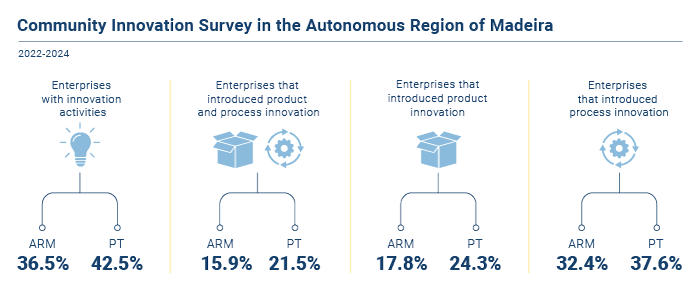
In the period 2022-2024, 36.5% of enterprises with 10 or more persons employed and headquartered in the ARM had some type of innovation activity (41.6% between 2020-2022), whether product or process innovation activities, activities ongoing until the end of 2024, abandoned or suspended innovation activities, research and development (R&D) activities carried out internally, on a continuous or occasional basis, or R&D contracted out to other enterprises (including those in their own group) or to public or private research organisations. Nationally, this indicator stood at 42.5% (44.7% between 2020-2022).
At NUTS 2 level, it should be noted that, in the three-year period 2022-2024, the regions with the highest percentage of innovative enterprises were Grande Lisboa and Peninsula de Setúbal, with 47.3% and 47.1%, respectively, and these were also the only regions to exceed the national average (42.5%). At the opposite end, the ARM appears with 36.5%, and the Autonomous Region of the Azores (ARA) with 36.7%. Regarding the change compared with the previous three-year period, it should be noted that, with the exception of Peninsula de Setúbal, which was the only region to record growth (+4.0 percentage points – pp), all other regions showed decreases in this indicator. The sharpest reductions occurred in the ARM and the ARA (-5.1 pp and -3.8 pp, respectively). Nationally, the decrease was 2.2 pp.
In the three-year period 2022-2024, 17.8% of enterprises with 10 or more persons employed and headquartered in the ARM introduced product innovation (new or improved), representing a decrease of 4.6 pp compared with the 2020-2022 three-year period (22.4%). Nationally, this percentage was higher, standing at 24.3%, corresponding to an increase of 1.7 pp compared with the previous period.
The proportion of enterprises that introduced process innovation stood at 32.4%, a value 5.6 pp lower than that observed in the previous three-year period (38.0%). Nationally, this proportion was higher, standing at 37.6%, corresponding to a decrease of 2.8 pp compared with the previous three-year period.
In 2022, expenditure on innovation activities totalled 27.8 million euros, representing 0.6% of the total recorded for Portugal (4 865.1 million euros). Of that amount, 49.3% corresponded to expenditure on intramural R&D (13.7 million euros), 47.2% to other innovation expenditure (13.1 million euros) and 3.5% to expenditure on extramural R&D (1.0 million euros). Compared with 2020, there was an increase of 9.1 million euros in total expenditure on innovation activities, explained mainly by the increase of 8.1 million euros in intramural R&D expenditure.
Between 2022 and 2024, with regard to factors related to climate change for the enterprise, the increase in the costs or prices of production factors resulting from climate change stood out, with 13.3% of enterprises classifying this factor as highly important (17.4% for all national enterprises).
In 2024, 12.2% of enterprises had more than 50% of persons employed with higher education qualifications, most of which were innovative enterprises (6.7%). In the same year, 20.8% of enterprises had no persons with higher education qualifications on their staff, of which 4.5% were innovative enterprises (-6.4 pp and -1.7 pp compared with 2022, respectively).
For more information, please click on:
International Statistical Cooperation
 |
International Statistical Cooperation
|
Statistical Literacy
 |
Statistical Literacy
|
|
|
|
|
 |
 |
|



 |
|
|
 |

Copyright © 2026 Direção Regional de Estatística da Madeira. All rights reserved.
Address: Calçada de Santa Clara 38, 9004-545 Funchal, Madeira Island
Phone: +351 291 145 110 (National landline call)