







Newsletters
Subscribe to our newsletter and get statistical data as soon as it is available!...
In 2019
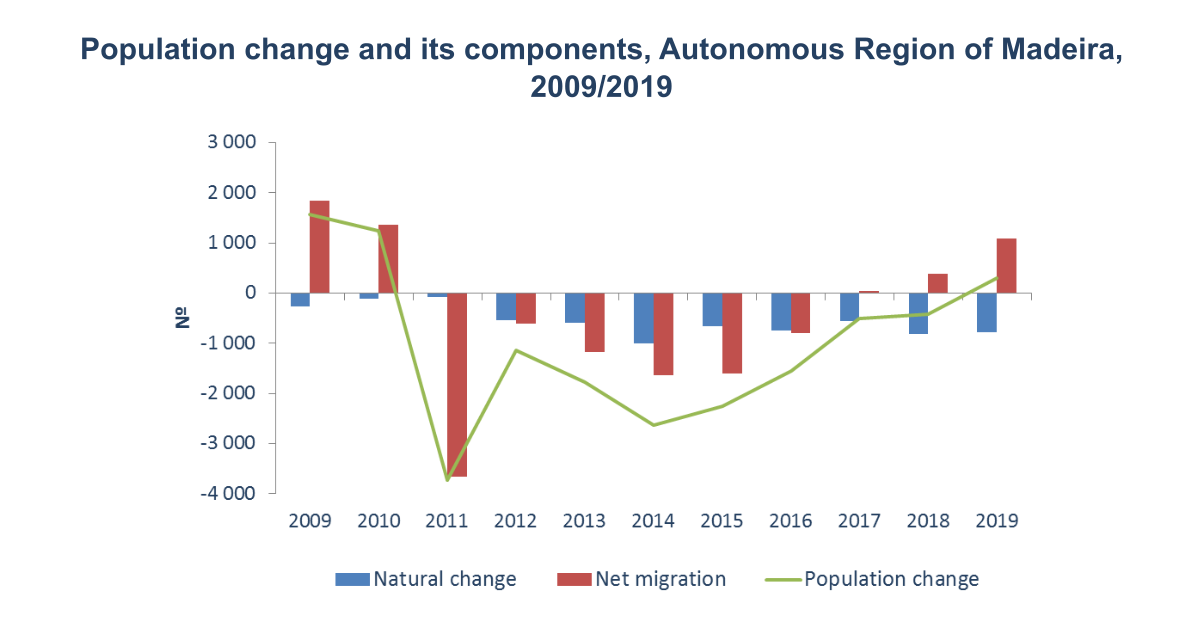
Increasingly positive net migration determined growth in the resident population of the Autonomous Region of Madeira for the first time since 2011
According to the Resident Population Estimates, at December 31st 2019, 254,254 persons were residing in the Autonomous Region of Madeira, which represents a 0.1% growth when compared to the same date of 2018. Of that total, 118,669 were men and 135,585 women. The population of the Region has been dropping consecutively since 2011, however in 2019 there was an increase of 309 residents when compared to 2018. This growth was a result of the return of Madeiran emigrants in Venezuela to the Region. Although the net migration has maintained positive values since 2017, in 2019 this value was the second highest of the decade (+1,357 in 2010 and +1,097 in 2019)
To this increase in the resident population contributed a less negative natural change (-788 persons) than in 2018 (-811), with a decline in the number of deaths (-51) and in the number of live births (-28), when compared to 2018.
The municipalities of Santa Cruz (11,9‰), Ponta do Sol (5,7‰), Porto Santo (5,0‰), Ribeira Brava (1,9‰) and Calheta (0,2‰) were the only in which the crude rate of population change was positive, while the lowest values in this variable were registered in the municipalities of Santana, Machico and Porto Moniz (-5.8‰, -5.6‰ and -3.4‰, respectively).
In 2019, the population density of the Autonomous Region of Madeira stood at 317.2 inhabitants per km2. Funchal had the highest value (1,365.9 pop/km2) and Porto Moniz the lowest (28.2 pop/km2).
In the referenced year, the proportion of youth population (15 years old and under) represented 13.1% of the total population (13.5% in 2018), while the proportion of the population aged 65 and over rose to 17.0% (16.7% in 2018). The ageing ratio reached 129.5, i.e., 129.5 older persons (65 and over) per 100 young persons. In 2018, this ratio was 123.6.
In 2019, the total fertility rate stood at 1.15 (meaning 1.15 children per woman aged between 15 and 49), the same rate as in 2018, remaining very much below the 2.1 value of the replacement-level of fertility.
International Statistical Cooperation
 |
International Statistical Cooperation
|
Statistical Literacy
 |
Statistical Literacy
|
|
|
|
|
 |
 |
|



 |
|
|
 |

Copyright © 2026 Direção Regional de Estatística da Madeira. All rights reserved.
Address: Calçada de Santa Clara 38, 9004-545 Funchal, Madeira Island
Phone: +351 291 145 110 (National landline call)