











Newsletters
Subscribe to our newsletter and get statistical data as soon as it is available!...
According to the resident population projections 2018-2080
The Autonomous Region of Madeira population will significantly decrease until 2080 and the ageing ratio will rise sharply
Statistics Portugal released the Resident Population Projections 2018-2080, by sex and age (year by year, up to 100 years old and over) for Portugal and for the NUTS2 regions.
The study released by INE “is based on hypotheses of future evolution of the demographic components of fertility, mortality and migration. These assumptions did not underlie the impact that the current situation determined by the Covid-19 pandemic may have on future demographic trends. Nevertheless, the information available today is useful to establish a reference to assess future developments”.
Statistics Portugal (INE) exercise reveals that the resident population in Portugal will decrease until 2080 in any of the projected scenarios. In the central scenario, the population decreases from 10.3 million people in 2018, to 8.2 million in 2080.
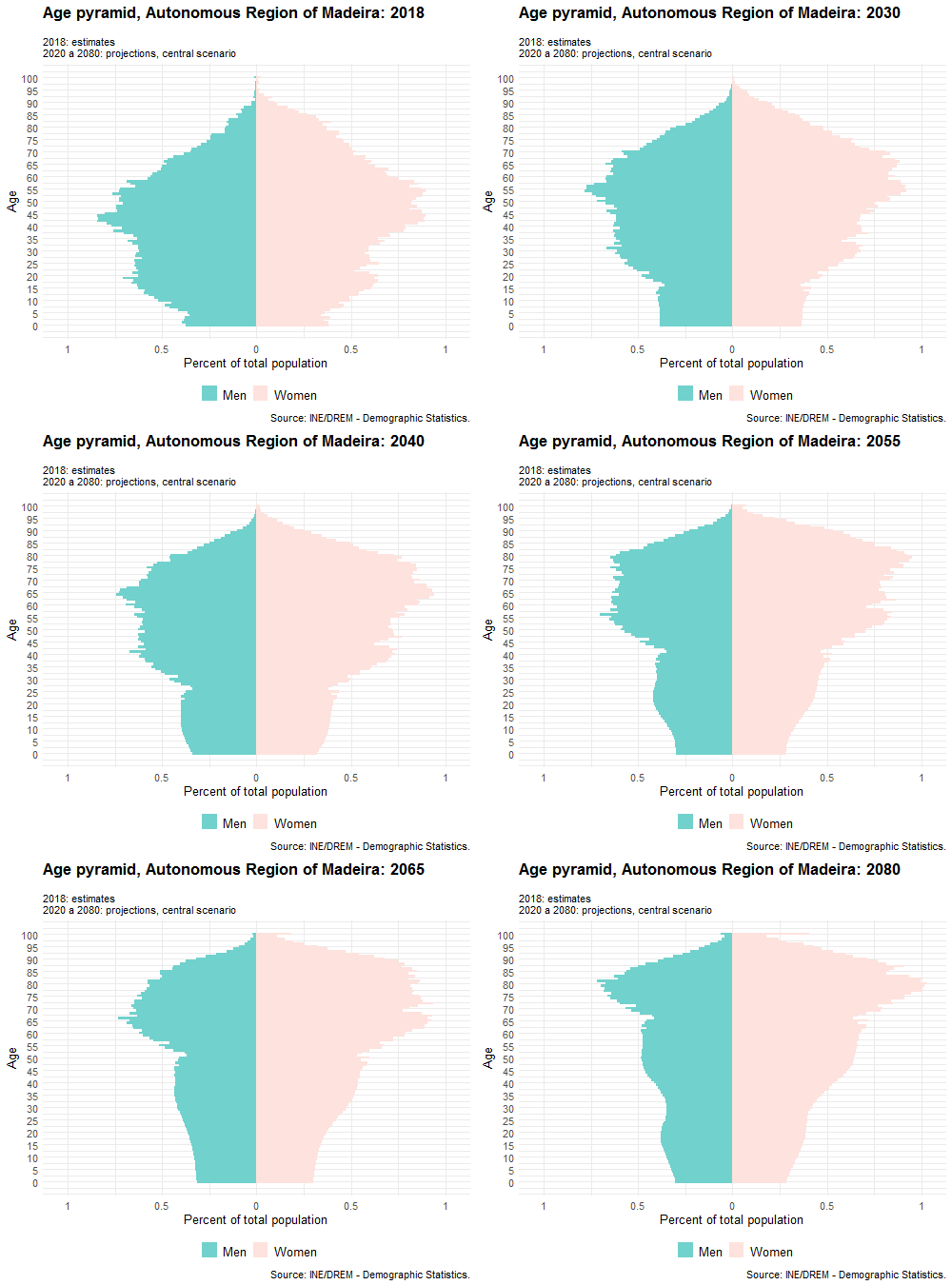
In the Autonomous Region of Madeira, the trend in population will be similar. In the central scenario, the Madeiran population will decrease from 253.9 thousand people in 2018 to 162.8 thousand in 2080. This means that in this period of 62 years, the population of the Autonomous Region of Madeira, will decline by 35.9% (-91.2 thousand people).
In the period under analysis, the population of the Autonomous Region of Madeira will be the following, according to the low (LS), central (CS) and high (HS) scenarios.
- 2025 – 250 711 (LS); 257 231 (CS); 263 489 (HS);
- 2035 – 227 560 (LS); 245 970 (CS); 263 924 (HS);
- 2055 – 170 799 (LS); 213 427 (CS); 256 402 (HS);
- 2080 – 94 590 (LS); 162 750 (CS); 235 674 (HS).
Moreover, profound changes in the population structure are expected since the proportion of old-age persons is predicted to continue to grow steadily.
Between 2018 and 2080, the ageing ratio in the central scenario will rise sharply from 124 to 429 old-age persons per 100 young-age persons. In Portugal, this ratio will increase from 159 to 300.
In the same period and scenario, the potential sustainability index for the Autonomous Region of Madeira will drop from 420 to 112 persons of working age for every 100 elderly persons. In Portugal this index will decrease from 295 to 138.
In the Autonomous Region of Madeira, life expectancy at birth of men will increase from 74.34 years in 2016-2018 to 84.98 years in 2080 and in women, in the same period, this same variable will rise from 81.44 years to 91.01 years. In Portugal, life expectancy at birth of men will go up from 77.78 years in 2016-2018 to 87.92 years in 2080 and in women, in the same period, the life expectancy will increase from 83.43 to 93.30 years.
For more information, please click on:
International Statistical Cooperation
 |
International Statistical Cooperation
|
Statistical Literacy
 |
Statistical Literacy
|
|
|
|
|
 |
 |
|



 |
|
|
 |

Copyright © 2026 Direção Regional de Estatística da Madeira. All rights reserved.
Privacy policy | Cookie Notice
Address: Calçada de Santa Clara 38, 9004-545 Funchal, Madeira Island
Phone: +351 291 145 110 (National landline call)