










Newsletters
Subscribe to our newsletter and get statistical data as soon as it is available!...
In 2021
Percentage of the population of the Autonomous Region of Madeira living in a condition of lack of space increased but remained below the national average
The Regional Directorate of Statistics of Madeira (DREM) releases today on its website a set of housing deprivation indicators of the population living in the Autonomous Region of Madeira (ARM). These data were obtained from the Survey on Living Conditions and Income (ICOR) carried out in 2021.
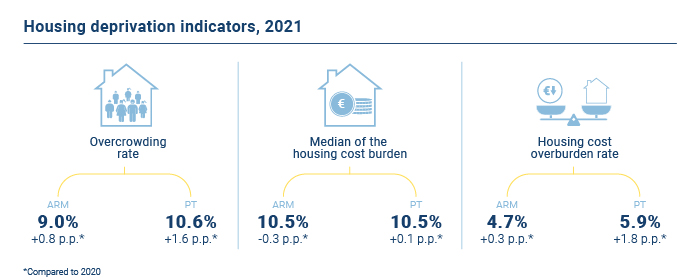
The Survey on Living and Income Conditions indicates that, in 2021, 9.0% of residents in the Autonomous Region of Madeira lived in a condition of lack of space, a higher percentage than in 2020 (8.2%). The national average was 10.6%. This rate corresponds to the proportion of people living in dwellings in which the number of habitable rooms (≥ 4 m2) was insufficient for the number and demographic profile of household members. Algarve (13.7%), A. M. Lisboa (13.0%), Norte (11.3%) and Autonomous Region of Azores (11.2%) were the regions with the highest values in this indicator, with Centro (6.9%) and Alentejo (7.1%) having the lowest values.
Two indicators regarding housing cost burden are also available. The housing cost burden is the ratio between the housing costs and the disposable household income (net of housing allowances). Housing costs include those related to housing facilities such as water, electricity, gas and other fuels, as well as condominium, insurance, sewage, minor repairs, rents and interest related to the main residence mortgage.
The median housing cost burden was 10.5% in 2021, lower than that observed in 2020 (10.8%) and the same as in the country. The results for the 7 NUTS2 regions are very close, ranging from 10.1% in the Centre to 11.8% in the Algarve.
The overburden housing cost rate, i.e. the percentage of people living in households where the share of housing expenditures to income is over 40%, stood at 4.7% in 2021, higher than that recorded in 2020 (4.4%). The national average was 5.9%, being higher in the Algarve region (9.9%) and lower in Alentejo (4.4%).
For more information, please click on:
International Statistical Cooperation
 |
International Statistical Cooperation
|
Statistical Literacy
 |
Statistical Literacy
|
|
|
|
|
 |
 |
|



 |
|
|
 |

Copyright © 2026 Direção Regional de Estatística da Madeira. All rights reserved.
Privacy policy | Cookie Notice
Address: Calçada de Santa Clara 38, 9004-545 Funchal, Madeira Island
Phone: +351 291 145 110 (National landline call)