









Newsletters
Subscribe to our newsletter and get statistical data as soon as it is available!...
In 2022
Resident population in the Autonomous Region of Madeira increased for the fourth consecutive year
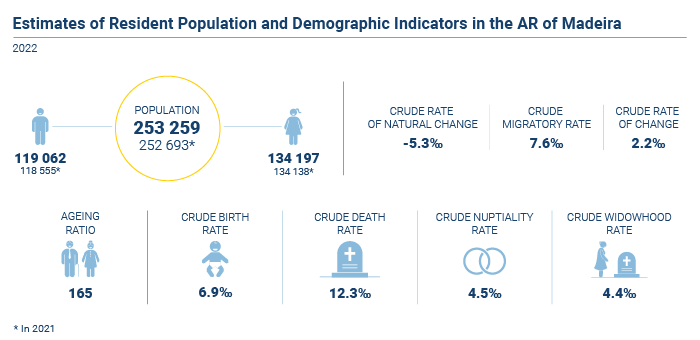
On December 31st, 2022, the estimated resident population of the Autonomous Region of Madeira (ARM) was 253,259 persons (119,062 men and 134,197 women). The Region continued its population growth trend for the fourth consecutive year, with an increase of 566 persons compared to 2021 (252,693 persons, 118,555 men, and 134,138 women).
In 2022, net migration (+1,911), which is the difference between those who came from outside to reside in the Region and those who left (no longer being residents here), played a decisive role in increasing the resident population of the Region, offsetting the unfavourable natural change (the difference between live births and deaths), which changed from -1,131 in 2021 to -1,345 in 2022.
The crude rate of increase (which combines the migratory effect with the natural effect) was positive at +2.2‰ (+3.1‰ in 2021). This rate was mainly driven by a positive migratory rate (7.6‰), which outweighed the negative crude rate of natural increase (-5.3‰).
The largest population increases in relative terms were observed in the municipalities of Porto Santo (26.0‰) and Santa Cruz (10.5‰), while Santana (-11.6‰), Machico (-5.6‰), São Vicente (-0.8‰), and Calheta (-0.5‰) had negative crude rates of increase.
The population density of the ARM in 2022 was 316.1 persons per square kilometre, with Funchal having the highest density (1,396.3 persons/km²) and Porto Moniz the lowest (30.1 persons/km²).
The proportion of young persons (under 15 years old) decreased to 12.5% of the total population (12.8% in 2021), while the proportion of elderly persons (aged 65 or older) continued to increase, reaching 20.6% (20.2% in 2021). This resulted in an ageing index of 165.0 elderly persons per 100 young persons (158.2 in 2021). The highest values of this indicator were observed in Porto Moniz (329.5) and Santana (291.8), while Santa Cruz (103.8) and Câmara de Lobos (107.3) had the lowest values, with the number of elderly peesons exceeding the number of young persons in all municipalities.
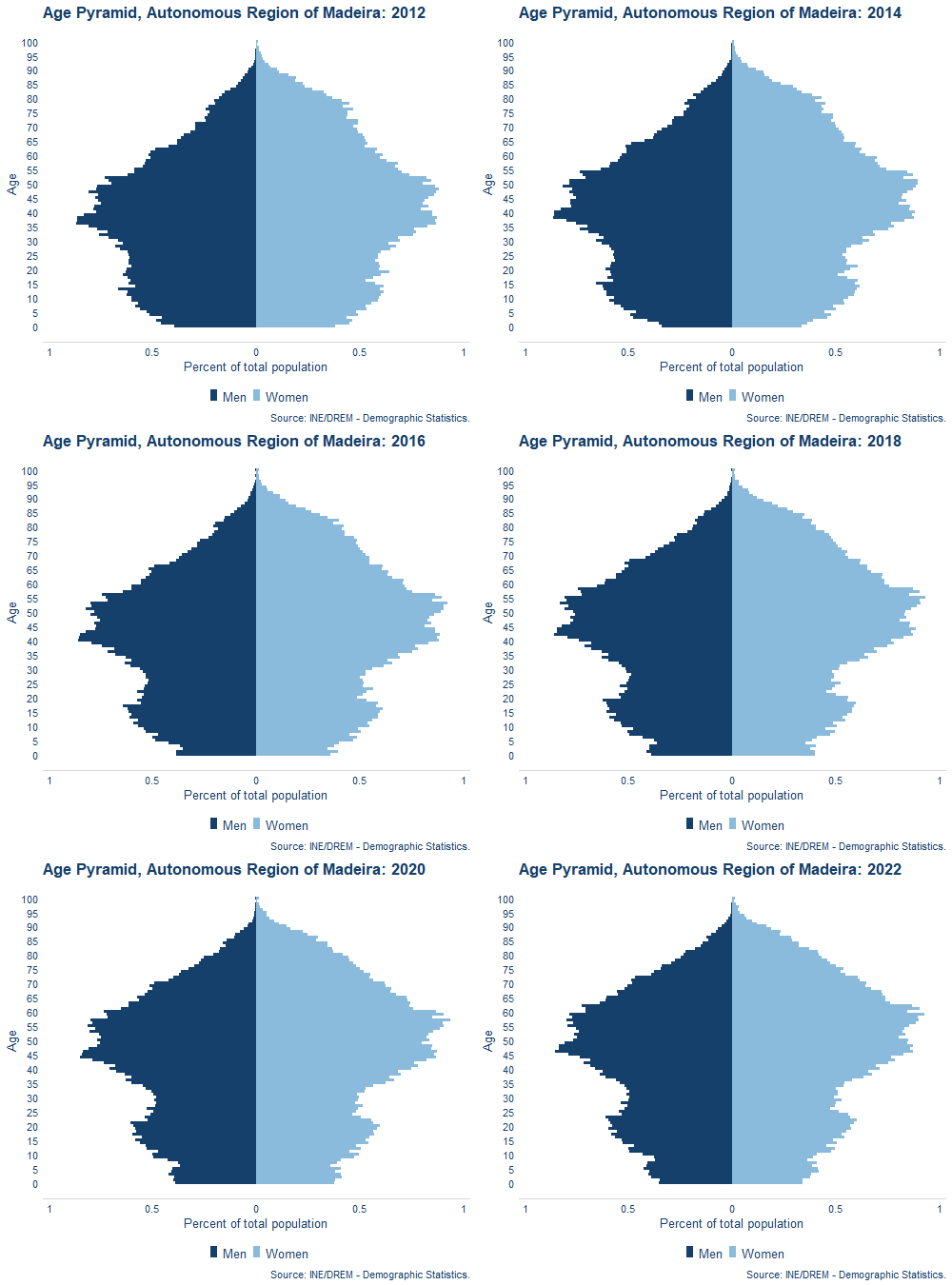
The demographic ageing trend is reflected in the changing profile of population pyramids in the Region from 2012 to 2022. The base of the pyramid has narrowed, reflecting a decline in population size due to lower birth rates, while the top has widened, indicating an increase in the number of elderly persons due to higher life expectancy.
The total fertility rate, expressed as the average number of children per woman of childbearing age (15-49 years old), was 1.25 children per woman (1.23 in 2021), significantly below the replacement level of 2.1 children per woman.
In 2022, there were 1,758 live births to mothers residing in the Region, an increase of 14 children over 2021, resulting in a crude birth rate of 6.9 live births per thousand persons (the same as the previous year).
The number of deaths of residents in the Region in 2022 was 3,103, an increase of 228 deaths (+7.9%) compared to 2021. The crude death rate reached 12.3 per thousand persons, higher than in 2021 (11.4‰).
The crude marriage rate showed a significant increase, rising from 3.4 marriages per 1,000 persons in 2021 to 4.5 marriages per 1,000 persons in 2022. The crude widowhood rate, the value was the same as the previous year (4.4 widows per 1,000 persons).
For more information, please click on:
International Statistical Cooperation
 |
International Statistical Cooperation
|
Statistical Literacy
 |
Statistical Literacy
|
|
|
|
|
 |
 |
|


 |
|
|
 |

Copyright © 2026 Direção Regional de Estatística da Madeira. All rights reserved.
Address: Calçada de Santa Clara 38, 9004-545 Funchal, Madeira Island
Phone: +351 291 145 126 (National landline call)