











Newsletters
Subscribe to our newsletter and get statistical data as soon as it is available!...
In 2020
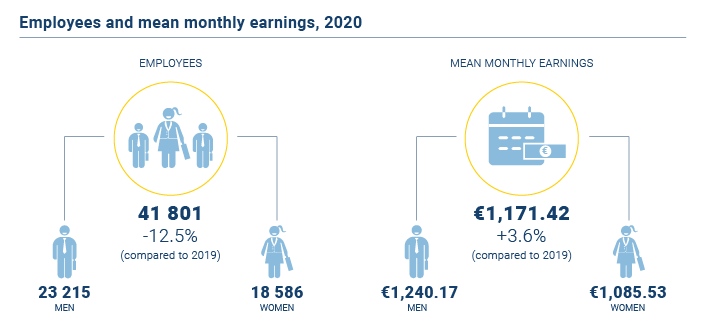
According to the Lists of Personnel, the number of employees decreased by 12.5% from 2019 while the mean monthly earnings increased by 3.6%
The Regional Directorate of Statistics (DREM) releases today, on its website, the update of the Time Series on Lists of Personnel with data for 2020.
These data come from the statistical compilation of information provided by Annex A of the Single Report which contains data about the social activity of the enterprise. All employers with at least one employee must provide data, which is reported by the establishment.
Economic consequences of the pandemic affected the number of employees
In the scope of this statistical operation, in 2020, 41.8 thousand employees (full-time and full paid) were counted in the establishments located in the Autonomous Region of Madeira. Compared with 2019, there was a 12.5% decrease. The Autonomous Region of Madeira followed the national downward trend (-3.3%), but its higher specialisation in tourism - heavily penalized by the pandemic – resulted in a greater loss in employees, even though only in the short term.
Funchal (63.4%), Santa Cruz (10.9%), Câmara de Lobos (5.6%) and Machico (5.4%) were the municipalities with the highest number of employees in establishments. On the opposite side stood the municipalities on the north coast of Madeira, namely Porto Moniz (0.5%), Santana (1.1%) and São Vicente (1.4%). Compared to 2019, the municipalities that showed the greatest reductions in this indicator were Porto Moniz (-15.9%), Funchal (-15.3%), Calheta (-13.5%) and Porto Santo (-11.0%). The municipality of São Vicente was the one which registered the largest increase (6.3%).
Tertiary sector maintained still ahead but not so much
In 2020, the tertiary sector concentrated the vast majority of employees (76.2%) despite the 16.5% drop. 22.8% of the employees worked in the secondary sector, which had a 3.8% increase compared to 2019. In turn, the primary sector, with only 1.1% of employees, recorded an annual decrease of 6.9%. Compared to 2019, the share of the secondary sector increased by 3.6 percentage points (pp), while the tertiary sector showed a reduction of 3.6 pp and the primary sector an increase of 0.1 pp.
Proportion of workers with tertiary education continues to grow
In 2020, 55.5% of the employees were male and 44.5% female. Female employment decreased by 15.6%, compared to 2019, while the number of male employees dropped by only 9.8%.
In 2020, all the employee classes decreased compared to 2019. The largest decrease between 2019 and 2020 was registered in enterprises with 250 to 499 employees (-44.2%, down by 1,122 employees) and in enterprises with 50 to 99 employees (-30,3%, down by 1,776 employees). In 2020, enterprises with more than 500 employees concentrated the largest share (24.5%).
As for educational qualifications, comparing 2019 with 2020, there was a decrease in the number of workers in all levels of education, except in the levels "Master" (+7.4%) and "PhD" (+4.7%). The most significant decline occurred in workers with the lowest qualifications (-20.9% in "Less than 1st cycle of primary education"). This was followed by decreases in the groups "Bachelor's Degree" (-16.4%) and "1st cycle of primary education" (-14.9%). The most representative groups continue to be those with "Secondary education" (31.6%) and "Lower secondary education" (26.4%). The workers with tertiary education (graduate, master or doctorate) represented 16.9%, which means that in 15 years that figure more than doubled. In 2006 it was only 6.8%.
Mean monthly earnings grew by 3.6% compared to 2019
The mean monthly earnings in 2020 stood at 1,171.42 euros, 3.6% higher than in the previous year (1,130.18 euros). It should be noted that among the NUTS2 regions, the Autonomous Region of Madeira is the one with the second highest figure, only behind Área Metropolitana de Lisboa ( 1,516.42 euros). In 2020, the secondary sector was the one with the highest average monthly earnings of employees (1,206.18 euros), 3.0% above the regional average. The tertiary (1,164.77 euros) and primary (902.99 euros) sectors had figures below this average.
Men earn 14.2% more than women
The analysis of mean monthly earnings by sex for the year 2020 shows that male employees had a higher earning (1,240.17 euros) than female employees (1,085.53 euros). While in 1995 women received 77.6% of the earnings of male employees, this ratio rose to 87.5% in 2020.
By geographical location, the municipality of Funchal was the one with the highest average monthly earnings (1,238.74 euros), followed by Porto Santo (1 205.99 euros) and Calheta (1 217.43 euros), the only ones above the regional average (1,171.42 euros). On the contrary, São Vicente (862.97 euros), Ponta do Sol (873.45 euros), Porto Moniz (880.67 euros), Santana (906.12 euros), Ribeira Brava (956.57 euros), Câmara de Lobos (1,015.88 euros), Santa Cruz (1,066.10 euros) and Machico (1,111.90 euros) were below the average.
The level of education is an important factor of differentiation among employees. The employees with a lower level of education (below primary education) have a lower mean monthly earning (928.86 euros). Between those with the 1st cycle of primary education (999.02 euros) and lower secondary education (979.04 euros), the gap is not pronounced but it widens for those with Upper secondary education (1,057.10 euros). Holding a graduate degree allows a significant increase in the mean monthly earnings (1,855.72 euros). The employees with a doctoral degree have the highest earnings (2,143.44 euros).
For more information, please click on:
International Statistical Cooperation
 |
International Statistical Cooperation
|
Statistical Literacy
 |
Statistical Literacy
|
|
|
|
|
 |
 |
|


 |
|
|
 |

Copyright © 2026 Direção Regional de Estatística da Madeira. All rights reserved.
Address: Calçada de Santa Clara 38, 9004-545 Funchal, Madeira Island
Phone: +351 291 145 126 (National landline call)