










Newsletters
Subscribe to our newsletter and get statistical data as soon as it is available!...
In 2021
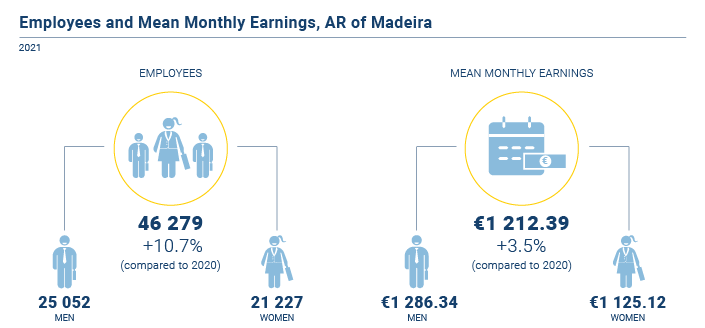
Number of employees determined through the Lists of Personnel increased by 10.7% compared to 2020, while the average monthly earnings experienced a growth of 3.5%
The Regional Directorate of Statistics of Madeira (DREM) has released the latest Time Series of Personnel Records Statistics for 2021 on its website. The data included in these statistics is provided to Statistics Portugal by the Strategy and Planning Office of the Ministry of Labour, Solidarity, and Social Security.
The statistical determination of the Lists of Personnel is based on Annex A of the Single Report - an annual report that compiles data on enterprises social activity and is filled out by employers with at least one employee. The Single Report serves as an annual compilation of data on the social activities of enterprises and is completed by employers who have at least one employee. This information is gathered at the establishment level.
Number of employees under an employment contract increased by 10.7%
As part of the statistical operation conducted in 2021, a total of 46.3 thousand employees under full-time employment contracts with full remuneration were identified in establishments located in the Autonomous Region of Madeira (ARM). This figure represents an increase of 10.7% compared to the previous year. The ARM followed the national growth trend (+1.9%), but due to its specialisation in the tourism sector, which was heavily affected by the pandemic in the preceding year, it observed a more significant rise in the number of employees under employment contracts.
In terms of relative changes compared to 2020, the municipalities with the highest increases in the number of employees under employment contracts were Porto Moniz (38.7%), Calheta (16.1%), and Funchal (15.6%), surpassing the regional average (10.7%). In 2021, the municipalities with the highest number of employees under employment contracts in establishments were Funchal (66.2%), Santa Cruz (10.3%), Câmara de Lobos (5.2%), and Machico (4.5%). The municipalities on the North coast of Madeira Island, namely Porto Moniz (0.6%), Santana (1.1%), and São Vicente (1.2%), recorded the lowest shares.
Tertiary sector strengthened its preponderance
When considering the distribution of employees under an employment contract by sector of activity, it is evident that the tertiary sector maintained the highest share. It accounted for 78.7% of the total workforce in 2021, experiencing a growth of 14.5% compared to the previous year. In contrast, the secondary sector had a smaller number of workers (20.2% of total workers), registering a decrease of 1.6% compared to 2020. On the other hand, the primary sector, with only 1.0% of employees under an employment contract, experienced an annual increase of 5.4%. Compared to 2020, the share of the primary sector decreased by 0.1 percentage points (pp), the secondary sector dropped by 2.5 pp, while the tertiary sector showed an increase of 2.6 pp.
Proportion of workers with tertiary education continues to increase
Taking gender into account, the results indicate that in 2021, the majority of persons employed in business establishments operating in the Autonomous Region of Madeira were male, accounting for 54.1% of the total (55.5% in 2020).
When examining the distribution of employees by personnel category within companies, there was an increase in workers across almost all categories, with more notable growth observed in companies with 250 to 499 employees (90.4%) and companies with 500 or more employees (20.2%) in relative terms.
Regarding educational qualifications, comparing 2020 to 2021, there was an increase in the number of workers at all qualification levels. The most significant growth was seen among workers with higher qualifications, such as "Bachelor's degree" (24.1%). This was followed by increases in the "Master's degree" group (18.3%) and the "Upper secondary education" group (16.5%). The most prominent groups continue to be those with "Upper secondary education" (33.2%) and "Lower secondary education" (26.4%). Workers with higher qualifications, including bachelor's, master's, or doctoral degrees, accounted for 16.6%. This value more than doubled in 14 years, as it was only 7.5% in 2007.
Average monthly earnings witnessed a 3.5% increase compared to 2020
In 2021, the average monthly earnings of employees amounted to 1,212.39 euros, surpassing the previous year's figure of 1,171.42 euros, signifying a 3.5% annual increase. Notably, among the NUTS 2 regions, the Autonomous Region of Madeira (ARM) ranked second in terms of average earnings, with Área Metropolitana de Lisboa holding the highest value at 1,562.69 euros.
Analysing the classes of the number of staff employed, there was a significant 5.3% increase in the average monthly earnings of workers in establishments belonging to companies with 50-99 employees. The group with 500 or more employees had the highest remuneration, averaging at 1,498.67 euros, which is 23.6% above the regional average. It is worth highlighting a 0.3% increase in the average monthly earnings within this class between 2020 and 2021. Conversely, the 1-9 personnel class offered lower earnings at 945.20 euros, although it experienced a 3.3% increase compared to 2020.
Regarding sectors, the secondary sector recorded the highest average monthly earnings for employees in 2021, reaching 1,252.22 euros, which was 3.3% above the regional average. In contrast, the tertiary (1,205.72 euros) and primary sectors (935.12 euros) reported values below the aforementioned average.
Men earn 14.3% more than women on average
The analysis of average monthly earnings by gender in 2021 reveals that men earned an average of 1,286.34 euros, which is 14.3% (i.e., 161.22 euros) higher than women's average earnings of 1,125.12 euros. This trend has persisted since the beginning of the time series. However, it is worth noting that the gender wage gap has narrowed over the years. In 1995, women earned 77.6% of men's average monthly earnings, whereas in 2021, that ratio increased to 87.5%.
In terms of geographical location, Porto Santo had the highest average monthly earnings at 1,323.46 euros, followed by Funchal (1,264.75 euros) and Calheta (1,230.93 euros), all exceeding the regional average of 1,212.39 euros. On the other hand, Porto Moniz (886.52 euros), São Vicente (893.75 euros), Santana (927.20 euros), Ponta do Sol (933.17 euros), Ribeira Brava (997.38 euros), Câmara de Lobos (1,028.79 euros), Machico (1,142.01 euros), and Santa Cruz (1,168.42 euros) had average earnings below the regional average.
When examining earnings by educational qualifications, significant differences become apparent. Workers with lower qualifications, below primary education level, had lower average monthly earnings at 979.30 euros. The differences among those with primary education level (1,021.20 euros) and lower secondary education level (1,016.26 euros) are not very significant, but the gap widens when compared to workers with secondary education level (1,104.08 euros). Possessing a bachelor's degree proves to be crucial in achieving higher average monthly earnings, reaching 1,896.51 euros. The highest average monthly earnings were recorded by individuals holding doctoral degrees in 2021, amounting to 2,437.34 euros.
For more information, please click on:
International Statistical Cooperation
 |
International Statistical Cooperation
|
Statistical Literacy
 |
Statistical Literacy
|
|
|
|
|
 |
 |
|


 |
|
|
 |

Copyright © 2026 Direção Regional de Estatística da Madeira. All rights reserved.
Address: Calçada de Santa Clara 38, 9004-545 Funchal, Madeira Island
Phone: +351 291 145 126 (National landline call)