

- HomeHome
- DREMDREM
-
Statistical InformationStatistical Information
-
Economic
- Government
- Agriculture, Forestry and Fishing
- Construction and housing
- Trade
- Economic Accounts
- Enterprises
- Industry and energy
- Innovation and knowledge
- Prices
- Monetary and Financial Sector
- Short-term trends
- Transports and Communications
- Tourism
-
Social
- Culture, Sport and Recreation
- Education
- Health
- Justice
- Labour market
- Population and Social Standards
- Social protection
- Territory
- Multithemes
- Indicators System
-
Economic
- Dissemination CalendarDissemination Calendar
- MetadataMetadata
- LinksLinks
- Site MapSite Map
- Press release
- Dashboards
- Contact usContact us










Notícias (GB)
In March 2026, the regional economic growth accelerated (Read more...)
In 2024, the Regional Development Composite Index of the Autonomous Region of Madeira improved slightly and approached the national average (Read more...)
In April 2026, the number of deaths decreased by 10.2% compared to the same month of the previous year, while the number of live births declined by 1.4% (Read more...)
In May 2026, the twelve-month average rate of change of the Consumer Price Index (CPI) rose to 3.3% and the year-on-year rate of change increased to 4.6% (Read more...)
In the 1st quarter of 2026, building permits grew 12.7% year-on-year, while completed buildings increased by 3.5% (Read more...)
In 2025, the number of births to mothers residing in the Autonomous Region of Madeira decreased by 3.3% compared to 2024 (Read more...)
In 2024, the regional poverty risk rate was below the national figure for the unemployed, above it for retirees, and close to it for workers (Read more...)
DREM releases the 5th edition of the Barometer of the Outermost Regions (Read more...)
In May 2026, the confidence indicator in Manufacturing, Trade, and Services increased, while in Construction and Public Works, there was a decrease (Read more...)
In 2024, the proportion of children up to 12 years of age receiving formal childcare in the ARM stood above the national average (Read more...)
Notícias (GB)
In March 2026, the regional economic growth accelerated (Read more...)
In 2024, the Regional Development Composite Index of the Autonomous Region of Madeira improved slightly and approached the national average (Read more...)
In April 2026, the number of deaths decreased by 10.2% compared to the same month of the previous year, while the number of live births declined by 1.4% (Read more...)
In May 2026, the twelve-month average rate of change of the Consumer Price Index (CPI) rose to 3.3% and the year-on-year rate of change increased to 4.6% (Read more...)
In the 1st quarter of 2026, building permits grew 12.7% year-on-year, while completed buildings increased by 3.5% (Read more...)
In 2025, the number of births to mothers residing in the Autonomous Region of Madeira decreased by 3.3% compared to 2024 (Read more...)
In 2024, the regional poverty risk rate was below the national figure for the unemployed, above it for retirees, and close to it for workers (Read more...)
DREM releases the 5th edition of the Barometer of the Outermost Regions (Read more...)
In May 2026, the confidence indicator in Manufacturing, Trade, and Services increased, while in Construction and Public Works, there was a decrease (Read more...)
In 2024, the proportion of children up to 12 years of age receiving formal childcare in the ARM stood above the national average (Read more...)
Newsletters
Subscribe to our newsletter and get statistical data as soon as it is available!...
In the school year 2015/2016
Retention and desistance rate at basic education and success rate at secondary education decreased
The Regional Directorate of Statistics of Madeira (DREM) releases an update of the time series on Education, including the data from the school year 2015/2016. This information is provided by the Education System Observatory of the Autonomous Region of Madeira (OERAM).
Concerning pre-primary education, in the school year 2015/2016 there were 151 institutions (down by 13 from the previous school year). The number of kindergarten teachers in preschool education stood at 743 (742 in 2014/2015), while the number of children enrolled at this level was 6,331 (6,586 in 2014/2015).
The number of students enrolled decreased in all three basic levels of education (-4.5% in the 1st cycle, -7.4% in the 2nd cycle and -1.1% in the 3rd cycle). Public schools had more students (83.9%) than the private ones (16.1%).
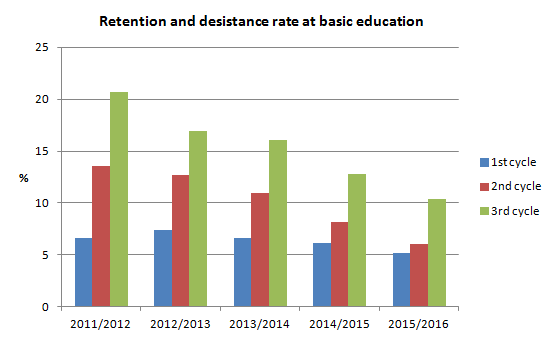
The retention and desistence rate at basic education stood at 7.2%, -1.7 percentage points (p.p.) compared to the previous school year.
The number of students enrolled at secondary education decreased by 2.6%. The success rate at secondary education was 83.0%, dropping by 0.1 p.p. from 2014/2015.
5,393 teachers worked in the basic and secondary educational institutions, a 2.6% drop from 2014/2015.
Concerning tertiary education, the number of students enrolled at this level of education in 2015/2016 was 3,266, up by 4.1% from the previous school year. The number of institutions providing tertiary education went up by one, to a total of five (3 public and 2 private). The teaching staff rose to 308 (297 in 2014/2015).
International Statistical Cooperation
 |
International Statistical Cooperation
|
Statistical Literacy
 |
Statistical Literacy
|
|
|
|
|
 |
 |
|


 |
|
|
 |

Copyright © 2026 Direção Regional de Estatística da Madeira. All rights reserved.
Address: Calçada de Santa Clara 38, 9004-545 Funchal, Madeira Island
Phone: +351 291 145 126 (National landline call)