










Newsletters
Subscribe to our newsletter and get statistical data as soon as it is available!...
In 2024
Proportion of children up to 12 years of age receiving formal childcare in the ARM stood above the national average
The Regional Directorate of Statistics of Madeira (DREM) publishes today on its website the results of the regular modules integrated in the Survey on Living Conditions and Income (ICOR) carried out in the Autonomous Region of Madeira (ARM) in 2024.
Based on the module "Health and material deprivation of children", the health status of children up to 15 years of age is characterised. The module "Access to services" analyses access to formal childcare services for children up to 12 years of age, the frequency of public transport use by the population, and family access to health services and home care.
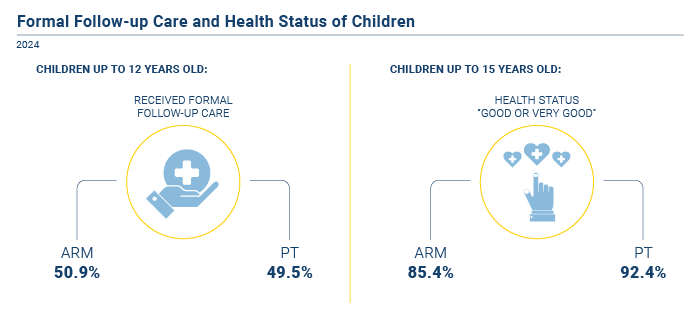
In 2024, in the ARM, the proportion of children up to 15 years of age whose health status was assessed as "Good or very good" stood at 85.4%, a value 7.0 percentage points (pp) below that recorded nationally (92.4%).
In the same period, the proportion of the resident population in the ARM aged 16 or over who reported using public transport every day or almost every day (5 to 7 days per week) was higher than that recorded nationally, standing at 15.1%, above the 10.8% observed in the country. The proportion of persons who used public transport every week, between 1 and 4 days per week, was also higher in the ARM, reaching 11.7%, compared to 6.8% in Portugal (+4.9 pp). On the other hand, the proportion of the population aged 16 or over who never or almost never used public transport was lower in the Region than in the country as a whole, at 60.0% and 67.8%, respectively.
Around half of children up to 12 years of age residing in the Region (50.9%) received formal childcare, recording a value slightly above that observed nationally (49.5%). Such formal care includes nurseries, certified childminders, care establishments for children with special needs, day centres/after-school clubs, kindergartens and/or school-organised care services outside school hours (excluding pre-school education and basic schooling time), covering both public and private providers.
On the other hand, at the national level, a higher proportion of households with children up to 12 years of age incurred expenditure on formal childcare compared to the ARM, at 59.5% and 52.4%, respectively.
The "Access to services" module also examined whether any household member had health care needs and/or needs for support in meeting basic needs and activities of daily living, provided on an individual and personalised basis at home, due to illness, disability, or other impediment, lasting at least 6 months or expected to continue for at least that period. Health care includes, among other things, medical, nursing, or other therapies, such as pain therapy, physiotherapy, psychotherapy, and occupational therapy. Home support services, in turn, cover, for example, companionship for elderly persons, meal delivery, assistance with personal hygiene, household tasks, and transport services.
In this regard, 7.1% of households in the ARM had at least one person in need of health care and home support services, a value 1.0 pp above that recorded nationally (6.1%).
For more information, please click on:
International Statistical Cooperation
 |
International Statistical Cooperation
|
Statistical Literacy
 |
Statistical Literacy
|
|
|
|
|
 |
 |
|



 |
|
|
 |

Copyright © 2026 Direção Regional de Estatística da Madeira. All rights reserved.
Address: Calçada de Santa Clara 38, 9004-545 Funchal, Madeira Island
Phone: +351 291 145 110 (National landline call)