









Newsletters
Subscribe to our newsletter and get statistical data as soon as it is available!...
In the 2023/2024 academic year
Number of enrolled students in non-tertiary education continues to decline
The Regional Directorate of Statistics of Madeira (DREM) has released today the preliminary data concerning education statistics for non-tertiary education in the Autonomous Region of Madeira (ARM) for the academic year 2023/2024. These statistics have been made available by the Observatory of Education of the Autonomous Region of Madeira (OERAM), a core unit of the Regional Directorate of School Administration (DRAE) of the Regional Secretariat of Education, Science, and Technology.
Madeira had 140 non-tertiary education institutions in the 2023/2024 academic year
In the academic year 2023/2024, considering the types of institutions, the ARM had a total of 140 educational establishments, four more than in the previous academic year. This increase was due to the rise in the number of kindergartens (+2) and vocational schools (+2). Of the total number of establishments, 79 were public and 61 were private, covering levels from kindergartens to vocational schools.
Number of enrolled students in the ARM in the 2023/2024 academic year continues to decline
The ARM recorded a total of 38,621 students enrolled in pre-primary, primary, and secondary education levels in the academic year 2023/2024, marking a reduction of 244 students (-0.6%) compared to the previous year. Regarding the institutional nature, public education accounted for 78.2% of enrolments, while private education represented 21.8%, proportions similar to those observed in the academic year 2022/2023. It is noteworthy that the total number of students was the lowest since the beginning of the series, which dates back to the 1999/2000 academic year.
In terms of sex distribution, there is an almost equal split, with 19,306 male students and 19,315 female students.
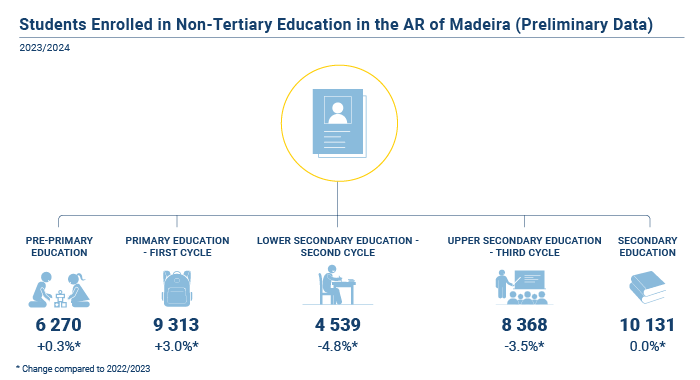
In pre-school education, the number of enrolled children increased by 0.3% compared to the previous academic year (17 more enrolled), totalling 6,270 children. This marks the sixth consecutive year of growth in pre-school enrolments.
In the 2023/2024 academic year, 22,220 students were enrolled in primary education, representing a 1.1% decline (257 fewer students) compared to the previous academic year, the lowest figure since the beginning of the series. In the 1st cycle, as in the previous academic year, there was a 3.0% increase in enrolments (+271 students). Conversely, the 2nd and 3rd cycles saw decreases of 4.8% (-227 students) and 3.5% (-301 students), respectively.
In secondary education, the number of enrolled students remained largely unchanged from the previous academic year, with a reduction of only 4 students (10,131 in 2023/2024).
Regarding adult education and training programmes, 2,391 students were enrolled in the 2023/2024 academic year, reflecting a 2.2% increase compared to the previous year. Of these, 1,194 students were enrolled in primary education programmes, while 1,197 were enrolled in secondary education programmes.
Number of teachers in the ARM reaches 5,757 in the 2023/2024 academic year
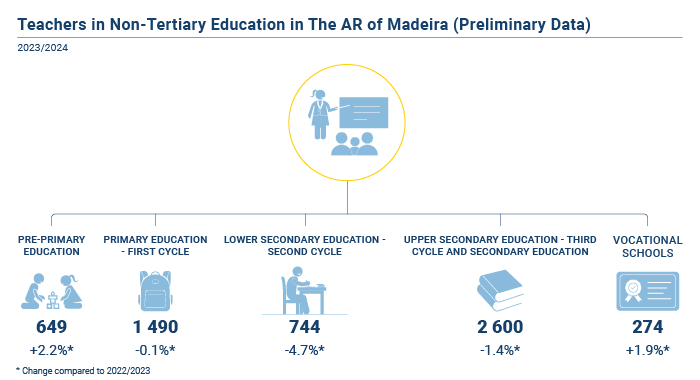
The ARM had 5,757 teachers in service during the 2023/2024 academic year, 56 fewer (-1.0%) than in 2022/2023, spread across various levels and cycles of education, from pre-school to secondary education and vocational schools. This reduction was due to a decrease in teaching staff in the primary education (-2 persons), the lower secondary education (-37 persons), and the upper secondary education and secondary education (-36 persons). In other levels of education, there were increases that totalled 19 persons (+14 in pre-school education and +5 in vocational schools).
The data reveals a predominance of teachers in public educational institutions, representing 88.8% of the total (5,115), while private institutions employed 642 professionals.
Regarding sex distribution, women continued to form the majority of the teaching staff, with 4,269 female teachers (74.2%), compared to 1,488 male teachers (25.8%).
Among the teachers, 439 were specialised and employed in special education across various teaching cycles, 8 of whom belonged to the Portuguese Sign Language recruitment group.
The non-teaching staff in pre-school, primary, and secondary education decreased by 2.3%, from 3,859 persons in 2022/2023 to 3,770 in 2023/2024, with 2,851 of them assigned to the public education network (75.6%).
For more information, please click on:
International Statistical Cooperation
 |
International Statistical Cooperation
|
Statistical Literacy
 |
Statistical Literacy
|
|
|
|
|
 |
 |
|


 |
|
|
 |

Copyright © 2026 Direção Regional de Estatística da Madeira. All rights reserved.
Address: Calçada de Santa Clara 38, 9004-545 Funchal, Madeira Island
Phone: +351 291 145 126 (National landline call)