










Newsletters
Subscribe to our newsletter and get statistical data as soon as it is available!...
DREM releases final results of the 2021 Census
Final results of the 2021 Census show that the resident population of the Region stood at 250,744 inhabitants, representing a decrease of 6.4% compared to 2011
The Regional Directorate of Statistics of Madeira (DREM) releases today the Final Results of the 16th General Population Census and 6th General Housing Census (2021 Census), concerning the Autonomous Region of Madeira (ARM). The Census 2021 was a statistical operation under the responsibility of Statistics Portugal (INE), with DREM overseeing the coordination of the operation in the Region. The municipal councils and the civil parish councils also had a very important role in the 2021 Census. The collection of information took place between the 5th of April and the 31st of May.
The final results of the 2021 Census are referenced to 19th April 2021 (census day). The Regional Directorate of Statistics of Madeira releases today the main results about population, households and buildings, although other releases regarding Census 2021 are planned, in order to deepen a diversity of topics.
Population
In the last decade, the population fell by 6.4%
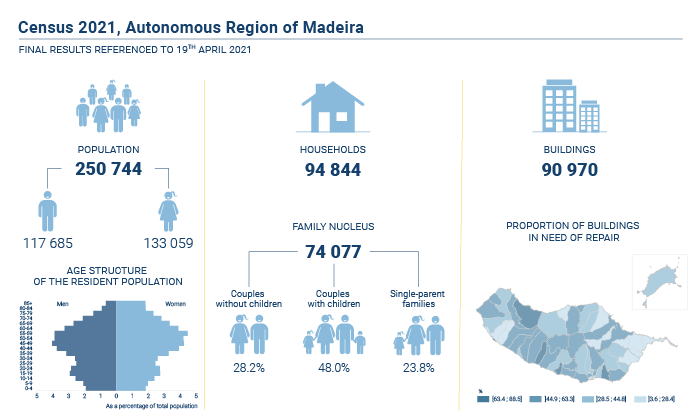
Final results from the 2021 Census indicate that the resident population in the Region was 250,744, 117,685 men (46.9%) and 133,059 women (53.1%).
In the last decade, the population decreased by 6.4%, contrary to what happened in the previous decade. The intercensal changes since Madeira became an Autonomous Region and until the 2011 Census were: +0.2% between 1981 and 1991, -3.3% between 1991 and 2001 and +9.3% between 2001 and 2011.
The majority of the parishes in the Region lost population in the last 10 years, with the exception of Tabua (+0.2%), Calheta (+0.8%), São Martinho (+1.7%), Caniço (+2.9%), Jardim do Mar (+5.4%), Sé (+8.2%) and Água de Pena (+12.9%) where the population increased. The largest falls were recorded in Paul do Mar (-27.1%), Ilha (-25.9%), Achadas da Cruz (-23.9%) and Ponta Delgada (-23.5%).
In 2021, the population density was higher in the parishes of São Pedro (4,834.9 inhabitants/km2) and Imaculado Coração de Maria (4,137.5 inhabitants/km2) and lower in Ilha (13.3 inhabitants/km2) and Ribeira da Janela (10.8 inhabitants/km2).
Ageing of the population continues, determined by the increase in the elderly population and the decrease in the young population
The phenomenon of population ageing, marked by an increase in the elderly population (people aged 65 or over) and a decrease in the younger population (people under 15 years of age), is clearly visible.
Between 2011 and 2021, the share of the young population in the total population fell from 16.4% to 12.7%, while the elderly population went up from 14.9% to 20.0%.
In 2021, there were 157 elderly persons for every 100 young persons in the Region, with this ratio being higher in the parishes in the north of the island, particularly in the parish of Ilha where this index reached a maximum of 888 elderly persons for every 100 young persons. On the contrary, it is in the parish of Caniço where the population is younger: 72 elderly per 100 youngsters. It is important to note that in most of the parishes (94.4%), the number of elderly persons per 100 youngsters was greater than 100.
Number of couples living in a consensual union has increased
In 2021, less than half of the resident population in the Region was single (45.7%), with the majority of the population either married (38.4%), divorced (7.9%) or widowed (8.0%).
In the last decade, there was an increase in the proportion of persons living in a consensual union: 6.0% in 2011 to 8.2% in 2021.
In 2021, the proportion of persons living in a consensual union and in a legal union was higher among men, with 8.8% of men living in a consensual union (7.7% of women) and 40.8% living in a legal union (36.3% of women).
In Caniço and Porto Santo, 12.3% and 11.7%, respectively, lived in a consensual union. On the other hand, Paul do Mar (3.1%) and Ribeira da Janela (2.0%) had the lowest proportion of persons living in a consensual union.
The largest proportion of persons living in a consensual union stood out among the population between 30 and 39 years of age (22.9%). The proportion of married persons was higher in the 60-69 age group (64.4%).
Approximately 6% of the resident population aged 5 years or more had a high level of difficulty in walking or climbing steps
A percentage of the resident population aged 5 or over declared a high level of difficulty (a lot of difficulties or not being able to perform the respective action) in seeing (4.1%), hearing (2.7%), walking or climbing steps (6.4%), memory or concentration (3.4%), bathing or dressing by oneself (3.1%) and understanding others or making oneself understood (1.7%).
The proportion of people aged 5 or more with great difficulty or who could not walk or climb steps is the one that stands out the most among the actions mentioned, the majority of whom are women (67.6%).
Still, for any of the actions, the proportion of persons with great difficulty or disability increases with age.
Among the population of foreign nationality residing in the Region, the majority were from countries outside the European Union (EU27, from 2020 onwards)
Among the population of foreign nationality residing in the Region (7,029), the majority were from countries outside the European Union (EU27 from 2020): 74,1%.
In 2021, the majority of the foreign-born Portuguese resident population (17,604) was from Venezuela (57.1%), followed by South Africa (9.2%), the United Kingdom (6.8%), Angola (5.7%) and France (4.5%).
Illiteracy rate fell in the last decade but remained higher among women
Between 2011 and 2021, the illiteracy rate - population aged 10 or more who cannot read or write, in the total population aged 10 or more - fell from 7.0% to 4.5%.
In 2021, the illiteracy rate remained higher among women: 3.7% of men and 5.2% of women.
The proportion of the resident population with at least complete secondary education reached 41.4% in 2021, increasing compared to 2011 (28.2%).
Unemployment rate decreased, being similar for men and women in 2021
In 2021, the activity rate of the resident population was 45.6% (48.9% for men and 42.8% for women), while in 2011 it was slightly higher: 47.6%.
The employment rate of the working-age population was 46.0%, lower than that recorded in 2011 (48.6%).
The unemployment rate was 12.1%, 12.0% for men and 12.1% for women (16.7% and 12.4% in 2011, respectively).
Households and family nuclei
Between 2011 and 2021, there is an increase in the family nuclei without children and of single-parent families
In 2021, 94,844 private households were counted, whose average family size fell to 2.6 persons compared to the average family size recorded in 2011 (2.9 persons per household).
Of the private households recorded in 2021, 78.1% (74,077) were family nuclei. Of these households, 28.2% were couples without children (25.3% in 2011), 48.0% were couples with children (55.0% in 2011), 20.7% were mothers with children (17.4% in 2011) and 3.1% were fathers with children (2.3% in 2011), thus, standing out the increase of family nuclei without children and of single-parent families.
In 2021, the number of couples without children, in the total family nuclei, was higher in Arco de São Jorge (45.8%), Ribeira da Janela (42.9%) and Ilha (41.8%). The proportion of single-parent families was higher in Paul do Mar (37.2%), Jardim do Mar (35.6%) and Ilha (32.7%).
Buildings
Majority (57.0%) of the buildings were not in need of repair and only 5.6% of the buildings required major repairs
In 2021, 90,970 buildings were counted, with 55.9% of the buildings being constructed after 1980.
Most buildings did not need repairs (57.0%), with 26.1% of buildings needing light repairs, 11.3% medium repairs and 5.6% deep repairs.
The proportion of buildings in need of repair, regardless of the size of repair, was higher in Jardim do Mar (88.5%), Seixal (82.4%), Tabua (74.9%) and Quinta Grande (71.7%), representing more than 70% of the buildings in those parishes.
In 2021, there were 131,037 dwellings, most of which were permanent dwellings (72.3%), with only 13.9% corresponding to secondary residences and 13.7% to vacant dwellings.
International Statistical Cooperation
 |
International Statistical Cooperation
|
Statistical Literacy
 |
Statistical Literacy
|
|
|
|
|
 |
 |
|


 |
|
|
 |

Copyright © 2026 Direção Regional de Estatística da Madeira. All rights reserved.
Address: Calçada de Santa Clara 38, 9004-545 Funchal, Madeira Island
Phone: +351 291 145 126 (National landline call)