






Newsletters
Subscribe to our newsletter and get statistical data as soon as it is available!...
In 2025
Region’s forest area increased by 9.1% compared with 2015
The Regional Directorate of Statistics of Madeira (DREM) continues to disseminate information on the Forest Area of the Autonomous Region of Madeira (RAM), updating it with data for 2025, recently made available by the Institute of Forests and Nature Conservation, IP-RAM, within the scope of the 3rd Forest Inventory of the Autonomous Region of Madeira (November 2025).
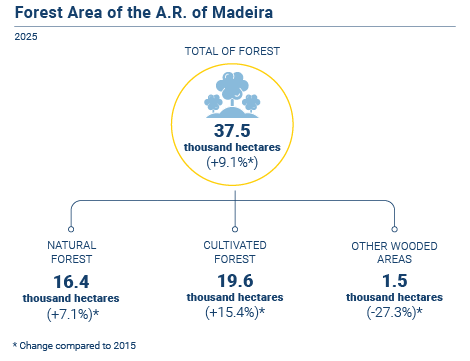
In 2025, the forest area of the ARM amounted to 37.5 thousand hectares, representing an increase of 9.1% compared with 2015, when it totalled 34.4 thousand hectares.
With regard to the components of the forest area of the ARM, cultivated forest (19.6 thousand hectares in 2025) predominated over natural forest (16.4 thousand hectares), accounting for 52.2% of the total forest area in 2025, up from 49.3% in 2015. In turn, natural forest represented 43.8% of the total (44.6% in 2015). Finally, other wooded land covered an area of 1.5 thousand hectares, corresponding to 4.0% of the total (6.1% in 2015).
Within the natural forest, the Laurisilva forest (16.1 thousand hectares) stands out, accounting, in 2025, for 98.0% of the natural forest and 42.9% of the total forest area of the ARM. The area of the Laurisilva forest increased by 5.9% between 2015 and 2025.
In the cultivated forest, forest stands (19.2 thousand hectares in 2025) are particularly noteworthy, accounting for 98.1% of the cultivated forest and 51.2% of the total forest area, having increased by 14.1% between 2015 and 2025. Within this group, the most prominent species are eucalyptus, acacia and maritime pine. Eucalyptus recorded growth between 2015 and 2025, increasing from 7.3 thousand hectares in 2015 to 10.2 thousand hectares in 2025, thereby strengthening its relative weight in the forest structure of the ARM (27.1% of the total in 2025). Acacia increased significantly, from 2.4 thousand hectares in 2015 to 4.1 thousand hectares in 2025. Maritime pine, in turn, recorded a decline, decreasing from 4.1 thousand hectares in 2015 to 2.3 thousand hectares in 2025, thus losing importance within the forest area of the ARM (6.2% in 2025 compared with 12.0% in 2015), which is explained by the pinewood nematode infestation.
For more information, please click on:
International Statistical Cooperation
 |
International Statistical Cooperation
|
Statistical Literacy
 |
Statistical Literacy
|
|
|
|
|
 |
 |
|



 |
|
|
 |

Copyright © 2026 Direção Regional de Estatística da Madeira. All rights reserved.
Address: Calçada de Santa Clara 38, 9004-545 Funchal, Madeira Island
Phone: +351 291 145 110 (National landline call)