

- HomeHome
- DREMDREM
-
Statistical InformationStatistical Information
-
Economic
- Government
- Agriculture, Forestry and Fishing
- Construction and housing
- Trade
- Economic Accounts
- Enterprises
- Industry and energy
- Innovation and knowledge
- Prices
- Monetary and Financial Sector
- Short-term trends
- Transports and Communications
- Tourism
-
Social
- Culture, Sport and Recreation
- Education
- Health
- Justice
- Labour market
- Population and Social Standards
- Social protection
- Territory
- Multithemes
- Indicators System
-
Economic
- Dissemination CalendarDissemination Calendar
- MetadataMetadata
- LinksLinks
- Site MapSite Map
- Press release
- Dashboards
- Contact usContact us
- RAMStats 2.0









Notícias (GB)
DREM releases Demographic Statistics of the Autonomous Region of Madeira for 2025 (Read more...)
DREM publishes a new edition of the Quarterly Statistical Bulletin covering the 2nd quarter of 2026 (Read more...)
In 2025, the number of divorces increased compared to the previous year (Read more...)
In August 2026, the overnight stays in tourist accommodation in the Region increased by 3.3% year-on-year (Read more...)
In the 2nd quarter of 2026, the median rental value of new lease agreements increased by 17.4% year-on-year, while the number of new agreements increased by 8.8% (Read more...)
In August 2026, seven meteorological stations recorded tropical nights on every day of the month (Read more...)
In August 2026, passenger movement at the Autonomous Region of Madeira airports recorded a year-on-year increase of 3.7% (Read more...)
In 2025, food donations in the Autonomous Region of Madeira increased by 31.5% compared with 2024, reaching 949.0 tonnes (Read more...)
In August 2026, the median value of bank appraisals for housing in the Autonomous Region of Madeira rose to 2 625 euros/m2 (Read more...)
In 2025, 69.8% of the resident population consulted a general practitioner or family doctor in the 12 months prior to the interview (Read more...)
Notícias (GB)
DREM releases Demographic Statistics of the Autonomous Region of Madeira for 2025 (Read more...)
DREM publishes a new edition of the Quarterly Statistical Bulletin covering the 2nd quarter of 2026 (Read more...)
In 2025, the number of divorces increased compared to the previous year (Read more...)
In August 2026, the overnight stays in tourist accommodation in the Region increased by 3.3% year-on-year (Read more...)
In the 2nd quarter of 2026, the median rental value of new lease agreements increased by 17.4% year-on-year, while the number of new agreements increased by 8.8% (Read more...)
In August 2026, seven meteorological stations recorded tropical nights on every day of the month (Read more...)
In August 2026, passenger movement at the Autonomous Region of Madeira airports recorded a year-on-year increase of 3.7% (Read more...)
In 2025, food donations in the Autonomous Region of Madeira increased by 31.5% compared with 2024, reaching 949.0 tonnes (Read more...)
In August 2026, the median value of bank appraisals for housing in the Autonomous Region of Madeira rose to 2 625 euros/m2 (Read more...)
In 2025, 69.8% of the resident population consulted a general practitioner or family doctor in the 12 months prior to the interview (Read more...)
Newsletters
Subscribe to our newsletter and get statistical data as soon as it is available!...
For the period 1995–2023
DREM releases the full time series of Regional Accounts, on the 2021 benchmark
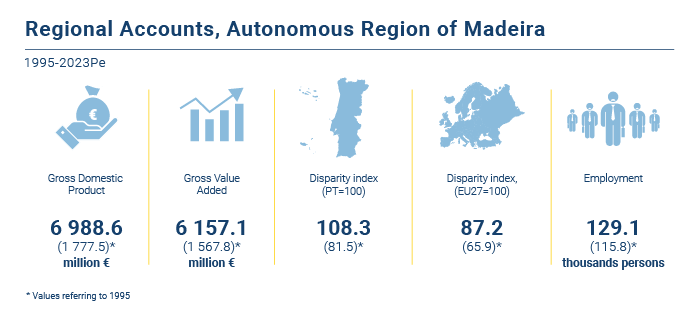
The Regional Directorate of Statistics of Madeira (DREM) publishes today the full time series of Regional Accounts on the 2021 benchmark, covering the period from 1995 to 2023. The data for 2023 are still preliminary.
Unlike what occurred in previous benchmark changes, the differences between the figures on the 2016 benchmark base and those on the 2021 benchmark are not substantial.
However, given that the series spans almost three decades, an analysis of the main indicators is appropriate. It should be noted that the backcasting carried out by Statistics Portugal (INE) is limited to indicators such as Gross Domestic Product (GDP), Gross Value Added (GVA), Employment and Apparent Labour Productivity. In the case of Gross Fixed Capital Formation (GFCF) and Household Accounts — which include, for example, Gross Disposable Income — no backcasting was undertaken, meaning that 2021 is the first year for which data on the 2021 benchmark are available.
It should also be highlighted that, on 17 December, INE and DREM are expected to release the first results of the Regional Accounts for 2024, as well as the revised figures for 2023. These will cease to be preliminary and will become final.
From the Em Foco publication released today, which presents an analysis of the main indicators, the following points stand out:
- Evolution of Regional Gross Domestic Product (GDP) – GDP of the Autonomous Region of Madeira quadrupled between 1995 and 2023;
- Evolution of Regional Gross Value Added (GVA) – Services sector increased its relative share in the regional economic structure;
- Comparisons within the national and European context – Between 1995 and 2023, Madeira improved its position compared to the national average of GDP per capita by 27 points, and to the European Union average by 21 points;
- Employment – Number of employed persons reached, in 2006, the highest value in the entire time series.
For more information, please click on:
International Statistical Cooperation
 |
International Statistical Cooperation
|
Statistical Literacy
 |
Statistical Literacy
|
|
|
|
|
 |
 |
|



 |
|
|
 |

Copyright © 2026 Direção Regional de Estatística da Madeira. All rights reserved.
Address: Calçada de Santa Clara 38, 9004-545 Funchal, Madeira Island
Phone: +351 291 145 110 (National landline call)