










Newsletters
Subscribe to our newsletter and get statistical data as soon as it is available!...
In the 2nd quarter of 2023
Number of jobs in the Regional Government of Madeira was 20,934
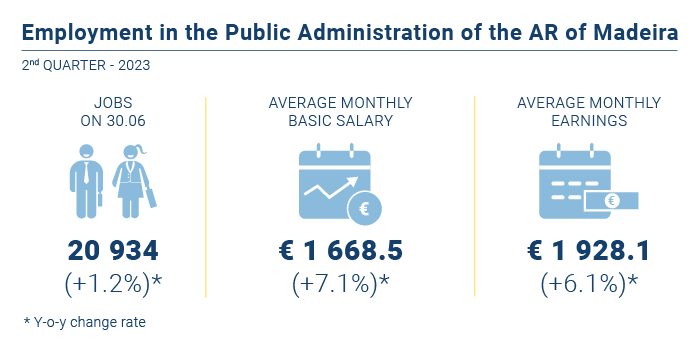
During the 2nd quarter of 2023, according to the information released by the Directorate-General for Administration and Public Employment (DGAEP) - the entity responsible for compiling information on human resources in the bodies of the state administration at the national level - there were 20,934 employment jobs in the Regional Government of Madeira (RGM) as of June 30th, 2023.This reflects a decrease of 50 jobs (-0.2%) from the previous quarter and an increase of 255 jobs (+1.2%) in a year-on-year comparison. Compared to the end of 2011, there was a reduction of 419 jobs (-2.0%).
Similarly, the Social Security Institute of Madeira, which is presented separately from the RGM, reported 1,355 jobs as of June 30th, 2023, indicating a decrease of 1 job (-0.1%) compared to the previous quarter. In year-on-year terms, there was an increase of 55 jobs (+4.2%). When compared to December 31st, 2011, there were 56 fewer jobs (-4.0%).
Among the subsectors, the Social Security Funds were the only one to experience a decrease (-1.9%) in jobs compared to the same period last year. On the other hand, all other subsectors observed growth when compared to the same period, with Local Government (+3.3%) leading the increases, followed by the Regional Government of the Azores (+2.1%), and the Regional Government of Madeira (+1.2%). The Central Government showed almost negligible change. The average year-on-year change for all Public Administrations was +0.6%.
In terms of the comparison to the previous quarter, the Regional Government of the Azores (+0.9%) and the Local Government (+0.6%) were the only ones to show an increase, surpassing the average growth rate for Public Administrations, which was nearly negligible. The subsectors of ARM and Central Government both experienced a decrease of 0.2% (for both), while the Social Security Funds decreased by 0.5%.
Analysing the data regarding employment within the institutional sector of public administrations at a national level, for the period between December 2011 and June 2023, reductions were observed only in the subsectors of Social Security Funds (-14.5%) and the Regional Government of Madeira (-2.0%). Other subsectors experienced increases, with the Regional Government of the Azores showing the largest relative growth (+18.4%). There was also an increase in the Local Government (+7.2%) and the Central Government (+1.5%). The average change across all Public Administrations was +2.5%. Notably, at the end of June 2023, the number of jobs in the Regional Government of the Azores exceeded that of ARM by 55, marking the first time this has occurred since these statistics have been compiled.
Regarding the breakdown by position, career, and group, the most representative group is that of teaching staff, accounting for 28.2%, followed by operational assistants and technical assistants at 25.5% and 14.4% of the total ARM employment, respectively. The hiring of workers for careers as senior technicians (net balance between entries and exits of +67), nurses (+56), operational assistants (+40), and doctors (+32) explains the overall year-on-year growth observed in the 2nd quarter of 2023.
Looking at the distribution of public employment by entity type, it is evident that in the 2nd quarter of 2023, establishments of primary and secondary education accounted for 40.1% of the total positions (40.6% in the same period the previous year), followed by Regional Public Business Entities at 29.2% (the same value as one year earlier) and Regional Directorates at 18.9% (18.6% at the end of the 2nd quarter of 2022).
The breakdown by Regional Secretariat (R.S.) reveals that the R.S. of Education, Science, and Technology is responsible for the highest number of workers, with 9,872 job positions (47.2% of the total for ARM), while the remaining Secretariats maintain employment volumes ranging from 215 (R.S. of Sea and Fisheries) to 982 (Regional Secretariat of Finance) positions.
As of April 2023, the average monthly base salary in the RGM was 1,668.54 euros, which is 1.9% higher than the overall average for Public Administrations, while the average monthly earnings (comprising base salaries, bonuses, allowances, or supplements) amounted to 1,928.11 euros, also exceeding the overall average by 0.5%. Compared to April 2022, the average monthly base salary in RGM increased by 7.1%, and the average monthly earnings increased by 6.1%.
Public companies that were not classified within the RGM had 2,503 jobs as of June 30th, 2023, representing an increase of 78 (+3.2%) compared to the previous quarter and an increase of 60 (+2.5%) on a year-on-year basis. Compared to December 2012 (the furthest period for which data is available for this type of company), the number of jobs increased by 197 (+8.5%).
The estimated average age of workers in the Regional Government of Madeira was 49.0 years as of December 2022 (compared to 48.7 years in December 2021).
Regarding educational qualifications, at the end of 2022, it was observed that over half of RGM's workers (58.0%) held a higher education degree, 22.6% had only completed primary education, and the remaining 19.4% had completed secondary education.
In turn, the eleven municipal councils of ARM accounted for 3,295 jobs during the reference period, an increase of 97 (+3.0%) compared to the preceding quarter and a rise of 58 (+1.8%) compared to the end of June 2022. In the ARM parish councils, 175 persons were employed as of June 30th, 2023, representing an increase of 1 job (+0.6%) compared to the previous quarter and a rise of 3 (+1.7%) on a year-on-year basis. Compared to December 31st, 2011, the Municipal Councils increased their workforce by 102 (+3.2%), and the parish councils by 6 (+3.6%) workers.
For more information, please refer to:
International Statistical Cooperation
 |
International Statistical Cooperation
|
Statistical Literacy
 |
Statistical Literacy
|
|
|
|
|
 |
 |
|



 |
|
|
 |

Copyright © 2026 Direção Regional de Estatística da Madeira. All rights reserved.
Address: Calçada de Santa Clara 38, 9004-545 Funchal, Madeira Island
Phone: +351 291 145 110 (National landline call)