










Newsletters
Subscribe to our newsletter and get statistical data as soon as it is available!...
In the fourth quarter of 2023
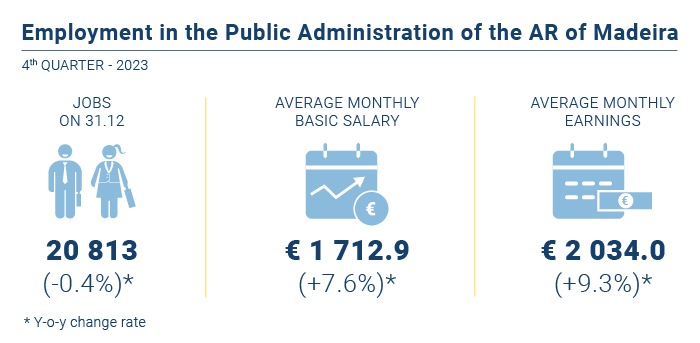
Number of jobs in the Regional Administration of Madeira was 20,813
According to information released by the Directorate-General for Administration and Public Employment (DGAEP) - the entity responsible for compiling information regarding human resources of public bodies and services in Portugal - which published the Statistical Synthesis of Public Employment (SIEP) for the fourth quarter of 2023 on February 14, there were 20,813 jobs in the Regional Administration of Madeira as of December 31, 2023. Compared to the previous quarter, there was a decrease of 44 (-0.2%) jobs, with a drop of 88 jobs (-0.4%) on a year-on-year basis. Compared to the end of 2011, there was a reduction of 540 jobs (-2.5%).
On the other hand, the Social Security Institute of Madeira, which according to the classification of institutional units should be presented separately from the Regional Government of Madeira (RGM), counted 1,362 jobs on December 31, 2023. Compared to the third quarter of 2023, there were no changes in the number of workers, and compared to December 31, 2022, there was a decrease of 36 workers (-2.6%). Compared to December 31, 2011, there were 49 fewer workers (-3.5%).
The analysis of data related to employment in the institutional sector of public administrations at the national level, for the period between December 2011 and December 2023, shows reductions only in the subsectors of Social Security Funds (-15.7%) and the Regional Government of Madeira (-2.5%). The other subsectors observed increases, with the largest relative rise being in the one operated by the Regional Government of the Azores (+14.8%). In the Local Government (+8.3%) and the Central Administration (+1.3%), there was also an increase. The average for all Public Administrations was +2.4%.
The subsectors that showed growth compared to the end of 2022 were Local Government (+2.3%) and Central Government (+0.1%). The remaining subsectors recorded a decrease compared to the previous year, with a decline of 0.4% in the Regional Government of Madeira, 0.5% in the Regional Government of the Azores, and 3.0% in Social Security Funds. The average year-on-year change in all Public Administrations was +0.4%.
Compared to the previous quarter, the Central Government (+1.2%) showed growth above the average of all Public Administrations (+1.0%). Increases below the average of all Public Administrations were recorded in the Regional Government of the Azores (+0.7%) and Local Government (+0.4%). The remaining subsectors showed decreases of 0.2% in the Regional Government of Madeira and 0.3% in Social Security Funds.
From 2018 to 2022, the Autonomous Region of Madeira consistently had a positive balance between entries and exits of workers in the RGM entities; however, in 2023, there was again a negative balance (-88).
Regarding the breakdown by position, career, and group, the most representative is that of teaching staff with 28.5%, followed by operational assistants and technical assistants, with 25.2% and 14.5% of the total, respectively. The departure of workers in the operational assistant career (balance between entries and exits of -153) and in 11 other careers explains the overall year-on-year decrease observed in the fourth quarter of 2023. The only career with a significant increase was that of nurses (+62).
Compared to the end of 2011, the medical career (+69.7%), senior technician (+53.1%), diagnostic and therapeutic technician (+21.9%), tax and customs administration technician (+21.5%), and nursing (+20.5%) had the highest growth rates. Conversely, conservators and notaries (-28.6%), kindergarten educators and primary and secondary school teachers (-13.7%), registry and notary officers (-13.6%), operational assistants (-12.3%), and technical assistants (-11.1%) had the most significant decreases.
The breakdown by Regional Secretariat (R.S.) shows that the R.S. of Education continues to be responsible for the largest number of workers, with 9,869 jobs (47.4% of the total in the RGM), while the other Secretariats maintain employment levels between 204 (R.S. of Sea and Fisheries) and 982 (R.S. of Finance) jobs.
If adding the Madeira Social Security Institute, the Municipal Councils, and Parish Councils of the Autonomous Region of Madeira (ARM), it is concluded that public employment in the RGM represented, in the last quarter of 2023, 18.6% of the active population (19.2% in the same period of the previous year) and 19.9% of the employed population (20.6% in the same period of the previous year). It is worth noting, however, that these percentages do not include public enterprises not classified within the RGM (i.e., those considered market producers) or services and entities under the Central Government that operate in the Region.
At the end of 2023, in terms of gender, the feminisation rate in the RGM was 69.9%, meaning that seven out of ten workers were female, a ratio higher than the average for Public Administrations in the country, where that rate is around 62.2%. The RGM presents, in fact, a feminisation rate higher than that of all other subsectors, except for Social Security Funds (82.4%).
The estimated average age of workers in the Regional Government of Madeira was 49.1 years in June 2023, slightly higher than the previous year (48.9 years). Most were concentrated in the age groups of "45 to 54 years" (35.6%) and "55 to 64 years" (29.2%). The percentage of workers "under 35 years" was only 9.4%.
Regarding qualifications, it is observed that more than half of the workers in the RGM (58.4%) have higher education, 22.2% have only primary education, and the remaining 19.4% have secondary education.
It is also noteworthy that, in June 2023, 210 jobs were occupied by workers with disabilities (+4 compared to June 2022), representing about 1.0% of the total.
In October 2023, the average monthly base salary in the RGM was 1,712.9 euros, 3.3% higher than the overall average for Public Administrations, while the average monthly earnings (which corresponds to the sum of base salaries, bonuses, subsidies, or supplements) was 2,034.0 euros, also higher than the overall average by 3.3%. Compared to October 2022, the average monthly base salary in the RGM increased by 7.6% and the average monthly earnings by 9.3%.
Public companies not classified within RGM had 2,473 jobs as of December 31, 2023, +68 on a year-on-year basis (+2.8%) and +167 compared to December 31, 2012 (+7.2%).
In the field of Local Administration, as of December 31, 2023, the eleven Municipal Councils of the ARM were responsible for 3,355 jobs, +141 (+4.4%) compared to the end of 2022 and +162 (+5.1%) compared to December 2011. In turn, the 54 Parish Councils of the ARM had 179 jobs as of December 31, 2023, +9 (+5.3%) on a year-on-year basis and +10 (+5.9%) compared to December 31, 2011.
For more information, please refer to:
International Statistical Cooperation
 |
International Statistical Cooperation
|
Statistical Literacy
 |
Statistical Literacy
|
|
|
|
|
 |
 |
|



 |
|
|
 |

Copyright © 2026 Direção Regional de Estatística da Madeira. All rights reserved.
Address: Calçada de Santa Clara 38, 9004-545 Funchal, Madeira Island
Phone: +351 291 145 110 (National landline call)