








Newsletters
Subscribe to our newsletter and get statistical data as soon as it is available!...
DREM releases the results of the Community Innovation Survey
The Regional Directorate of Statistics of Madeira (DREM) releases today the main results on entrepreneurial innovation in the Autonomous Region of Madeira (ARM), based on the Community Innovation Survey (CIS), with reference to the period between 2018 and 2020.
In the triennium 2018-2020, 42.6% of enterprises with more than 10 persons headquartered in the Autonomous Region of Madeira had innovation activities
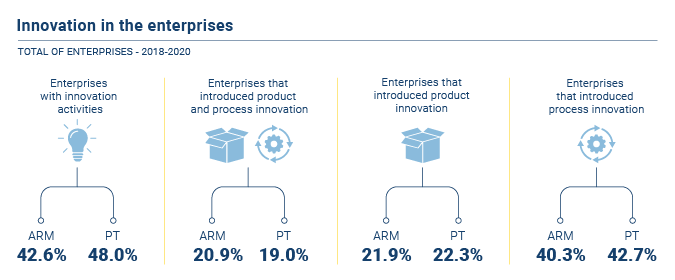
In the period 2018-2020, 42.6% of enterprises headquartered in the ARM with 10 or more people had some type of innovation activity (33.5% in the previous triennium), generating expenditure, whether product or process innovation activities, ongoing activities until the end of 2020, innovation activities abandoned or suspended, or research and development (R&D) activities carried out internally, continuously or occasionally, or contracting R&D to other enterprises (including from their group) or to public or private research organisations. This percentage was lower than in the country (48.0%). By NUTS 2 region, Área Metropolitana de Lisboa (52.2%) and Centro (51.1%) were the regions with the highest proportion of innovative enterprises and the only ones which exceeded the value registered for the Country (48.0%), with the Algarve (43.5%) and the Autonomous Region of the Azores (43.7%) and Madeira (42.6%) on the opposite side. These regions also recorded the highest increases in the previous three-year period (+17.9 pp and +16.4 pp), along with the Autonomous Region of the Azores (+19.4 pp). It should also be noted that all regions showed increases in the percentage of innovative enterprises.
In the 2018-2020 triennium, 21.9% of the enterprises headquartered in the Autonomous Region of Madeira developed product innovation (i.e. a new or improved good or service that differs significantly from the enterprises’ previous goods or services and that was implemented in the market), registering a decrease of 4.2 pp compared to the previous period (26.1%). In the country, this indicator stood at 22.3% (23.0% in 2016-2018).
The proportion of enterprises that introduced process innovation (new or improved business process for one or more business functions, which differs significantly from the enterprises’ previous processes and which were implemented in the enterprise) rose to 40.3% (+9.7 pp than in 2016-2018). At a national level, this percentage stood at 42.7% (+14.7 pp than in 2016-2018).
These results indicate that the broadening of innovation activities carried out by enterprises in the Autonomous Region of Madeira was mainly due to process innovation, and there is strong evidence that such a situation is largely associated with the effects of the COVID-19 pandemic, namely the adaptation of processes and procedures related to teleworking and non-face-to-face contacts (online sales, for example) to ensure business continuity for enterprises.
In the Autonomous Region of Madeira, between 2018 and 2020, 17.9% of the enterprises introduced new or improved goods in the market and 19.5% of the enterprises introduced new or improved services, meaning, compared to the previous triennium, a decrease of 2.8 pp in new or improved goods and 2.6 pp in new or improved services. Despite the reductions in the ARM, the national averages (17.7% and 18.2%, respectively) were surpassed. However, compared to the previous period, the scenario was more positive for the country, registering a decrease of only 0.9 pp in new or improved goods and an increase of 0.5 pp in new and improved services.
In 2020, 6.8% of the turnover of enterprises in the Autonomous Region of Madeira resulted from the introduction of new or improved products to the market and/or the enterprise, with 4.8% concerning the introduction of new products for the enterprise and 1.9% from the introduction of new products for the market, corresponding to values very close to those observed in 2018. These percentages were lower than those recorded in the Country (13.8%, 9.5% and 4.3%, in the same order), which recorded values above 2018 (11.2%, 7.0% and 4.2%).
In the 2018-2020 triennium, 20.5% of the enterprises from Madeira introduced innovations with some type of environmental benefit, regardless of the degree of contribution to environmental protection, 19.0% with environmental benefits obtained within the enterprise and 18.1% with benefits obtained during the consumption or use of the goods or services by the user. In the Country, those percentages were 23.9%, 22.3% and 19.4%, by the same order.
Between 2018-2020, the highest percentages of enterprises in the ARM that introduced innovations with significant environmental benefits, obtained within the enterprise, were seen in the recycling of waste, water or materials for own consumption or sale (i.e. the reduction of CO2 emissions), with 11.5% (12.3% in the Country), followed by the replacement of part of the materials by other less polluting/hazardous ones, with 10.3% (8.2% in Portugal), and the reduction of energy use or CO2 footprint, with 10.0% (7.7% in the Country).
In 2020, the total expenditure on innovation activities carried out by enterprises in the Autonomous Region of Madeira was 22.8 million euros, which represented 0.8% of the total for Portugal (2,735.8 million euros). Of that amount, 47.7% corresponded to other innovation expenditure (10.9 million euros), 41.8% to intramural R&D expenditure (9.5 million euros) and 10.6% to expenditure on extramural R&D activities (2.4 million euros). Compared to 2018, there was a decrease of 4.1 million euros in total expenditure on innovation activities (-15.2%). The increase in expenditure on intramural R&D of 13.1% (+1.1 million euros) was not enough to offset the decreases in expenditure on extramural R&D (-4.4 million euros; -64.7%).
For more information, please click on:
International Statistical Cooperation
 |
International Statistical Cooperation
|
Statistical Literacy
 |
Statistical Literacy
|
|
|
|
|
 |
 |
|



 |
|
|
 |

Copyright © 2026 Direção Regional de Estatística da Madeira. All rights reserved.
Address: Calçada de Santa Clara 38, 9004-545 Funchal, Madeira Island
Phone: +351 291 145 110 (National landline call)