










Newsletters
Subscribe to our newsletter and get statistical data as soon as it is available!...
DREM releases the updated time series on Communications, incorporating data from 2021
The Regional Directorate of Statistics of Madeira (DREM) presents the updated time series for the Communications sector in the Autonomous Region of Madeira (ARM), now including data from 2021.
This series was compiled using information directly collected from Statistics Portugal(INE) and the National Communications Authority (ANACOM).
Electronic Communications - ARM surpasses the country in the coverage of high-speed networks and services in fixed locations for residential customers
According to data provided by ANACOM, the number of residential customers using high-speed networks and services in fixed locations reached 82.7 thousand in the 4th quarter of 2021. This represents a growth of 7.6% compared to the same quarter of the previous year, and a rise of 16.1% vis-a-vis the 4th quarter of 2019.
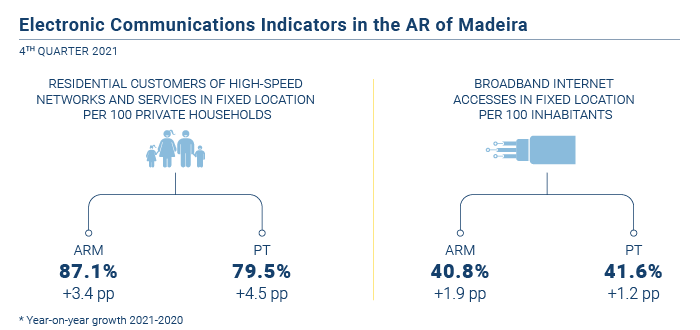
In the 4th quarter of 2021, the penetration rate of residential customers related to private households in the ARM reached 87.1%, indicating an increase of 3.4 percentage points (pp) compared to the same period last year. When compared to the same quarter of 2019, this rate went up by 11.2 pp. ANACOM's published information reveals that the regional rate exceeds the national rate (79.5%) by 7.6 pp.
This growth trend is also observed in the number of high-speed wired dwellings in the ARM, specifically in fibre optic FTTH (Fiber to the Home) networks, which are the main technology for fixed access, as well as in HFC (Hybrid Fiber-Coaxial) cable TV networks. By the end of the 4th quarter of 2021, the number of ARM dwellings wired with fibre optic (FTTH/B) by all operators reached approximately 163.9 thousand, reflecting a year-on-year growth of 6.7% (+26.2% compared to 2019). Considering dwellings prepared to receive these services but supported by cable TV networks, ARM had about 75.1 thousand dwellings in this quarter, the same number as in the same quarter of 2020, but an increase of 2.5% compared to the 4th quarter of 2019.
Regarding fixed broadband internet access, the penetration rate reached 40.8% of the population in 2021, compared to 38.9% in 2020 and 37.5% in 2019. The national rate was slightly higher at 41.6%. Among municipalities, Porto had the highest penetration rate at 53.1%, followed by Funchal at 45.0% and Calheta at 43.4%. On the other hand, Câmara de Lobos had the lowest rate at 31.6%, followed by Ribeira Brava at 34.6% and Santana at 35.3%. In terms of absolute numbers, there were 87.0 thousand broadband internet access connections in the residential segment and 15.5 thousand in the non-residential segment in 2021, resulting in a total of 102.6 thousand connections. This represents a growth of 3.8% compared to 2020 and 7.7% compared to 2019. The increase in teleworking and internet usage during the pandemic and resulting lockdowns contributed to the positive evolution of these indicators in recent years.
The number of subscribers to subscription-based television services has been steadily increasing over time. In 2004 - the first year for which this indicator is available - the number of subscribers was 65.5 thousand, and in 2021, it reached 107.1 thousand, showing an increase of 2.0% compared to 2020 and 4.1% compared to 2019.
The number of telephone accesses per 100 inhabitants in the ARM increased continuously between 2011 and 2018, reaching 47.84 accesses in that year. In 2019. There was a slight reduction in 2019 to 46.84 accesses, but it rose again to 47.75 in 2020 and 49.33 in 2021. In 2021, there were 91.7 thousand residential main telephone accesses and 32.2 thousand non-residential accesses, representing increases of 1.9% and 2.9% respectively compared to the previous year. Compared to 2019, these numbers increased by 3.9% and 4.8% respectively. Overall, the total number of telephone accesses amounted to 123.9 thousand in 2021, representing a 2.1% increase compared to 2020 and a 4.1% rise compared to 2019.
As the use of mobile phones has become widespread, the number of public payphones has been decreasing over the years. The average annual rate of decrease has been 6.5% since 2013, resulting in 202 public payphones in 2021. At the municipal level, the number of public payphones either decreased or remained unchanged compared to 2020 and 2019.
Postal Services - Number of post offices remained stable while the number of branches decreased
The number of post offices in the region remained steady at 19 since 2018, following a significant reduction between 2013 and that year.
As for post office branches, after a prolonged period of stability until 2015, a year when the number of branches was 24, there was growth until 2019, reaching a peak of 36. However, in 2021, there was a reduction to 35 agencies. Overall, when considering the total number of postal establishments in 2021 (54), there has been a net increase of 2 establishments compared to 2012. This indicates that during this period, the number of post office branches created exceeded the number of post offices closed in the ARM.
For more information, please click on:
International Statistical Cooperation
 |
International Statistical Cooperation
|
Statistical Literacy
 |
Statistical Literacy
|
|
|
|
|
 |
 |
|



 |
|
|
 |

Copyright © 2026 Direção Regional de Estatística da Madeira. All rights reserved.
Address: Calçada de Santa Clara 38, 9004-545 Funchal, Madeira Island
Phone: +351 291 145 110 (National landline call)