










Newsletters
Subscribe to our newsletter and get statistical data as soon as it is available!...
DREM releases time series on Communications for the Autonomous Region of Madeira updated with 2020 data
The Regional Directorate of Statistics of Madeira (DREM) DREM releases a time series on Communications in the Autonomous Region of Madeira for the period 2000-2020. This series was based on information collected directly by Statistics Portugal (INE) and the National Communications Authority (ANACOM).
Electronic communications – RAM surpasses the country in the penetration of networks and high-speed services in a fixed location in residential customers
According to data provided by ANACOM, the number of high-speed networks and services at a fixed location of residential customers was 76,844 in the 4th quarter of 2020. It increased by 7.9% when compared to the same quarter of the previous year.
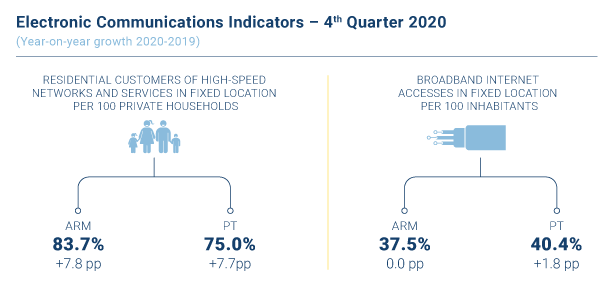
In the 4th quarter of 2020, the penetration rate of residential customers facing private households reached 83.7%, +7.8 percentage points (p.p.) above the same period of the prior year. According to information published by ANACOM, the regional rate exceeded the national average (75.0%) by 8.7 p.p.
This growth trend has also occurred in cabled high-speed households, both in optic fibre networks FTTH (Fibre to the Home), the main access technology at a fixed location, as well as in HFC (Hybrid Fiber-Coaxial). By the end of the 4th quarter of 2020, the number of households in the Autonomous Region of Madeira cabled with optic fibre (FTTH/B) by all operators was 153,578, representing a 18.3% growth y-o-y. If considered the households prepared to receive these services, but supported by cable TV networks, there were 75,100 households in the Autonomous Region of Madeira under these circumstances in the 4th quarter of 2020, up by 1 812 (+2.5%) from the same period of the previous year.
In relation to broadband Internet access at a fixed location, in 2020, the coverage reached 37.5% of the Madeiran population, to be compared to 40.4% on a national level. Porto Santo (46.7%), Funchal (43.7%) and Calheta (38.7%) were the municipalities with the highest coverage rates, in contrast with Câmara de Lobos (28.0%), Santana (29.4%) and Ribeira Brava (32.0%), which had the lowest rates. In 2020, the number of broadband internet accesses (at a fixed location) in the residential segment was 83,958 and in the non-residential segment of 14,903, totalling 98,861 (+3.8% than in 2019).
The number of subscribers of television subscription services has steadily increased over time. In 2004 – the first year for which this indicator is available – the number was 65,520, and in 2020, were counted 105,063 subscribers, up by 2.1% over 2019.
The number of telephone accesses per 100 inhabitants in the Autonomous Region of Madeira increased successively between 2011 and 2018, when it reached a peak of 47.84 accesses. In 2019, there was a reduction to 46.84 accesses, but, in 2020, this indicator rose again, to 47.75. That year, the number of major residential telephone accesses reached 90,070, while the number of non-residential accesses rose to 31,267 accesses. Overall, the number of accesses is approximately 121,337.
With the widespread use of mobile phones, the number of public telephone stations has been decreasing in the recent years, from 349, in 2013, to 225, in 2020. At the Municipality level, when compared to 2019, there is the maintenance or decrease in the number of telephone stations, except in Santa Cruz and Câmara de Lobos ( up by 1 public telephone in each).
Postal services - Creation of new post offices branches offset the reduction of post offices
The number of post offices in the Region remained stable between 2000 and 2012, where the number of post offices in the Region was 28. From 2013 on, a downward trend began which led the number of post offices to 19, in 2020, that is, between 2012 and 2019, the number of post offices fell by 32.1%.
Regarding post offices branches, between 2000 and 2015, the fluctuations were minimal, with the figures relatively stable. In 2015, the number of post offices was 24. From 2016 on, there was a successive growth until 2020, when the number of post offices reached 36. If considered the total number of postal office establishments, in 2020, there was an increase of 3 establishments compared to 2012 (52 postal office establishments), with the new post offices branches exceeding the post offices closed in the Autonomous Region of Madeira.
International Statistical Cooperation
 |
International Statistical Cooperation
|
Statistical Literacy
 |
Statistical Literacy
|
|
|
|
|
 |
 |
|



 |
|
|
 |

Copyright © 2026 Direção Regional de Estatística da Madeira. All rights reserved.
Address: Calçada de Santa Clara 38, 9004-545 Funchal, Madeira Island
Phone: +351 291 145 110 (National landline call)