






Newsletters
Subscribe to our newsletter and get statistical data as soon as it is available!...
Regional Directorate of Statistics of Madeira has updated the time series on Lifelong Learning in the Autonomous Region of Madeira with data from 2022
The Regional Directorate of Statistics of Madeira releases on its internet website the times on Lifelong Learning in the Autonomous Region of Madeira, updated with the results of the Adult Education and Training Survey (IEFA), conducted between September 2022 and February 2023. This analysis considers the participation of the adult population (aged 18 to 69) in various forms of lifelong learning, including formal and non-formal education activities, as well as informal learning and proficiency in languages other than the native tongue.
Lifelong Learning - 38.0% of persons aged 18 to 64 participated in lifelong learning activities in 2022
In this context, lifelong learning encompasses participation in formal and/or non-formal education activities. Formal education refers to intentional, institutionalized, and planned education offered by educational and training institutions that provide educational certification or dual certification, featuring a progressive sequence of educational levels, and delivered by public or private entities recognized by national authorities in matters of education and training. Non-formal education, on the other hand, relates to intentional, institutionalized, and planned education that complements or supplements formal education in the context of lifelong learning, conferring a certificate of attendance but not a level of education.
In 2022, more than one-third of the population (38.0%) aged 18 to 64 participated in at least one lifelong learning activity within the 12 months prior to the interview. This represents a 6.9 percentage point decrease compared to 2016 but is 18.1 percentage points higher than the lowest value in the series, which was 19.9% in 2007. The participation of persons of the male gender surpassed that of females in 2022, with 40.0% for males and 36.0% for females, reversing the trend observed in 2007, 2011, and 2016 when female participation exceeded male participation. In the country as a whole, a slight decrease (-0.8 percentage points) in lifelong learning activity participation was observed in 2022 compared to 2016 (49.4% in 2022; 50.2% in 2016).
Regarding the participation of the adult population aged 18 to 64 in formal education activities, there was a decrease of 1.5 percentage points, declining from 11.3% in 2016 to 9.8% in 2022. Nevertheless, this proportion remained 1.2 percentage points higher than the proportion of persons participating in such activities in 2007 (8.6%). In 2022, the participation rates were very similar between women (9.7%) and men (9.9%). At the national level, there was a 2.6 percentage point increase in persons participating in formal education activities in 2022 compared to 2016 (13.9% in 2022; 11.3% in 2016).
In 2022, the proportion of persons participating in non-formal education activities decreased by 7.0 percentage points, marking a reversal in the positive trend observed since 2007. There was also a shift in the gender distribution for this type of learning, as male participation (34.1%) slightly exceeded female participation (30.6%) in 2022. Similarly, Portugal experienced an inversion in the proportion of persons participating in non-formal education activities, dropping from 45.2% in 2016 to 42.5% in 2022 (-2.7 percentage points).
Informal Learning - 72.1% of persons aged 18 to 64 participated in informal learning activities in 2022
Informal learning involves intentional learning where the organization, methodology, and duration of activities are the responsibility of the person and do not involve teachers, trainers, educational institutions, or other formal organizations. After consistent increases in the years under examination, there was a 14.0 percentage point decrease in 2022, with participation falling from 86.1% in 2016 to 72.1% in 2022. In this aspect, the participation of men (70.1%) was slightly lower than that of women (74.1%) in 2022. At the national level, there was also a 16.5 percentage point decrease (72.9%) in the number of persons participating in this type of activity in 2022, compared to 2016 (72.9% in 2022; 89.4% in 2016).
Non-Participation in Education, Training, and Learning - 22.9% of persons aged 18 to 64 did not participate in any form of learning, whether formal, non-formal, or informal, in 2022
The non-participation rate was 23.8% for men and 22.0% for women in this age group. In the initial years , this category gradually decreased (from 68.4% in 2007 to 11.5% in 2016) but increased by 11.4 percentage points in 2022, still far below the maximum value of 68.4% observed in 2007. On a national level, there was also a progressive decrease in this category until 2016 (8.2%), followed by a significant increase in 2022, reaching 19.9%.
Knowledge of Foreign Languages - Over 70% of persons aged 18 to 64 knew at least one foreign language in 2022
The proportion of adults with knowledge of languages other than their native tongue, which had been steadily increasing in the years under consideration (from 44.2% in 2007 to 79.0% in 2016), fell to 72.3% in 2022. The results were very close between women (73.7%) and men (70.9%). At the national level, the proportion of adults with this type of knowledge had also been increasing from 2007 (52.0%) until 2016 (71.8%), but there was a slight decrease in 2022 (-1.6 percentage points; 70.2%).
In the 2022 edition of the IEFA, indicators are also provided for the age group corresponding to the entire adult population surveyed, persons aged 18 to 69.
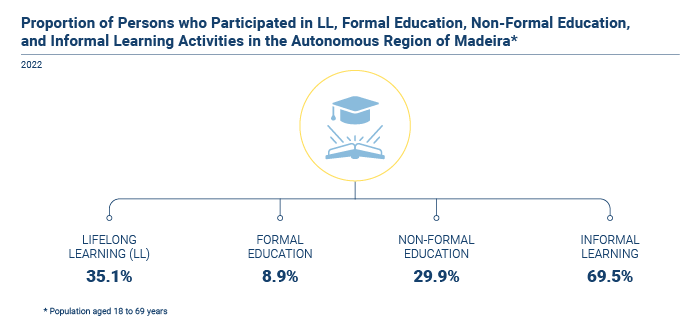
Lifelong Learning - 35.1% of adults aged 18 to 69 participated in lifelong learning activities
The proportion of persons aged 18 to 69 who participated in lifelong learning activities (formal and/or non-formal education) saw a decrease between 2016 and 2022. Participation in lifelong learning decreased from 42.7% to 35.1%. Participation in formal education activities decreased from 10.5% to 8.9%, and participation in non-formal education activities decreased from 37.6% to 29.9% during this period. At the national level, participation in lifelong learning decreased from 46.9% in 2016 to 45.6% in 2022, with a 2.3 percentage point increase in the proportion of persons participating in formal education activities (from 10.3% in 2016 to 12.6% in 2022) and a 3.0 percentage point decrease in non-formal education activities (from 42.4% in 2016 to 39.4% in 2022).
Informal Learning - 69.5% of adults aged 18 to 69 participated in informal learning activities
In the Region, the proportion of persons aged 18 to 69 who participated in informal learning activities was 69.5% in 2022, representing a 14.8 percentage point decrease compared to 2016. In the country, this indicator dropped from 87.6% in 2016 to 70.4% in 2022, marking a 17.2 percentage point decrease.
For more information, please click on:
International Statistical Cooperation
 |
International Statistical Cooperation
|
Statistical Literacy
 |
Statistical Literacy
|
|
|
|
|
 |
 |
|



 |
|
|
 |

Copyright © 2026 Direção Regional de Estatística da Madeira. All rights reserved.
Address: Calçada de Santa Clara 38, 9004-545 Funchal, Madeira Island
Phone: +351 291 145 110 (National landline call)