










Newsletters
Subscribe to our newsletter and get statistical data as soon as it is available!...
In the third quarter of 2024
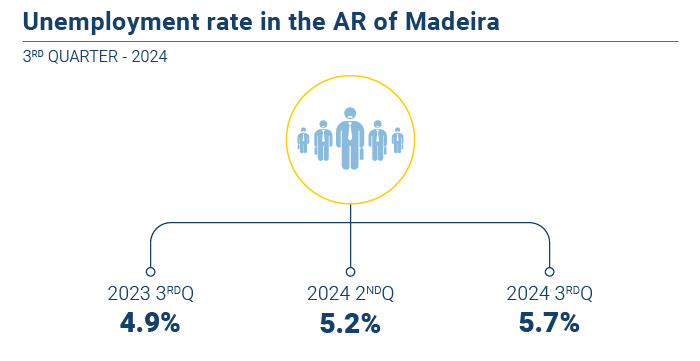
Unemployment rate in the Autonomous Region of Madeira was estimated at 5.7%
The results of the Labour Force Survey for the third quarter of 2024 indicate an estimated unemployment rate of 5.7%, up by 0.5 percentage points (pp) compared to the previous quarter and up by 0.8 pp over the same quarter of 2023.
The estimated unemployed population in the Autonomous Region of Madeira (ARM) stood at 7,600 persons, representing a year-on-year increase of 19.8% and a 9.0% rise compared to the previous quarter.
Regarding employment, the total employed population in the ARM was 126,400, marking a year-on-year increase of 2.2% (+2,700 persons) but a slight quarter-on-quarter decline of 0.2% (-300 persons). Within the employed population, 3,000 persons were in part-time underemployment, 5,500 engaged in secondary employment, and 17,100 worked from home (accounting for 15.1% of employed women and 12.0% of employed men).
The activity rate in the ARM, for persons aged 16 to 89, was estimated at 60.5%, showing an increase of 1.1 pp compared to the same quarter of the previous year, with no change from the preceding quarter. Among women, the activity rate was 56.8%, which is 7.9 pp lower than that of men, whose rate stood at 64.7%.
When compared to the rest of the country, the unemployment rate in Portugal for the same quarter was recorded at 6.1%, remaining unchanged from both the previous quarter and the same quarter of the previous year.
Regions with the highest unemployment rates included Península de Setúbal (8.2%), Oeste and Vale do Tejo (7.5%), and Norte (6.2%). Conversely, Algarve registered the lowest rate (4.5%), followed by the Autonomous Region of the Azores (4.9%). The Grande Lisboa region recorded an unemployment rate of 5.6%, slightly lower than the ARM and the Centro region, both at 5.7% and Alentejo at 5.9%.
On a quarterly basis, reductions in the unemployment rate were observed in Norte, Grande Lisboa, Algarve, and the Autonomous Region of Azores. The most substantial decline was recorded in Grande Lisboa (-0.8 pp), followed by the ARA (-0.6 pp) and Algarve (-0.5 pp). The highest quarterly increases were observed in Oeste and Vale do Tejo (+1.6 pp) and Alentejo (+0.7 pp).
Year-on-year, the Autonomous Region of Azores registered the largest decline in the unemployment rate (-1.1 pp). In Norte (-0.5 pp), Grande Lisboa (-0.4 pp) and Algarve (-0.1 pp), the unemployment rate also decreased. Conversely, Oeste and Vale do Tejo experienced the most significant increase (+2.0 pp), followed by the ARM (+0.8 pp), the Centro region (+0.7 pp), and Peninsula de Setúbal (+0.3 pp).
For further information, please refer to:
International Statistical Cooperation
 |
International Statistical Cooperation
|
Statistical Literacy
 |
Statistical Literacy
|
|
|
|
|
 |
 |
|



 |
|
|
 |

Copyright © 2026 Direção Regional de Estatística da Madeira. All rights reserved.
Address: Calçada de Santa Clara 38, 9004-545 Funchal, Madeira Island
Phone: +351 291 145 110 (National landline call)