








Newsletters
Subscribe to our newsletter and get statistical data as soon as it is available!...
In 2024, Self-employed workers in the Region strengthened their economic and organisational independence compared to 2023
The Regional Directorate of Statistics of Madeira (DREM) releases today data from the Labour Force Survey for the period 2021–2024, focusing on the self-employed population of the Autonomous Region of Madeira. This includes information on their economic and organisational independence, the influence of clients on their activity, and their ability to determine their own working hours. Additionally, data is provided on the participation in educational or training activities among persons aged 16 to 74, as well as on self-assessed health status and health-related limitations among persons aged 16 to 89.
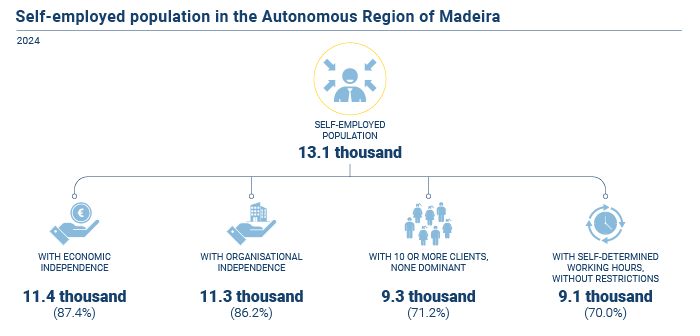
87.4% of self-employed workers in the ARM have economic independence, and 86.2% have organisational independence
In 2024, it is estimated that approximately 13.1 thousand self-employed persons resided in the Autonomous Region of Madeira, representing 10.4% of the employed population. This proportion has been declining over the past two years, with a decrease of 1.5 percentage points (pp) in 2024 compared to 2022, when self-employed workers accounted for 11.8% of the employed population. Among them, the proportion of self-employed persons without employees (63.9% of all self-employed workers) exceeded that of those employing others (36.1%).
The proportion of self-employed persons with economic independence stood at 87.4% in 2024. Compared to 2021, this figure increased by 12.4 pp, while compared to 2023, the rise was 2.2 pp. Additionally, 71.2% of self-employed workers had 10 or more clients with none being dominant in 2024, up from 62.5% in 2021. Regarding organisational independence, 86.2% of self-employed workers in 2024 reported having autonomy in decision-making, a figure lower by 8.3 pp than in 2021 (94.5%) but slightly higher than in 2023 (85.9%).
Moreover, 70.0% of self-employed persons determined their own working hours without restrictions in 2024, a lower proportion compared to both 2021 (75.3%) and 2023 (73.1%).
Decline in formal education participation and increase in non-formal education activities
Among the 199.3 thousand persons aged 16 to 74 residing in the region in 2024, 29.8% reported having participated in education or training activities in the past 12 months, an increase of 1.3 pp compared to 2022.
Participation in formal education declined over the period, decreasing from 12.0% in 2022 to 10.2% in 2024. In contrast, participation in non-formal education activities increased by 2.8 pp, rising from 20.1% in 2022 to 22.9% in 2024.
Self-assessed health status improved, and health-related limitations decreased
In 2024, 40.6% of persons aged 16 to 89 rated their health status as “Fair,” reflecting an increase of 3.4 pp compared to 2022. Meanwhile, 11.6% classified their health as “Poor” or “Very poor”, representing a decrease of 3.9 pp compared to 2022.
The proportion of persons experiencing limitations in daily activities due to long-term health issues (lasting at least six months) also declined, affecting 24.1% of the population of the Region aged 16 to 89 in 2024, a decrease of 1.5 pp compared to 2022 (25.6%).
For further information, please refer to:
International Statistical Cooperation
 |
International Statistical Cooperation
|
Statistical Literacy
 |
Statistical Literacy
|
|
|
|
|
 |
 |
|



 |
|
|
 |

Copyright © 2026 Direção Regional de Estatística da Madeira. All rights reserved.
Address: Calçada de Santa Clara 38, 9004-545 Funchal, Madeira Island
Phone: +351 291 145 110 (National landline call)