










Newsletters
Subscribe to our newsletter and get statistical data as soon as it is available!...
In 2021
Life expectancy at birth increased again in the Autonomous Region of Madeira
In the 2019-2021 period, life expectancy at birth for the population of the Autonomous Region of Madeira stood at 78.55 years: 74.80 years for men and 81.74 years for women. Compared to the three-year period 1999-2001, longevity in the Region increased by 5.39 years, with a growth of 6.33 years for men and 4.36 years for women.
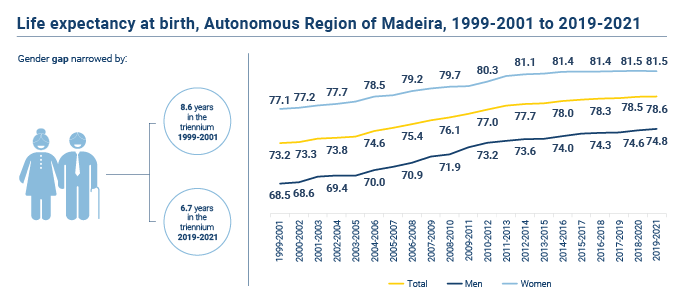
Life expectancy at birth continues to be higher for women, however, the gap between genders shrunk between 1999-2001 (8.64 years) and 2019-2021 (6.67 years). Still, Madeira is the NUTS 2 region in which the difference between genders remains higher than the difference observed in the other NUTS2 regions (5.70 years in the country). The highest differences were observed in the Autonomous Regions of Azores (7.10 years) and Madeira (6.67 years) and the smallest in Área Metropolitana de Lisboa (5.63) and in the Norte region (5.66).
For Portugal, life expectancy at birth was estimated at 80.72 years (2.17 years higher when compared with the Autonomous Region of Madeira). In the country, life expectancy for the female gender was 83.37 years while for men is 77.67 years. In NUTS2 region, longevity is greater in Norte (81.13 years), contrasting with the Autonomous Region of the Azores, whose life expectancy at birth was the lowest in the country (78.18 years). Between 2018-2020 and 2019-2021, life expectancy at birth dropped in almost all NUTS2 regions, with the exception of the Autonomous Regions that maintained the trend of increasing longevity.
Life expectancy at age 65, for the population of the Autonomous Region of Madeira, was 17.76 years (17.72 in 2018-2020). Men aged 65 can expect to live an additional 15.06 years longer, on average, and women an average of 19.55 years longer. Note that, compared to the previous period, there was a slight decrease in life expectancy at age 65 for men (15.08 years in 2018-2020) and an increase for women (19.46 years in 2018-2020).
Life expectancy at age 65 for the total Portuguese population stood at 19.35 years (1.59 years higher than in Madeira): 17.38 years for men and 20.80 years for women. In Área Metropolitana de Lisboa longevity at 65 years (19.60 years) is the highest and in the Autonomous Region of Azores, this longevity is the lowest in the country (17.58 years). Between 2018-2020 and 2019-2021, only the Autonomous Region of Madeira maintained the trend of increasing life expectancy at age 65, while in the other regions there was a decrease in this indicator.
Although life expectancy (at birth and at age 65) remains lower than the estimated for the country as a whole, the Autonomous Regions of Madeira and Azores are the NUTS2 regions in which life expectancy increased the most in the last decade.
International Statistical Cooperation
 |
International Statistical Cooperation
|
Statistical Literacy
 |
Statistical Literacy
|
|
|
|
|
 |
 |
|



 |
|
|
 |

Copyright © 2026 Direção Regional de Estatística da Madeira. All rights reserved.
Address: Calçada de Santa Clara 38, 9004-545 Funchal, Madeira Island
Phone: +351 291 145 110 (National landline call)