










Newsletters
Subscribe to our newsletter and get statistical data as soon as it is available!...
DREM releases the 2021 edition of the study on municipal purchasing power conducted by Statistics Portugal
Statistics Portugal released today the 2021 edition of the study on municipal purchasing power.
This study provides an analysis of Portuguese municipalities regarding their purchasing power, encompassing various aspects of material well-being. It relies on a set of variables and utilizes a principal component factor analysis model to generate composite indicators representing purchasing power. The variables considered encompass data from the SIBS network, housing credit granted, taxation, population, monthly income of wage-earning workers, business activities, new automobile sales, and urban real estate.
This study commenced in 1993. The methodological document supporting this statistical operation indicates that "The methodology used in EPCC is particularly suitable for spatial comparisons of the various purchasing power indicators presented but is less suited for temporal comparisons." Therefore, the analysis conducted here pertains to the year 2021, with results from previous years available on the DREM website. While it is essential to exercise caution when comparing indicators across different years, it is legitimate to compare the rankings of various municipalities in terms of their evolution over time.
The EPCC comprises three key indicators: the Per Capita Indicator of Purchasing Power (IpC), the Proportion of Purchasing Power (PPC), and the Relative Dynamism Factor (FDR).
The IpC represents the daily purchasing power per capita in different municipalities or regions, using the national value as a reference. It's important to note that this indicator reflects the manifested purchasing power within the municipality, not the IpC of its residents.
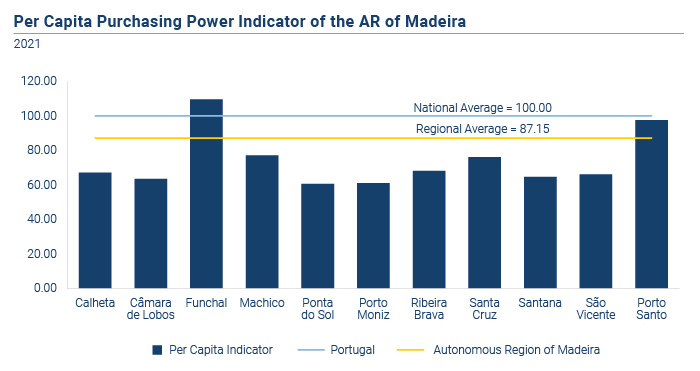
In this indicator, the Autonomous Region of Madeira (ARM) has an IpC value of 87.15, placing it alongside the Autonomous Region of the Azores (87.37) at the lower end of the country's seven NUTS 2 regions. The top position in this category is held by Área Metropolitana de Lisboa (121.37). Funchal is the only municipality in the ARM with an IpC higher than the national average (109.59), ranking as the 15th highest municipality in the country for this indicator (13th in 2019). Besides from Funchal, only Porto Santo (97.51) surpasses the regional average (87.15). Ponta do Sol (60.72) and Porto Moniz (61.04) are the municipalities in the ARM with the lowest IpC in the country, both falling within the group of four municipalities where IpC is below 62.
The Proportion of Purchasing Power (PPC) indicator is derived from the Per Capita Purchasing Power (IpC) and is designed to assess the degree of purchasing power concentration in different territories. It is important to note that regions with higher or lower purchasing power are not solely influenced by the per capita distribution of purchasing power across the nation but also by the spatial distribution of the resident population.
In this indicator, ARM accounts for 2.113% of the country's purchasing power, with the Funchal standing out due to its high IpC and inclusion in the exclusive group of 23 municipalities that have more than 1% of the national purchasing power, which includes several municipalities from Áreas Metropolitanas de Lisboa and Porto, Braga, Coimbra, Guimarães, Leiria, and Vila Nova de Famalicão. Porto Moniz presents the lowest PPC in ARM, reflecting its small population size, individually accounting for less than 0.015% of the national purchasing power, similar to two municipalities in the Azores (Corvo and Lajes das Flores) and one municipality in Alentejo (Barrancos). In the regional context, Funchal concentrates 53.0% of ARM's purchasing power, followed by Santa Cruz (14.9%) and Câmara de Lobos (9.3%).
The Relative Dynamism Factor (FDR) indicator aims to reflect the irregularly manifested purchasing power, usually associated with seasonal population flows driven by tourism. It reveals the ongoing dynamics beyond the purchasing power per capita manifested daily in the territories (IpC).
This indicator to some extent gauges the significance of tourism for municipalities within the national context. In this regard, all ARM municipalities, except Câmara de Lobos (-0.169), exhibit a higher FDR than the national average (-0.092) . Noteworthy municipalities with high FDR values include Porto Moniz (1.125), Calheta (0.998), Porto Santo (0.947), and São Vicente (0.623). It's worth highlighting that within the NUTS II regions, RAM possesses the second-highest value (0.342), following the Algarve (3.030).
For more information, please click on:
International Statistical Cooperation
 |
International Statistical Cooperation
|
Statistical Literacy
 |
Statistical Literacy
|
|
|
|
|
 |
 |
|



 |
|
|
 |

Copyright © 2026 Direção Regional de Estatística da Madeira. All rights reserved.
Address: Calçada de Santa Clara 38, 9004-545 Funchal, Madeira Island
Phone: +351 291 145 110 (National landline call)