










Newsletters
Subscribe to our newsletter and get statistical data as soon as it is available!...
In the 1st quarter of 2026
Egg production and poultry meat increased compared with the same period of the previous year, while livestock slaughtering and landed catch declined
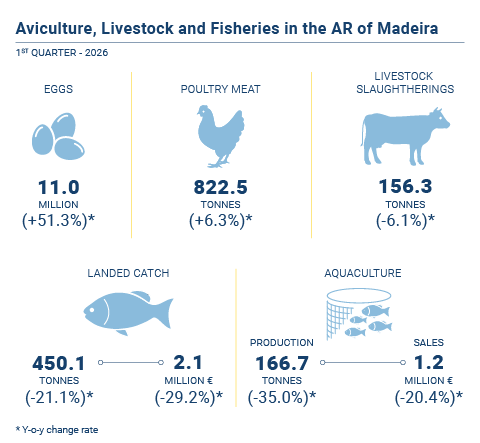
According to information collected by the Regional Directorate of Statistics of Madeira (DREM) from the Region’s industrial poultry farms, in the 1st quarter of 2026, egg production totalled around 11.0 million units, representing a year-on-year increase of 51.3%. This particularly strong growth is associated with the increase in production by one of the enterprises, compared with the same quarter of the previous year.
In the same period, poultry meat recorded an increase of 6.3%, compared with the first three months of the previous year, totalling 822.5 tonnes.
In turn, according to data provided by the Slaughterhouse Centre of the Autonomous Region of Madeira (CARAM), livestock slaughtering reached 156.3 tonnes, corresponding to a reduction of 6.1% compared with the 1st quarter of 2025.
In the field of fisheries, information collected from the Regional Directorate of Fisheries relating to the 1st quarter of 2026 shows that this period was characterised by a year-on-year decrease both in the volume of landed catch (-21.1%) and in first-sale value (-29.2%). Over the first three months of the current year, landed catch in the Region totalled around 450.1 tonnes, generating first-sale revenues of 2.1 million euros.
The main species caught recorded decreases: black scabbardfish catches fell by 22.3%, while tuna and similar species declined by 1.9%. In value terms, black scabbardfish decreased by 30.9%, whereas sales of tuna and similar species increased by 6.9%.
Regarding blue jack mackerel and chub mackerel, following the temporary suspension of purse seine fishing targeting small pelagic species — a measure established by ordinance of the Regional Secretariat for Agriculture, Fisheries and Environment, in force between February and July 2025, aimed at protecting the reproductive period of the target species and ensuring long-term sustainability — catches of these species between January and March this year approached the levels recorded in the 1st quarter of 2024.
Black scabbardfish nevertheless remained the most caught species, accounting for 91.0% of total volume and 84.1% of total value. By contrast, catches of tuna and similar species amounted to only 7.6 tonnes, corresponding to a first-sale value of merely 118.4 thousand euros.
The average first-sale fish price recorded during the reference period (excluding landed fish intended for self-consumption) stood at 4.91 euros, below the 5.38 euros recorded in the same period of 2025. The average price of tuna and similar species reached 15.51 euros (compared with 14.25 euros in the corresponding period), while black scabbardfish stood at 4.55 euros, below the 5.02 euros recorded in the first three months of the previous year.
Aquaculture recorded year-on-year declines in production and sales value
According to information collected by DREM from aquaculture production companies operating in the Region, in the 1st quarter of 2026, 166.7 tonnes of seabream were produced, representing a decrease of 35.0% compared with the same quarter of 2025. Likewise, sales totalled 1.2 million euros, declining by 20.4% compared with the corresponding quarter. The sector’s performance in this quarter was adversely affected by the absence of seabream of commercial size, a situation associated with low water temperatures and also by the smaller number of cages used for production.
By market, 71.6% of sales value corresponded to the national market (Mainland Portugal and the Azores) and 28.2% to the regional market. In the same quarter of the previous year, these shares stood at 76.9% and 22.9%, respectively. Sales to the European Union market accounted for only 0.2% of the total.
International Statistical Cooperation
 |
International Statistical Cooperation
|
Statistical Literacy
 |
Statistical Literacy
|
|
|
|
|
 |
 |
|



 |
|
|
 |

Copyright © 2026 Direção Regional de Estatística da Madeira. All rights reserved.
Address: Calçada de Santa Clara 38, 9004-545 Funchal, Madeira Island
Phone: +351 291 145 110 (National landline call)