











Newsletters
Subscribe to our newsletter and get statistical data as soon as it is available!...
:: Statistical Indicators ::
- Resident Population
- Natural Balance
- Unemployment
- GDP
- RIEAI
- Inflation
- Overnight Stays
- Dwelling Sales
- Companies
|
Resident Population Resident Population Estimates (31 December). |
|
2025, Resident Population Estimates based entirely on administrative data. 2021 - 2024, Revised Resident Population Estimates following the compilation of the 2025 Resident Population Estimates, based entirely on administrative data. Source: Statistics Portugal/DREM - Demographic Statistics |
|
Unemployment Rate Quarterly rate obtained from the Labour Force Survey, corresponding to the ratio of the unemployed population to the active population (%). |
|
Source: Statistics Portugal/DREM - Labour Force Survey |
|
Inflation Rate Average Rate of Change over the last 12 months of the Consumer Price Index (%). |
|
Source: Statistics Portugal/DREM - Consumer Price Index |
|
Overnight Stays Overnight stays recorded in total collective tourist accommodation (thousands). |
|
Source: Statistics Portugal/DREM - Tourism Statistics |
|
GDP Gross Domestic Product (GDP) of the Autonomous Region of Madeira at current prices, base 2021 (million euros). |
|
The value for 2024 is provisional. Source: Statistics Portugal - Regional Accounts (Base 2021) |
|
Family Dwelling Sales Number of Family Dwelling Sales (Total, New and Existing) in the Autonomous Region of Madeira. |
|
Source: Statistics Portugal (INE, IP.). |
|
Company Incorporation and Dissolution Number of companies incorporated and dissolved. |
|
Source: Directorate-General for Justice Policy |
|
Natural Balance Difference between the number of live births and the number of deaths in a given period of time (No.). |
|
* Preliminary data compiled up until June 5th 2026. Source: Statistics Portugal/DREM - Demographic Statistics |
|
Regional Indicator of Economic Activity 3-month moving average (%). |
|
Source: DREM |
:: Statistical Indicators ::
|
Population Resident Population estimates by the 31st of December. |
|
2025, Resident Population Estimates based entirely on administrative data. 2021 - 2024, Revised Resident Population Estimates following the compilation of the 2025 Resident Population Estimates, based entirely on administrative data. Source: INE/DREM - Demographic Statistics |
|
Unemployment Rate Quarterly rate derived from the Labour Fource Survey, which corresponds to the ratio between the unemployed and the active population(%). |
|
Source: INE/DREM - Labour Force Survey |
|
Inflation Rate 12-month average growth rate of the Consumer Price Index. |
|
Source: INE/DREM - Consumer Price Index |
|
Overnight stays Overnight stays in tourism accommodation (thousands). |
|
Source: INE/DREM - Tourism Statistics |
|
GDP Gross Domestic Product (GDP) of the Autonomous Region of Madeira at current prices, base 2021 (millions of euros). |
|
The value for 2024 is provisional. Source: INE - Regional Accounts (Base 2021) |
|
Dwelling Sales Number of Dwelling Sales (Total, New e Existing), in the Autonomous Region of Madeira. |
|
Source: Statistics Portugal |
|
Formation and Dissolution of Companies Number of formed and dissolved companies. |
|
Source: Directorate-General for Justice Policy |
|
Natural Change Balance between the number of live births and the number of deaths in a given time period (No.). |
|
* Preliminary data compiled up until May 8th, 2026. Source: INE/DREM - Demographic Statistics |
|
Regional Indicator of Economic Activity 3-month moving average (%). |
|
Source: DREM |
:: Publications ::
-

Annual publication
Price: papel - 3,50 € / PDF - Free
Year of publication: 2024
Reference period: 2023
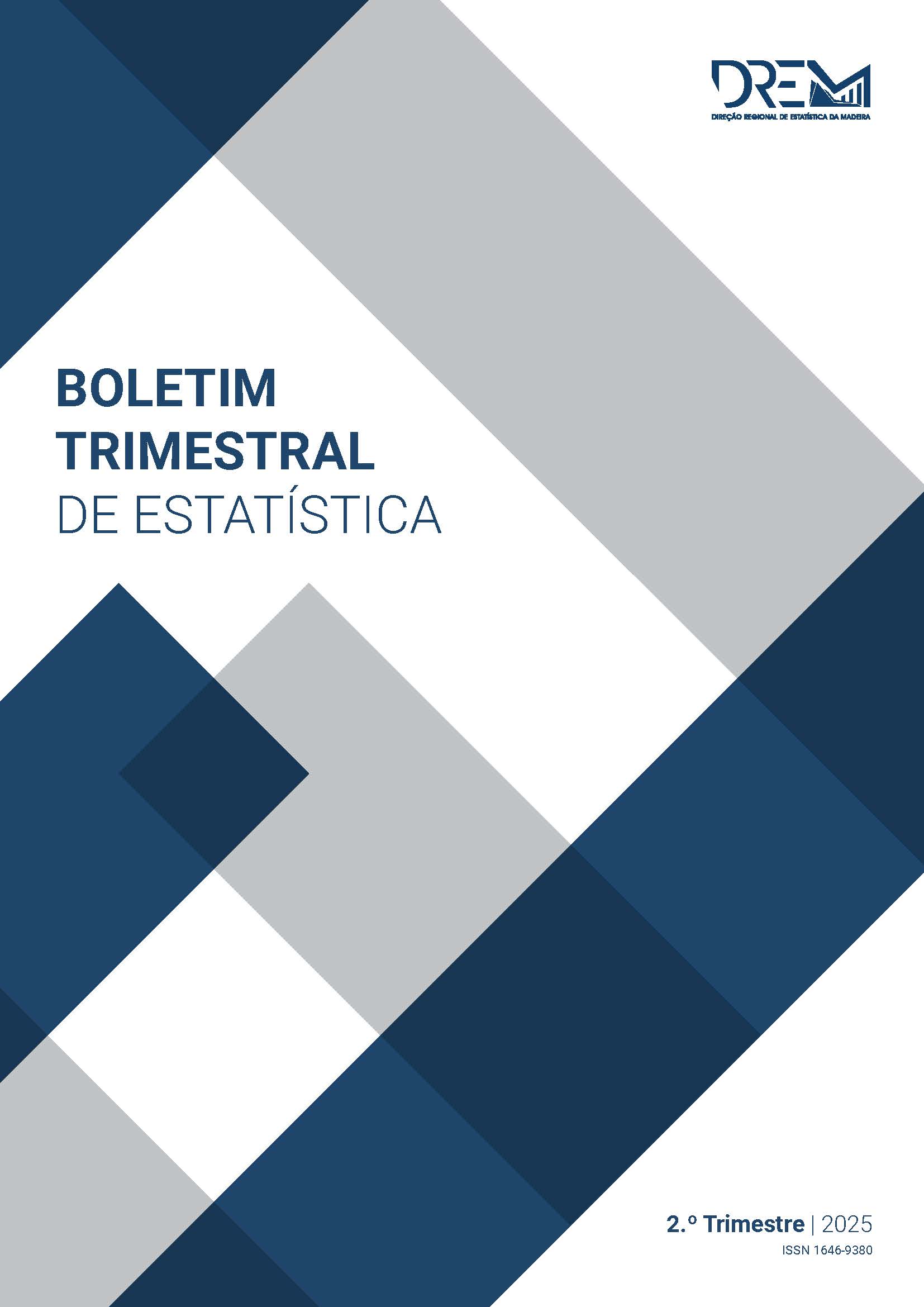
Quarterly Bulletin of Statistics
Quarterly publication
Price: paper - 4,00 € / PDF - Free
Year of publication: 2025
Reference period: 2nd Quarter 2025
-
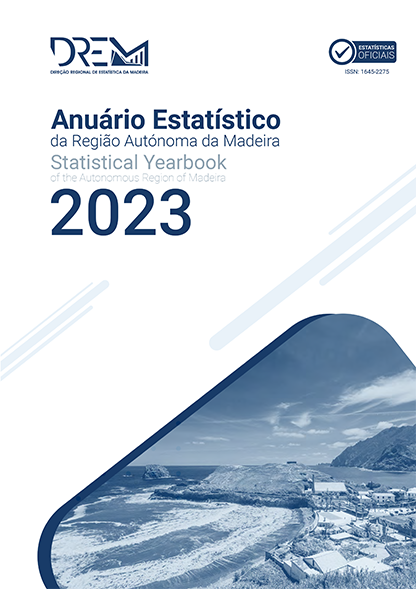
Annual publication
Price: paper - 22,00 € / PDF - Free
Year of publication: 2024
Reference period: 2023

Census - Final results: Autonomous Region of Madeira - 2021
Annual publication
Price: paper - 10,00 € / PDF - Free
Year of publication: 2023
Reference period: 2021
-

Annual publication
Price: PDF - Free
Year of publication: 2026
Reference period: 2025

Monthly publication
Price: paper - 3,00 € / PDF - Free
Year of publication: 2025
Reference period: December 2024
-
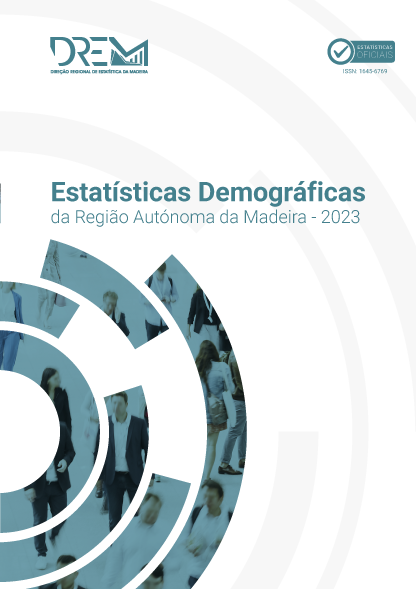
Annual publication
Price: paper - 10,00 € / PDF - Free
Year of publication: 2024
Reference period: 2023

Annual publication
Price: paper- 12,00 € / PDF - Free
Year of publication: 2026
Reference period: 2024
-

International Trade Statistics
Annual publication
Price: paper- 6,00 € / PDF - Free
Year of publication: 2021
Reference period: 2020

Quarterly publication
Price: paper- 2,00 € / PDF - Free
Year of publication: 2025
Reference period: 4th Quarter 2024
-

Annual publication
Price: paper - 4,00 € / PDF - Free
Year of publication: 2024
Reference period: 2023

Agriculture and Fishery Statistics
Annual publication
Price: paper - 3,50 € / PDF - Free
Year of publication: 2024
Reference period: 2023
-

Annual publication
Price: paper - 12,00 € / PDF - Free
Year of publication: 2021
Reference period: 2019

Construction and Housing Statistics
Annual publication
Price: paper - 4,50 € / PDF - Free
Year of publication: 2024
Reference period: 2023
:: Publicações ::
-
Annual publication
Price: paper - 3,50 € / PDF - Free
Year of publication: 2024
Reference period: 2023
-

Annual publication
Price: paper - 22,00 € / PDF - Free
Year of publication: 2023
Reference period: 2022
-

Monthly publication
Price: paper - 1,50 € / PDF - Free
Year of publication: 2025
Reference period: May 2025
-
Annual publication
Price: paper - 10,00 € / PDF - Free
Year of publication: 2024
Reference period: 2023
-
International Trade Statistics
Annual publication
Price: paper - 6,00 € / PDF - Free
Year of publication: 2021
Reference period: 2020
-
Annual publication
Price: paper - 4,00 € / PDF - Free
Year of publication: 2024
Reference period: 2023
-
Annual publication
Price: paper - 12,00 € / PDF - Free
Year of publication: 2021
Reference period: 2019
-
Quarterly Bulletin of Statistics
Quarterly publication
Price: paper - 4,00 € / PDF - Free
Year of publication: 2025
Reference period: 2nd Quarter 2025
-
Census - Final results. Autonomous Region of Madeira - 2021
Annual publication
Price: paper - 10,00 € / PDF - Free
Year of publication: 2023
Reference period: 2021
-
Construction and Housing Statistics
Annual publication
Price: paper - 4,50 € / PDF - Free
Year of publication: 2023
Reference period: 2022
-
Agriculture and Fishery Statistics
Annual publication
Price: paper - 3,50 € / PDF - Free
Year of publication: 2024
Reference period: 2023
-
Quarterly publication
Price: paper - 2,00 € / PDF - Free
Year of publication: 2026
Reference period: 1st Quarter 2026
-
Annual publication
Price: paper - 12,00 € / PDF - Free
Year of publication: 2024
Reference period: 2022
-
Monthly publication
Price: paper - 3,00 € / PDF - Free
Year of publication: 2025
Reference period: December 2024
DREM releases Regional Accounts data for 2021 and 2022
Statistics Portugal (INE) releases today the results of the Regional Accounts for the years 2021 and 2022, of final and provisional nature, respectively.
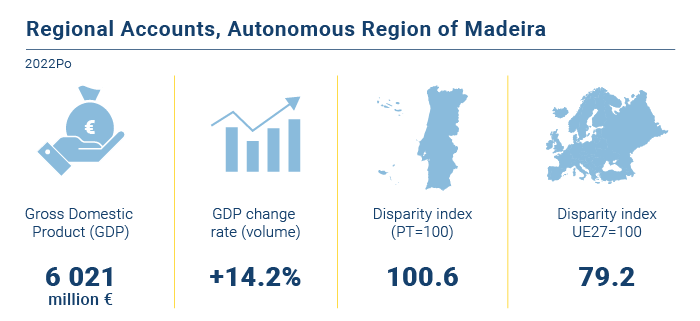
Regional Gross Domestic Product (GDP) exceeded the threshold of 6 billion euros in 2022, growing by 14.2% in real terms
In its initial estimate for 2022, Statistics Portugal indicates a Gross Domestic Product in the Autonomous Region of Madeira (ARM) of 6,020.5 million euros, reflecting growth of 19.8% in nominal terms and 14.2% in real terms (excluding the effect of price change). Only Algarve surpassed the ARM, observing increases of 21.3% and 17.0%, respectively, with both regions significantly exceeding the national averages of nominal growth (+12.2%) and real growth (+6.8%). Área Metropolitana de Lisboa also outperformed the country's average, growing by 8.2% in real terms, while the Azores (6.8%) matched the national average. Norte (5.6%), Alentejo (4.7%), and Centro (3.8%) had more modest economic performances.
The Region's performance is attributed, on the one hand, to the recovery from the pandemic effect (the GDP of 2021 fell short of that of 2019 by approximately 101 million euros), but mainly to the strong growth in tourist activity. Other sectors also stood out, contributing to the unprecedented increase in real GDP in 2022 since the time series began in 1995. It is noteworthy that the GDP of 2022 is 17.4% higher than that of 2019, the largest relative differential between those two years among the 7 Portuguese regions NUTS 2, surpassing the national average of 13.0%.
Thus, by branch of activity in 2022, the Gross Value Added (GVA) of "Wholesale and retail trade; repair of motor vehicles and motorcycles; transport and storage; accommodation and food service activities" (+33.4%) was the one that grew the most in real terms, followed by "Activities of consultancy, scientific, technical, and related services; administrative and support service activities" (+27.5%) and "Information and communication" (+21.3%).
The analysis of the remaining seven branches of activity reveals somewhat differentiated behaviour. Although all are in positive territory in terms of real growth, some branches maintained the growth rate of 2021 ("Real estate activities," with +1.9%, and "Financial and insurance activities," with +1.4%), while others recorded a decrease in their growth rate compared to 2021, with "Construction" standing out (2.6% in 2022 and 7.8% in 2021). It is noteworthy that the branch of "Public administration and defence; mandatory social security; education, human health, and social action," whose GVA has a strong contribution from the institutional sector of Public Administration, grew by 3.1% in real terms.
Regarding GDP per capita in 2022, it stood at 23,675 euros in the Region, slightly above the national average, which was 23,531 euros. Área Metropolitana de Lisboa (30,462 euros) and Algarve (26,754 euros) presented values above the national average, followed by the ARM. Norte (20,137 euros) has the lowest GDP per capita, followed by the Centro (20,161 euros) and the Azores (21,096 euros).
For the Region, the disparity indices of GDP per capita compared to the national average (PT=100) and compared to the European Union average (EU27=100) were 100.6 and 79.2, respectively. When compared to the national, it is noteworthy that, since the beginning of the series (1995), only in 2005 had the ARM exceeded the national average (100.2), and in 2022, this overcoming assumes slightly more expressive contours (100.6), aligning the ARM, Área Metropolitana de Lisboa (129.5), and Algarve (113.7) as regions with GDP per capita higher than the national average. Note that compared to 2021, this index grew by 6.3 percentage points. Compared with the EU-27, it is noteworthy the increase in its disparity index by 8.2 percentage points, reflecting convergence towards the average of the EU-27, with the value of 79.2 being the highest since 2011.
As for apparent labour productivity, which corresponds to the ratio between GVA and Employment, it stood at 39,353 euros, below the national value (41,658 euros).
It should be noted that Statistics Portugal is expected to present the final values for 2022 a year from now, and due to the small size of the Region's economy, revisions may have some significance.
Growth of the Autonomous Region of Madeira's Economy in 2021 revised upwards by Statistics Portugal to 9.2%
The final information for the year 2021 reveals that the regional Gross Domestic Product (GDP) reached 5,025.7 million euros, reflecting growth of 12.9% in nominal terms and 9.2% in real terms compared to the previous year (10.0% and 8.0%, respectively, in Statistics Portugal's first estimate). After the strong real decline in GDP in 2020 (-15.4%), the performance in 2021 indicates a partial recovery, still within the pandemic context, driven by tourist activity, the main dynamo of the Region's economy. The ARM stood out from the other regions, with the highest real growth (9.2%), followed by the Azores and Algarve (both with 7.4%) and Alentejo (6.8%), all above the national average (5.7%). The Área Metropolitana de Lisboa (5.7%) equalled the national average, while Norte (5.6%) and Centro (4.9%) remained below.
The activities that most contributed to the economic growth in 2021 were "Activities of consultancy, scientific, technical, and related services; administrative and support service activities," whose GVA increased by 29.0% in real terms, while in "Wholesale and retail trade; repair of motor vehicles and motorcycles; transport and storage; accommodation and food service activities," this growth was 17.4%.
In 2021, the disparity indices compared to the national average and compared to the average of the European Union (EU27) were 94.3 and 71.0, respectively.
It should be noted that Gross Fixed Capital Formation (GFCF, the main component of investment) carried out in the ARM in 2021 amounted to 971.7 million euros, representing a substantial growth compared to the previous year of 22.2%, higher than that observed in the country (13.3%). The ARM effectively recorded the highest growth among the NUTS 2 regions of the country in this macroeconomic variable, and this GFCF amount is the highest since 2012.
In turn, the gross disposable income (GDI) of the ARM households increased by 5.0% in 2021, standing at 13,544 euros per capita, translating into a disparity index compared to the national average of 93.6, i.e., 6.4% below average. At the national level, households’ GDI recorded a slightly higher increase (5.2%).
For more information, please click on:
International Statistical Cooperation
 |
International Statistical Cooperation
|
Statistical Literacy
 |
Statistical Literacy
|





|
|
|
|
 |
 |
|


 |
|
|
 |

Copyright © 2026 Direção Regional de Estatística da Madeira. All rights reserved.
Address: Calçada de Santa Clara 38, 9004-545 Funchal, Madeira Island
Phone: +351 291 145 126 (National landline call)