











Newsletters
Subscribe to our newsletter and get statistical data as soon as it is available!...
:: Statistical Indicators ::
- Resident Population
- Natural Balance
- Unemployment
- GDP
- RIEAI
- Inflation
- Overnight Stays
- Dwelling Sales
- Companies
|
Resident Population Resident Population Estimates (31 December). |
|
2025, Resident Population Estimates based entirely on administrative data. 2021 - 2024, Revised Resident Population Estimates following the compilation of the 2025 Resident Population Estimates, based entirely on administrative data. Source: Statistics Portugal/DREM - Demographic Statistics |
|
Unemployment Rate Quarterly rate obtained from the Labour Force Survey, corresponding to the ratio of the unemployed population to the active population (%). |
|
Source: Statistics Portugal/DREM - Labour Force Survey |
|
Inflation Rate Average Rate of Change over the last 12 months of the Consumer Price Index (%). |
|
Source: Statistics Portugal/DREM - Consumer Price Index |
|
Overnight Stays Overnight stays recorded in total collective tourist accommodation (thousands). |
|
Source: Statistics Portugal/DREM - Tourism Statistics |
|
GDP Gross Domestic Product (GDP) of the Autonomous Region of Madeira at current prices, base 2021 (million euros). |
|
The value for 2024 is provisional. Source: Statistics Portugal - Regional Accounts (Base 2021) |
|
Family Dwelling Sales Number of Family Dwelling Sales (Total, New and Existing) in the Autonomous Region of Madeira. |
|
Source: Statistics Portugal (INE, IP.). |
|
Company Incorporation and Dissolution Number of companies incorporated and dissolved. |
|
Source: Directorate-General for Justice Policy |
|
Natural Balance Difference between the number of live births and the number of deaths in a given period of time (No.). |
|
* Preliminary data compiled up until June 5th 2026. Source: Statistics Portugal/DREM - Demographic Statistics |
|
Regional Indicator of Economic Activity 3-month moving average (%). |
|
Source: DREM |
:: Statistical Indicators ::
|
Population Resident Population estimates by the 31st of December. |
|
2025, Resident Population Estimates based entirely on administrative data. 2021 - 2024, Revised Resident Population Estimates following the compilation of the 2025 Resident Population Estimates, based entirely on administrative data. Source: INE/DREM - Demographic Statistics |
|
Unemployment Rate Quarterly rate derived from the Labour Fource Survey, which corresponds to the ratio between the unemployed and the active population(%). |
|
Source: INE/DREM - Labour Force Survey |
|
Inflation Rate 12-month average growth rate of the Consumer Price Index. |
|
Source: INE/DREM - Consumer Price Index |
|
Overnight stays Overnight stays in tourism accommodation (thousands). |
|
Source: INE/DREM - Tourism Statistics |
|
GDP Gross Domestic Product (GDP) of the Autonomous Region of Madeira at current prices, base 2021 (millions of euros). |
|
The value for 2024 is provisional. Source: INE - Regional Accounts (Base 2021) |
|
Dwelling Sales Number of Dwelling Sales (Total, New e Existing), in the Autonomous Region of Madeira. |
|
Source: Statistics Portugal |
|
Formation and Dissolution of Companies Number of formed and dissolved companies. |
|
Source: Directorate-General for Justice Policy |
|
Natural Change Balance between the number of live births and the number of deaths in a given time period (No.). |
|
* Preliminary data compiled up until May 8th, 2026. Source: INE/DREM - Demographic Statistics |
|
Regional Indicator of Economic Activity 3-month moving average (%). |
|
Source: DREM |
:: Publications ::
-

Annual publication
Price: papel - 3,50 € / PDF - Free
Year of publication: 2024
Reference period: 2023
Quarterly Bulletin of Statistics
Quarterly publication
Price: paper - 4,00 € / PDF - Free
Year of publication: 2025
Reference period: 2nd Quarter 2025
-
Annual publication
Price: paper - 22,00 € / PDF - Free
Year of publication: 2024
Reference period: 2023

Census - Final results: Autonomous Region of Madeira - 2021
Annual publication
Price: paper - 10,00 € / PDF - Free
Year of publication: 2023
Reference period: 2021
-

Annual publication
Price: PDF - Free
Year of publication: 2026
Reference period: 2025
Monthly publication
Price: paper - 3,00 € / PDF - Free
Year of publication: 2025
Reference period: December 2024
-
Annual publication
Price: paper - 10,00 € / PDF - Free
Year of publication: 2024
Reference period: 2023

Annual publication
Price: paper- 12,00 € / PDF - Free
Year of publication: 2026
Reference period: 2024
-

International Trade Statistics
Annual publication
Price: paper- 6,00 € / PDF - Free
Year of publication: 2021
Reference period: 2020
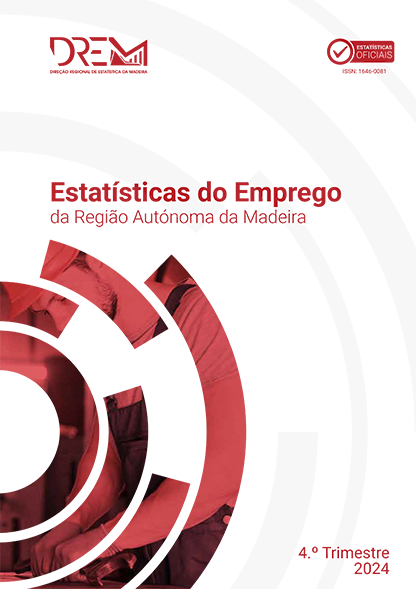
Quarterly publication
Price: paper- 2,00 € / PDF - Free
Year of publication: 2025
Reference period: 4th Quarter 2024
-

Annual publication
Price: paper - 4,00 € / PDF - Free
Year of publication: 2024
Reference period: 2023

Agriculture and Fishery Statistics
Annual publication
Price: paper - 3,50 € / PDF - Free
Year of publication: 2024
Reference period: 2023
-

Annual publication
Price: paper - 12,00 € / PDF - Free
Year of publication: 2021
Reference period: 2019

Construction and Housing Statistics
Annual publication
Price: paper - 4,50 € / PDF - Free
Year of publication: 2024
Reference period: 2023
:: Publicações ::
-
Annual publication
Price: paper - 3,50 € / PDF - Free
Year of publication: 2024
Reference period: 2023
-

Annual publication
Price: paper - 22,00 € / PDF - Free
Year of publication: 2023
Reference period: 2022
-

Monthly publication
Price: paper - 1,50 € / PDF - Free
Year of publication: 2025
Reference period: May 2025
-
Annual publication
Price: paper - 10,00 € / PDF - Free
Year of publication: 2024
Reference period: 2023
-
International Trade Statistics
Annual publication
Price: paper - 6,00 € / PDF - Free
Year of publication: 2021
Reference period: 2020
-
Annual publication
Price: paper - 4,00 € / PDF - Free
Year of publication: 2024
Reference period: 2023
-
Annual publication
Price: paper - 12,00 € / PDF - Free
Year of publication: 2021
Reference period: 2019
-
Quarterly Bulletin of Statistics
Quarterly publication
Price: paper - 4,00 € / PDF - Free
Year of publication: 2025
Reference period: 2nd Quarter 2025
-
Census - Final results. Autonomous Region of Madeira - 2021
Annual publication
Price: paper - 10,00 € / PDF - Free
Year of publication: 2023
Reference period: 2021
-
Construction and Housing Statistics
Annual publication
Price: paper - 4,50 € / PDF - Free
Year of publication: 2023
Reference period: 2022
-
Agriculture and Fishery Statistics
Annual publication
Price: paper - 3,50 € / PDF - Free
Year of publication: 2024
Reference period: 2023
-
Quarterly publication
Price: paper - 2,00 € / PDF - Free
Year of publication: 2026
Reference period: 1st Quarter 2026
-
Annual publication
Price: paper - 12,00 € / PDF - Free
Year of publication: 2024
Reference period: 2022
-
Monthly publication
Price: paper - 3,00 € / PDF - Free
Year of publication: 2025
Reference period: December 2024
For the period 2020-2022
DREM releases final data from the Community Innovation Survey
The Regional Directorate of Statistics of Madeira (DREM) has released today the final data from the Community Innovation Survey (CIS) for the period 2020-2022, providing insights into business innovation within the Autonomous Region of Madeira.
Below is a summary of the key findings derived from the aforementioned data.
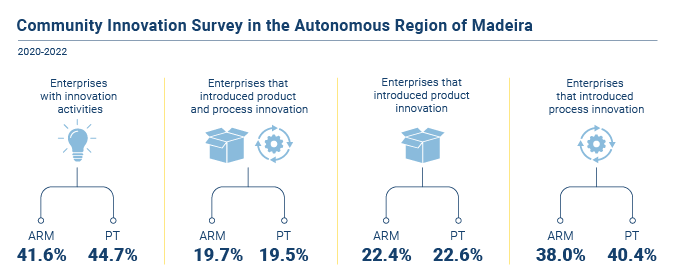
In the 2020-2022 triennium, 41.6% of enterprises with more than 10 employees based in the Autonomous Region of Madeira engaged in some form of innovation activity
During the period 2020-2022, 41.6% of enterprises with 10 or more employees based in the Autonomous Region of Madeira engaged in some form of innovation activity, compared to 42.6% in the 2018-2020 period and 33.5% in the 2016-2018 period. These activities included product or process innovation, ongoing innovation efforts up to the end of 2022, innovation activities that were abandoned or suspended, research and development (R&D) conducted internally either continuously or occasionally, as well as R&D contracted to other enterprises (including those within the same group) or to public or private research organisations. Nationally, this indicator stood at 44.7% (48.0% between 2018-2020 and 32.4% between 2016-2018).
At the NUTS 2 level, it is noteworthy that during the 2020-2022 period, the regions with the highest percentage of innovative enterprises were Grande Lisboa and Centro, with 50.0% and 45.8%, respectively. Conversely, the Autonomous Region of the Azores (40.5%) and Alentejo (41.5%) recorded the lowest percentages. At the NUTS 1 level, and compared to the previous period, both the mainland and autonomous regions experienced decreases, with the declines being more pronounced on the mainland and in the Autonomous Region of the Azores (-3.4 percentage points and -3.2 percentage points, respectively), and less so in the Autonomous Region of Madeira (-1.0 percentage point).
During the 2020-2022 triennium, 22.4% of enterprises with 10 or more employees based in the ARM introduced product innovations (new or improved), representing a slight increase of 0.5 percentage points compared to 2018-2020 (21.9%) and a decrease of 3.7 percentage points compared to the 2016-2018 period (26.1%). Nationally, this percentage was slightly higher, at 22.6% (+0.3 percentage points compared to 2018-2020).
The proportion of enterprises that introduced process innovation was 38.0%, a decrease of 2.3 percentage points compared to 2018-2020 (40.3%) and an increase of 7.4 percentage points compared to the 2016-2018 triennium (30.6%). Nationally, this proportion was higher, at 40.4%, although the changes observed were very close to those in the ARM.
In 2022, expenditure on innovation activities totalled 18.7 million euros, representing 0.6% of the total recorded for Portugal (3,382.4 million euros). Of this amount, 65.8% corresponded to other innovation expenses (12.3 million euros), 30.2% to intramural R&D expenses (5.6 million euros), and 4.0% to extramural R&D expenses (0.7 million euros). Compared to 2020, there was a decrease of 4.1 million euros in total expenditure on innovation activities, influenced by a reduction of 3.9 million euros in intramural R&D expenses and a decrease of 1.7 million euros in extramural R&D expenses.
Between 2020 and 2022, among the factors related to climate change affecting businesses, the increase in costs or prices of production factors resulting from climate change was the most prominent, with 15.4% of enterprises rating it as highly important (18.7% for all national enterprises).
In 2022, 11.5% of enterprises had more than 50% of their employees with higher education qualifications, the majority of which were innovative enterprises (7.7%). In the same year, 27.2% of enterprises had no employees with higher education qualifications, of which 6.2% were innovative enterprises.
For more information, please click on:
International Statistical Cooperation
 |
International Statistical Cooperation
|
Statistical Literacy
 |
Statistical Literacy
|





|
|
|
|
 |
 |
|


 |
|
|
 |

Copyright © 2026 Direção Regional de Estatística da Madeira. All rights reserved.
Address: Calçada de Santa Clara 38, 9004-545 Funchal, Madeira Island
Phone: +351 291 145 126 (National landline call)