











Newsletters
Subscribe to our newsletter and get statistical data as soon as it is available!...
:: Statistical Indicators ::
- Resident Population
- Natural Balance
- Unemployment
- GDP
- RIEAI
- Inflation
- Overnight Stays
- Dwelling Sales
- Companies
|
Resident Population Resident Population Estimates (31 December). |
|
2025, Resident Population Estimates based entirely on administrative data. 2021 - 2024, Revised Resident Population Estimates following the compilation of the 2025 Resident Population Estimates, based entirely on administrative data. Source: Statistics Portugal/DREM - Demographic Statistics |
|
Unemployment Rate Quarterly rate obtained from the Labour Force Survey, corresponding to the ratio of the unemployed population to the active population (%). |
|
Source: Statistics Portugal/DREM - Labour Force Survey |
|
Inflation Rate Average Rate of Change over the last 12 months of the Consumer Price Index (%). |
|
Source: Statistics Portugal/DREM - Consumer Price Index |
|
Overnight Stays Overnight stays recorded in total collective tourist accommodation (thousands). |
|
Source: Statistics Portugal/DREM - Tourism Statistics |
|
GDP Gross Domestic Product (GDP) of the Autonomous Region of Madeira at current prices, base 2021 (million euros). |
|
The value for 2024 is provisional. Source: Statistics Portugal - Regional Accounts (Base 2021) |
|
Family Dwelling Sales Number of Family Dwelling Sales (Total, New and Existing) in the Autonomous Region of Madeira. |
|
Source: Statistics Portugal (INE, IP.). |
|
Company Incorporation and Dissolution Number of companies incorporated and dissolved. |
|
Source: Directorate-General for Justice Policy |
|
Natural Balance Difference between the number of live births and the number of deaths in a given period of time (No.). |
|
* Preliminary data compiled up until June 5th 2026. Source: Statistics Portugal/DREM - Demographic Statistics |
|
Regional Indicator of Economic Activity 3-month moving average (%). |
|
Source: DREM |
:: Statistical Indicators ::
|
Population Resident Population estimates by the 31st of December. |
|
2025, Resident Population Estimates based entirely on administrative data. 2021 - 2024, Revised Resident Population Estimates following the compilation of the 2025 Resident Population Estimates, based entirely on administrative data. Source: INE/DREM - Demographic Statistics |
|
Unemployment Rate Quarterly rate derived from the Labour Fource Survey, which corresponds to the ratio between the unemployed and the active population(%). |
|
Source: INE/DREM - Labour Force Survey |
|
Inflation Rate 12-month average growth rate of the Consumer Price Index. |
|
Source: INE/DREM - Consumer Price Index |
|
Overnight stays Overnight stays in tourism accommodation (thousands). |
|
Source: INE/DREM - Tourism Statistics |
|
GDP Gross Domestic Product (GDP) of the Autonomous Region of Madeira at current prices, base 2021 (millions of euros). |
|
The value for 2024 is provisional. Source: INE - Regional Accounts (Base 2021) |
|
Dwelling Sales Number of Dwelling Sales (Total, New e Existing), in the Autonomous Region of Madeira. |
|
Source: Statistics Portugal |
|
Formation and Dissolution of Companies Number of formed and dissolved companies. |
|
Source: Directorate-General for Justice Policy |
|
Natural Change Balance between the number of live births and the number of deaths in a given time period (No.). |
|
* Preliminary data compiled up until May 8th, 2026. Source: INE/DREM - Demographic Statistics |
|
Regional Indicator of Economic Activity 3-month moving average (%). |
|
Source: DREM |
:: Publications ::
-

Annual publication
Price: papel - 3,50 € / PDF - Free
Year of publication: 2024
Reference period: 2023
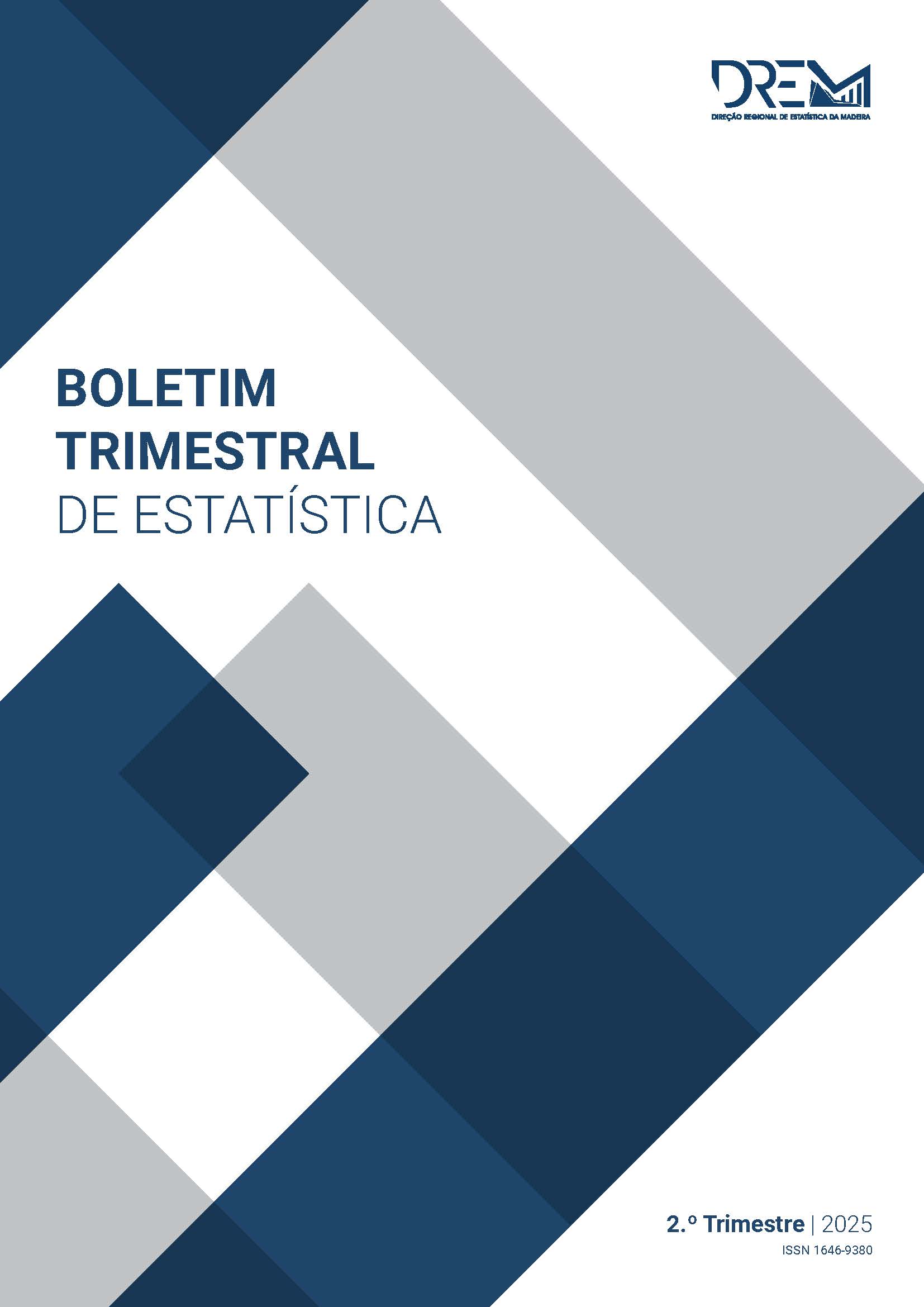
Quarterly Bulletin of Statistics
Quarterly publication
Price: paper - 4,00 € / PDF - Free
Year of publication: 2025
Reference period: 2nd Quarter 2025
-
Annual publication
Price: paper - 22,00 € / PDF - Free
Year of publication: 2024
Reference period: 2023

Census - Final results: Autonomous Region of Madeira - 2021
Annual publication
Price: paper - 10,00 € / PDF - Free
Year of publication: 2023
Reference period: 2021
-

Annual publication
Price: PDF - Free
Year of publication: 2026
Reference period: 2025

Monthly publication
Price: paper - 3,00 € / PDF - Free
Year of publication: 2025
Reference period: December 2024
-
Annual publication
Price: paper - 10,00 € / PDF - Free
Year of publication: 2024
Reference period: 2023

Annual publication
Price: paper- 12,00 € / PDF - Free
Year of publication: 2026
Reference period: 2024
-

International Trade Statistics
Annual publication
Price: paper- 6,00 € / PDF - Free
Year of publication: 2021
Reference period: 2020

Quarterly publication
Price: paper- 2,00 € / PDF - Free
Year of publication: 2025
Reference period: 4th Quarter 2024
-

Annual publication
Price: paper - 4,00 € / PDF - Free
Year of publication: 2024
Reference period: 2023

Agriculture and Fishery Statistics
Annual publication
Price: paper - 3,50 € / PDF - Free
Year of publication: 2024
Reference period: 2023
-

Annual publication
Price: paper - 12,00 € / PDF - Free
Year of publication: 2021
Reference period: 2019

Construction and Housing Statistics
Annual publication
Price: paper - 4,50 € / PDF - Free
Year of publication: 2024
Reference period: 2023
:: Publicações ::
-
Annual publication
Price: paper - 3,50 € / PDF - Free
Year of publication: 2024
Reference period: 2023
-

Annual publication
Price: paper - 22,00 € / PDF - Free
Year of publication: 2023
Reference period: 2022
-

Monthly publication
Price: paper - 1,50 € / PDF - Free
Year of publication: 2025
Reference period: May 2025
-
Annual publication
Price: paper - 10,00 € / PDF - Free
Year of publication: 2024
Reference period: 2023
-
International Trade Statistics
Annual publication
Price: paper - 6,00 € / PDF - Free
Year of publication: 2021
Reference period: 2020
-
Annual publication
Price: paper - 4,00 € / PDF - Free
Year of publication: 2024
Reference period: 2023
-
Annual publication
Price: paper - 12,00 € / PDF - Free
Year of publication: 2021
Reference period: 2019
-
Quarterly Bulletin of Statistics
Quarterly publication
Price: paper - 4,00 € / PDF - Free
Year of publication: 2025
Reference period: 2nd Quarter 2025
-
Census - Final results. Autonomous Region of Madeira - 2021
Annual publication
Price: paper - 10,00 € / PDF - Free
Year of publication: 2023
Reference period: 2021
-
Construction and Housing Statistics
Annual publication
Price: paper - 4,50 € / PDF - Free
Year of publication: 2023
Reference period: 2022
-
Agriculture and Fishery Statistics
Annual publication
Price: paper - 3,50 € / PDF - Free
Year of publication: 2024
Reference period: 2023
-
Quarterly publication
Price: paper - 2,00 € / PDF - Free
Year of publication: 2026
Reference period: 1st Quarter 2026
-
Annual publication
Price: paper - 12,00 € / PDF - Free
Year of publication: 2024
Reference period: 2022
-
Monthly publication
Price: paper - 3,00 € / PDF - Free
Year of publication: 2025
Reference period: December 2024
DREM releases income statistics for the 2015-2017 period based on the Personal Income Tax (IRS) return
The Regional Directorate of Statistics of Madeira (DREM) releases, for the first time, a set of regional information based on anonymised fiscal data from the Portuguese Tax and Customs Authority (AT). These data is related with the settlement note of Personal Income Tax (IRS - Modelo 3), obtained under an agreement between Statistics Portugal (INE) and AT. The information refers to the 2015-2017 period and is broken down by municipality.
In this study - which will be updated annually by DREM - several indicators related to the gross reported income (per se or excluding the tax paid) are released, by tax household or taxable person and also some variables that allow to assess income inequality (S80/S20 ratio and Gini coefficient).
Median value of gross reported income minus income tax paid by taxable person in the Region and country is similar
In 2017, 112,219 tax households and 156,537 taxable persons were recorded in the Region. Both variables grew in 2016 and 2017.
In the same year, the gross reported income in the Autonomous Region of Madeira (ARM) was around 1,885 million euros, while the gross reported income minus income tax paid amounted to 1,675 million euros, showing an average annual growth rate between 2015 and 2017 of 3.0% (2.7% in the country).
In 2017, the average gross reported income minus income tax paid by taxable person was € 10,701, while the median was € 8,673. At the national level the average was 10 954 €, while the median was only 14 euros higher than the regional average (8 687 €).
In the context of the 7 NUTS2 regions, the Autonomous Region of Madeira is behind A.M. Lisbon, the region with the highest median (10 397 €), which stands out quite apart from the other regions while Norte has the lowest median (€ 8,049). Between ARM (2nd region, with 8 673 €) and Algarve (6th region, with 8 481 €) the medians are relatively close.
Main indicators of income inequality in the Region are similar to the country’s
The S80/S20 ratio, which corresponds to the ratio between the total income of the 20% with the highest income and the income earned by the 20% with the lowest income, stands at 3.1, meaning the income of the richest 20% is 3.1 times higher than that of the poorest 20%. The national average is 3.0, and by region, A.R. Azores has the highest ratio (3.2), followed by the A.M. Lisbon and ARM (3.1). The region with the lowest inequality according to this indicator is Alentejo (2.6).
The Gini coefficient is also an indicator of inequality in income distribution, which aims to summarize the asymmetry of this distribution in a single value. It varies between 0% (when all taxable persons have the same income) and 100% (when all income is concentrated in a single taxable person).
In 2017, the regional Gini coefficient of gross reported income minus income tax paid by taxable person was 26.7%, the same as in the country. By region, Alentejo (23.9%) and Centro (24.8%) had the lowest Gini coefficients, while AR Azores (28.1%) and A.M. Lisbon (27.7%) showed the highest values. ARM was the 3rd region with the highest Gini coefficient.
International Statistical Cooperation
 |
International Statistical Cooperation
|
Statistical Literacy
 |
Statistical Literacy
|





|
|
|
|
 |
 |
|


 |
|
|
 |

Copyright © 2026 Direção Regional de Estatística da Madeira. All rights reserved.
Address: Calçada de Santa Clara 38, 9004-545 Funchal, Madeira Island
Phone: +351 291 145 126 (National landline call)