










Newsletters
Subscribe to our newsletter and get statistical data as soon as it is available!...
DREM releases Demography data concerning the final results of the Census 2021 for the period 2011-2021
The Regional Directorate of Statistics of Madeira (DREM) makes available today revised Demographic data for the period 2011-2021 based on the final results of the Census 2021. You can navigate the Demography dashboard, now expanded with new interactive graphics and cartograms, and also with greater temporal and geographical breakdown, displaying several demographic indicators depending on the year and municipality of the Region.
The publication "Demographic Statistics of the Autonomous Region of Madeira 2021" will be released on the DREM website very soon and the time series of Demography will be updated with the Final Estimates of Resident Population 2011-2020 and the Provisional Estimates of Resident Population 2021, revised according to the final results of the Census 2021.
The main results are the following:
Resident Population – Population increased in 2021
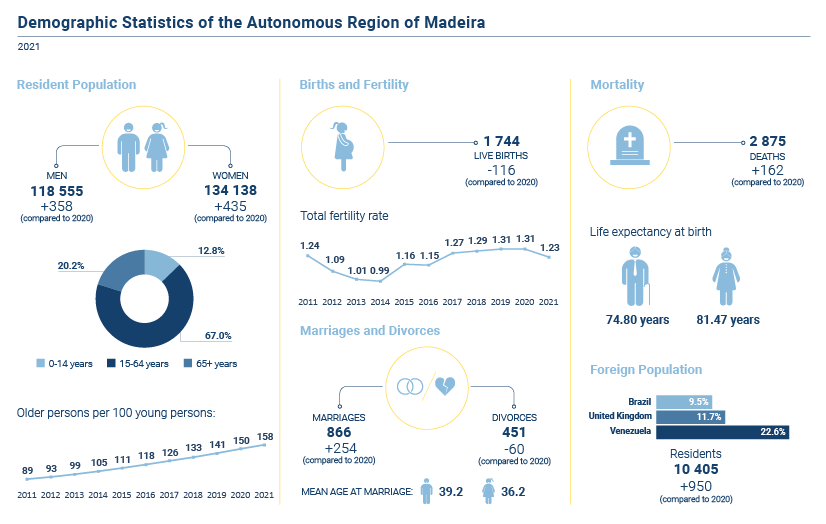
- In 2021, the resident population in the Autonomous Region of Madeira was estimated at 252,693 (118,555 men and 134,138 women), representing an increase of 793 persons compared to 2020.
- The crude rate of increase was +3.1‰ (+4.7‰ in 2020), the result of a positive crude migratory rate (+7.6%) that overlapped the negative natural growth rate (- 4.5‰).
- The proportion of the youth population (population under 15 years old) continued to shrink, representing 12.8% of the total population (13.2% in 2020).
- The proportion of elderly (population aged 65 and over) also maintained the upward trend of the previous years, reaching 20.2% of the resident population (19.7% in 2020).
- As a result, the ageing ratio continued to rise, showing no signs of slowing down and standing at the highest value ever recorded: 158 older persons per 100 young persons (150 in 2020).
Births and Fertility – Low number of live births puts the Autonomous Region of Madeira far from the generations’ replacement threshold
- In 2021, there were 1,744 live births, children of mothers residing in the Autonomous Region of Madeira, 6.2% fewer (116 children) than in 2020, which corresponds to a crude birth rate of 6.9 live births per 1,000 inhabitants, lower than in 2020 (7.4 live births per 1,000 inhabitants).
- The total fertility rate dropped from 1.31 children per woman in their child-bearing years (15-49 years) in 2020 to 1.23 in 2021, remaining considerably below the generations replacement threshold (2.1 children born per woman).
- The mean age of mothers at birth of first child increased from 30.4 years in 2020 to 30.8 years in 2021. The mean age at birth of a child (regardless of birth order) increased slightly from 32.1 years to 32.3 years.
- Around 64% of the live births were born outside of the marriage, 41.3% with cohabiting parents and 22.8% without.
Mortality – Number of deaths in 2021 increased from the previous year
- 2,875 deaths were counted in 2021, in the Autonomous Region of Madeira, up by 162 from 2020 (+6.0%). The crude death rate was 11.4% deaths per 1,000 inhabitants (10.8‰ in 2020).
- The number of deaths was higher in the Winter months (267 deaths, on average) and lower in the Summer months (213 deaths, on average).
- In the year of reference, 6 deaths of children under 1 year of age were registered, the same amount as the previous year.
- The infant mortality rate was 3.4‰, increasing compared to the value recorded in 2020 (3.2‰).
- In the 2019-2021 triennium, the average life expectancy at birth for the population of the Autonomous Region of Madeira stood at 78.55 years: 74.80 years for men and 81.47 years for women.
- The average life expectancy at age 65 for the total population was 17.76 years: Men aged 65 can expect to live an average of 15.06 years longer and women an average of 19.55 years longer.
Marriages and Divorces
Marriages – Number of marriages celebrated in 2021 increased compared to the previous year
- In 2021, 866 marriages were celebrated, representing an increase of 41.5% over the previous year (+254 marriages).
- The crude marriage rate increased from 2.4‰ in 2020 to 3.4‰ in 2021.
- There were 30 same-sex marriages (19 in 2020), 13 between men and 17 between women.
- The highest number of marriages was registered in September (135) and the lowest was in February (28).
- The mean age at marriage decreased compared to 2020, standing at 39.2 years for men and 36.2 for women (40.0 and 36.8 years, respectively, in 2020).
- 65.2% of the celebrated marriages were “first marriages” (both spouses were single).
- 76.8% of marriages between persons of the opposite sex were civil and 23.2% were catholic.
- In 70.9% of marriages performed in 2021, the bride and groom already had a common previous residence.
Divorces – Number of divorces was the lowest in the last 20 years
- In 2021, 451 divorces were decreed - down by 60 from 2020 - corresponding to a crude divorce rate of 1.8‰.
- Of the decreed divorces, all concern divorces between persons of the opposite sex.
- The mean age at divorce was 48.0 years for men and 45.4 for women.
- Of the total divorces, only 27.1% resulted from marriages lasting more than 24 years.
Foreign Population – Foreigners residing in the Region hit a maximum in the last 13 years
- According to the Immigration and Borders Service (SEF), on December 31st, 2021, the foreign population with resident status in the Autonomous Region of Madeira reached 10,405 persons, representing an increase of 10.0% from 2020. The overall foreign population is the total residence permits (10,405) since there was no registration of long-stay visas.
- The Venezuelan (22.6%), British (11.7%), Brazilian (9.5%), and German (8.5%) nationalities remain the largest foreign communities residing in the Region.
- There was a growth in the number of foreigners residing in the Region holding a residence permit with German and Brasilian nationalities, representing an increase of 42.5% (from 623 in 2020 to 888 in 2021) and 10.3% (from 895 in 2020 to 987 in 2021), respectively.
International Statistical Cooperation
 |
International Statistical Cooperation
|
Statistical Literacy
 |
Statistical Literacy
|
|
|
|
|
 |
 |
|


 |
|
|
 |

Copyright © 2026 Direção Regional de Estatística da Madeira. All rights reserved.
Address: Calçada de Santa Clara 38, 9004-545 Funchal, Madeira Island
Phone: +351 291 145 126 (National landline call)