











Newsletters
Subscribe to our newsletter and get statistical data as soon as it is available!...
In the 1st quarter of 2023
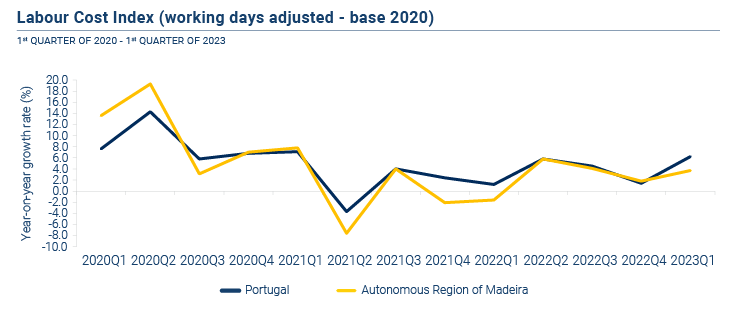
Labour Cost Index (ICT) in the Autonomous Region of Madeira increased by 3.7% compared to the same quarter last year
With this publication, the Regional Directorate of Statistics of Madeira (DREM) presents the time series of the Labour Cost Index, both quarterly and annually, recalculated for the year 2020 (2020=100), following the procedure adopted by Eurostat for the Labour Cost Index whenever more up-to-date information from the quadrennial Survey on the Cost of Labour becomes available.
In the 1st quarter of 2023, the ICT (adjusted for working days) in the Autonomous Region of Madeira recorded a 3.7% increase compared to the 1st quarter of 2022. This increase is the combined result of changes in its two main components:
- Wage costs (per hour actually worked), increased by 3.4% compared to the same quarter of the previous year.
Wage costs include base salary, regular bonuses and allowances, irregular bonuses and allowances (holiday allowance, Christmas allowance, end-of-year bonuses/profit sharing, other irregular bonuses and allowances), payment for overtime work, and in-kind payments.
- Other costs (non-wage, also per hour actually worked), showed a year-on-year increase of 5.1%.
Other costs include severance pay, legal charges borne by the employer (employer's contribution to Social Security, accident insurance, and occupational diseases), conventional, contractual, and optional charges (supplementary pension/disability benefits, health insurance, life/personal accident insurance, social benefits paid directly to the worker in case of absence due to illness).
At the national level, the value of the index registered a higher year-on-year increase of +6.2%: +5.9% in wage costs and +7.3% in other costs.
During this quarter, both at the national and regional levels, non-wage costs experienced higher changes compared to wage costs. This can be attributed to the normalisation of employer contribution payments by companies that, during the COVID-19 pandemic, participated in the simplified layoff scheme, the Extraordinary Support for Progressive Recovery, or the New Incentive for Business Activity Normalisation, which exempted or partially exempted them from paying employer contributions. Starting from the 2nd quarter of 2021, the payment of employer contributions gradually resumed, and in the 1st quarter of 2022, a certain number of employers still benefited from these measures, which is reflected in the year-on-year changes analysed.
For more information, please click on:
International Statistical Cooperation
 |
International Statistical Cooperation
|
Statistical Literacy
 |
Statistical Literacy
|
|
|
|
|
 |
 |
|


 |
|
|
 |

Copyright © 2026 Direção Regional de Estatística da Madeira. All rights reserved.
Address: Calçada de Santa Clara 38, 9004-545 Funchal, Madeira Island
Phone: +351 291 145 126 (National landline call)