











Newsletters
Subscribe to our newsletter and get statistical data as soon as it is available!...
For the period 1995-2023
Regional Directorate of Statistics of Madeira publishes information on Investment and Household Accounts
The Regional Directorate of Statistics of Madeira (DREM) is releasing today an update of Information relating to some indicators of the Regional Accounts (2021 basis) – particularly Gross Fixed Capital Formation (GFCF) and Household Accounts – for the Autonomous Region of Madeira (ARM). Data on GFCF and on households’ Primary and Disposable Income are now available for the period 1995–2023, while for the detailed annual Household Accounts (Allocation of Primary Income Account and Secondary Distribution of Income Account), the information available according to the 2021 benchmark refers to the period from 2016 to 2023.
It should be noted that until now, only data from 2021 to 2023 were available, with Statistics Portugal (INE) – the entity responsible for producing National and Regional Accounts – having not only revised some of the values for this period but also carried out a back casting exercise for earlier periods.
Investment peaked in 2004 and had its minimum value in 2013
The analysis of GFCF between 1995 and 2023 shows strong variability in this macroeconomic indicator.
In the period between 1999 and 2005, GFCF reached its highest levels in the Region. The peak was recorded in 2004 (1 849.6 million euros), followed by 2005 (1 849.4 million euros), 2000 (1 776.4 million euros), and 2002 (1 572.4 million euros). These, along with 1999 (1 516.9 million euros), were the only years in which GFCF in the Autonomous Region of Madeira (ARM) exceeded the 1 500 million mark. In the period 2006-2011, GFCF values stabilised around 1 200 million euros.
This was followed by a period in which the Economic and Financial Adjustment Programme (PAEF), applied to the ARM, significantly impacted investment, particularly public investment. Between 2011 and 2012, GFCF fell by almost half, not exceeding 571.3 million euros in the latter year. Until 2016, GFCF remained within this level, but from 2017 onwards, it began to show an upward trend that continued until 2023, the year in which it reached 1 203.5 million euros, the highest value since 2010.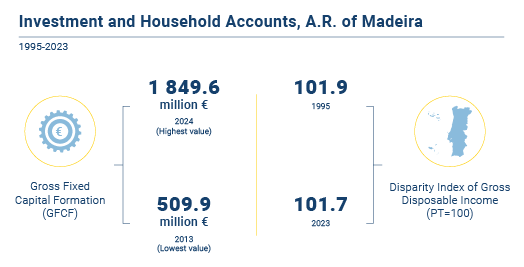
Gross Disposable Income of Households per capita was kept close to the national average
Informally, Gross Disposable Income (GDI) of Households is the total amount of money that households have available to spend and save after deducting income taxes and social security contributions. Disposable income increases with the receipt of income, such as wages, interest or pensions, and decreases with the payment of taxes, social security contributions and other charges that reduce the family budget.
In the Autonomous Region of Madeira (ARM), the value of GDI of households per capita in 1995 was 6 653 euros, 1.9% higher than the national average. Between 1995 and 2009, the regional value always exceeded the national average, with the exception of the year 2000 (0.6% below). Between 2010 and 2015, the Region observed a GDI per capita that was consistently lower than the national average, with the largest difference observed in 2015 (3.6% lower).
Between 2016 and 2018, the Autonomous Region of Madeira (ARM) again surpassed the national average, by a very slight margin, before falling below it again in the following four years.
In 2023, the GDI per capita was higher in the Region (17 068 euros) than in the country as a whole (16 785 euros), meaning it was 1.7% above the national average.
For more information, please click on:
International Statistical Cooperation
 |
International Statistical Cooperation
|
Statistical Literacy
 |
Statistical Literacy
|
|
|
|
|
 |
 |
|


 |
|
|
 |

Copyright © 2026 Direção Regional de Estatística da Madeira. All rights reserved.
Address: Calçada de Santa Clara 38, 9004-545 Funchal, Madeira Island
Phone: +351 291 145 126 (National landline call)