






Newsletters
Subscribe to our newsletter and get statistical data as soon as it is available!...
In 2019
For the first time, the enterprises concentrated the largest share of Research and Development (R&D) expenditure in the Autonomous Region of Madeira
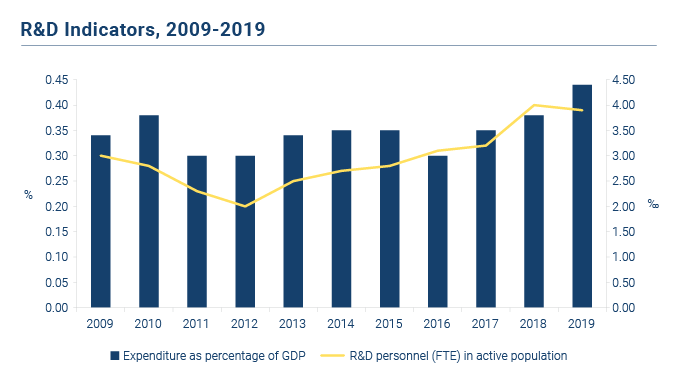
In the reference year, the share of research and development (R&D) expenditure in the Gross Domestic Product (GDP) of the Autonomous Region of Madeira (ARM) was 0.44%, 0.06 percentage points (pp) above the share of 2018, a year in which this indicator stood at 0.38%. It should be noted that this is the highest value ever for this indicator, whose time series begins in 2010. When compared with other regions of the country, the data show that the two Autonomous Regions of Azores and Madeira and the region of Algarve have similar results in this metric, standing below the national average. In 2019, the expenditure on R&D in the Portuguese GDP was 1.40%, while the Autonomous Region of Azores, with 0.30% and the Algarve, with 0.41% had a percentage below the Autonomous Region of Madeira. The Metropolitan Area of Lisbon (1.69%) and Norte (1.53%) appear as the regions with the best performance in this indicator. It is of note that all regions recorded an increase in this indicator, with the exception of the Autonomous Region of Azores (-0.02 pp).
The proportion of full-time equivalent R&D personnel in the active population, in 2019, was 3.90 for 1,000 active persons, representing a slight decrease from the previous year (4.00 ‰). In turn, the ratio for researchers was 0.30%, the same value as the previous year.
In 2019, a total of 66 research units were active, in the Autonomous Region of Madeira, employing 535 people (in full-time equivalent). The majority of the personnel worked in Higher Education (38.6%), followed by Enterprises (36.6%) and in the State (24.8%), where the Regional and Local Administrations are also included.
R&D expenditure amounted to 22.3 million euros, in 2019, up by 17.4% (19.0 million euros) from 2018. In the year of reference, the enterprises lead the R&D activities in the Autonomous Region of Madeira, accounting for 41.2% of the total expenditure in those types of activities, followed by Higher Education (34.3%) and the State (24.5%). It should be underlined that since the beginning of the series it is the first time that enterprises concentrate the largest share of R&D expenditure, instead of Higher Education.
In all years of the series with available data, the State was the main source of financing R&D expenditure in the Autonomous Region of Madeira, concentrating more than half (55.1%) of the total in 2019, followed by the enterprises with 33.6%. The State funding stood at 12.3 million euros, down by 0.4% from 2018.
In 2019, the scientific or technological area where more R&D expenditure in the Autonomous Region of Madeira were, for the first time, the engineering and technology sciences, something which happened for the first time. Since 2011, the social sciences, humanities and arts had stood out in relation to the other areas, a circumstance which didn´t happen in the year of reference.
In fact, in 2019, expenditure on R&D in the engineering and technology scientific area was 3.3 million euros, followed by social sciences, humanities and the arts, with 3.0 million euros and natural sciences, with 2.3 million euros.
In the 2016-2018 period, 33.5% of the enterprises headquartered in the Autonomous Region of Madeira, with 10 or more persons at work, had innovation activities, a percentage which stands above the country (32,4%) by 1.1 pp. As for the innovation intensity of the Region’s enterprises - an indicator that corresponds to the percentage of total innovation expenditure in the turnover of companies that declared innovation expenditure - it stood at 3.2% in the 2016-2018 period, also 1.7 pp above the country (1.5%).
International Statistical Cooperation
 |
International Statistical Cooperation
|
Statistical Literacy
 |
Statistical Literacy
|
|
|
|
|
 |
 |
|



 |
|
|
 |

Copyright © 2026 Direção Regional de Estatística da Madeira. All rights reserved.
Address: Calçada de Santa Clara 38, 9004-545 Funchal, Madeira Island
Phone: +351 291 145 110 (National landline call)