











Newsletters
Subscribe to our newsletter and get statistical data as soon as it is available!...
In February 2024
Regional economy maintained growth, though slowing down
The Regional Indicator of Economic Activity (RIEA) suggests that in February 2024, regional economic activity maintained a positive growth trajectory, although at a slower rate compared to the previous month.
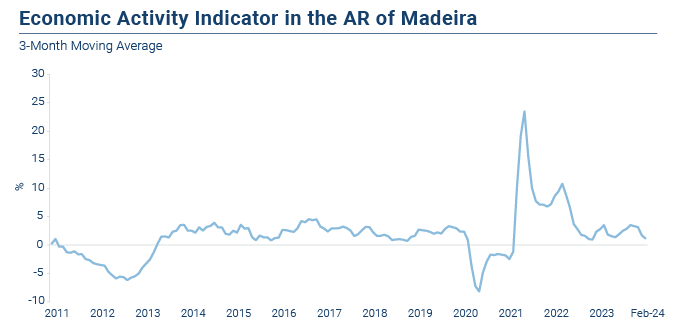
As previously mentioned by DREM in the initial release of the RIEA in October 2017, its purpose is "to signal the behaviour of economic activity, particularly with regard to its direction and the magnitude of fluctuations: whether it is in positive or negative territory, accelerations, decelerations, and the identification of turning points." Therefore, its quantitative value assumes secondary importance and should not be seen as a substitute for the actual change of the Gross Domestic Product, which is determined with a more varied and comprehensive set of statistical information, despite the strong correlation between the two variables.
Economic Overview for February 2024 - 7 Key Themes
The Regional Directorate of Statistics of Madeira (DREM) presents a concise analysis of the main short-term indicators, divided into themes, noting that many of the changes mentioned are in three-month moving averages, a common technique in economic bulletins to smooth out irregularities and show the trend. It is also noteworthy that following DREM's initial release of the qualitative survey results on 29th April of the current year, particularly confidence indicators, this information is now integrated into this Economic Overview
Economic Activity
As previously mentioned, the regional economic activity in February 2024, although growing, slowed compared to the previous month.
The performance of the tourism sector contributed to economic growth, as overnight stays (excluding local accommodation with fewer than 10 beds) increased by 0.7% this month, albeit lower than the 1.1% recorded in the previous January. It is also noteworthy that total revenue in the tourist accommodation sector increased by 10.4% (12.8% in January).
The electricity distribution, an indicator typically associated with economic activity, grew by 2.0% in February 2024, the same growth rate as the previous month. The diesel released for consumption increased by 0.4%, well above the 0.8% decline observed in the previous January.
Analysing the relationship between incorporated and dissolved companies, it is observed that in February 2024, 1.9 new companies were created for every company dissolved in the region, a slightly higher ratio than the previous month (1.8).
Qualitative Indicators
Short-term qualitative indicators available for February 2024 show increases compared to the previous month in trade and services sectors, and decreases in manufacturing and construction.
Private Consumption
One of the revealing indicators of the evolution of private consumption refers to operations of the SIBS network, with cards issued by national banks. Observing the total amounts withdrawn from ATMs and purchases made through automatic payment terminals with national cards, there was a 7.4% growth in February 2024, reversing the deceleration that began in October last year.
The gasoline released for consumption accelerated, with the year-on-year change growing by 9.6% in February 2024, compared to 7.9% in January. On the other hand, purchases of new light passenger vehicles by residents decreased by 5.3% (+3.6% in the previous month). The balance of consumer loans granted to households and nonprofit institutions serving households decreased by 14.9% in February 2024, compared to a 15.1% decrease in the previous month.
Investment
Regarding Investment, the indicators are divided into two groups: those showing positive signals, such as sales of light commercial vehicles (10.2%; 94.6% in the previous January), housing bank appraisals (17.9%; 17.2% in the previous month), building permits (18.2%; 9.6% in the previous month), and cement sales (5.4%; 6.7% in the previous January); and those in decline, such as loans granted to households for housing (-0.9%, -1.2% in the previous January) and the balance of loans granted to non-financial corporations (-3.9%; -4.4% in January 2024)
External Demand
Although trade with foreign countries represents only a small portion of the region's global trade (most of which is with the mainland), it is important to note that both exports (-5.9%) and imports of goods (-27.6%) decreased. Cargo movement in ports (0.0%; 9.1% in the previous month), which is a broader indicator of foreign trade dynamics, dropped. In other indicators, in February 2024, it is observed that the slowdown in passenger movement at airports (2.8%; 4.8% in the previous January) is in line with the evolution of total withdrawals from ATMs and purchases through automatic payment terminals with international cards (9.7%; 11.6% in the previous month)
Labour Market
Data from the entities responsible for the employment area in the Country and the Region show that in February 2024, there were reductions in job offers (-34.8%), job applications (-2.7%), and also in the number of unemployed registered throughout the month (-4.0%).
Prices
In February 2024, the year-on-year inflation rate, which stood at 2.8%, slowed compared to the previous month (3.0%), being lower in Goods (1.5%) and higher in Services (4.7%). The underlying inflation (excluding unprocessed food and energy products) was 2.8%.
For further information, please refer to:
International Statistical Cooperation
 |
International Statistical Cooperation
|
Statistical Literacy
 |
Statistical Literacy
|
|
|
|
|
 |
 |
|



 |
|
|
 |

Copyright © 2026 Direção Regional de Estatística da Madeira. All rights reserved.
Privacy policy | Cookie Notice
Address: Calçada de Santa Clara 38, 9004-545 Funchal, Madeira Island
Phone: +351 291 145 110 (National landline call)