










Newsletters
Subscribe to our newsletter and get statistical data as soon as it is available!...
Regional Directorate of Statistics of Madeira is joining the celebration of the International Day of Education
The Regional Directorate of Statistics of Madeira (DREM) is joining the celebration of the International Day of Education by releasing a brief analysis of statistical indicators related to the evolution of the educational system in the Region. The analysis also characterises the level of education of the resident population in the Autonomous Region of Madeira (ARM) and its correlation with the labour market. The underlying data comes from various sources, including the ARM Education Observatory (OERAM), the Directorate-General of Education and Science Statistics (DGEEC), Statistics Portugal(INE), and DREM.
The regional education system
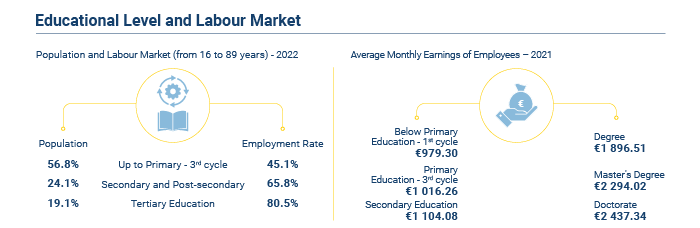
- Over the past 10 years, there has been a decreasing trend in the number of educational institutions in the ARM providing non-higher education levels, from preschool to secondary education. This trend is justified by the decrease in the number of enrolled students at each level of education, with the exception of tertiary education, which saw an increase in the number of enrolled students.
- In the last decade, the number of students enrolled in tertiary education rose by about 16%, while non-tertiary education levels experienced decreased in the number of enrolled students.
- The real enrolment rate has increased in the last 10 years at all education levels. In the academic year 2021/2022, the real enrolment rate in secondary education reached the decade's maximum at 84.4%.
- In the academic year 2021/2022, the enrolment rate in tertiary education was 16.0%.
- Analysis of transition/completion rates over the last decade shows a growing trend at all education levels. Generally, rates decrease as the education level increases. However, since the academic year 2019/2020, transition rates from Primary Education - 2nd cycle have become the highest.
- In 2021/2022, in public education, 94.1% of teachers in Primary Education - 2nd cycle were permanent.
- In the academic year 2021/2022, non-teaching staff in non-tertiary education institutions consisted of 3,831 persons, with 89.4% being women.
Educational Level and Labour Market
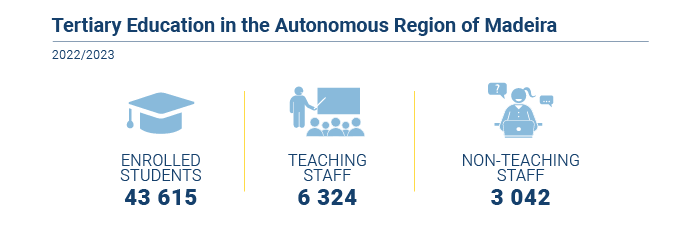
- Between 2012 and 2022, the number of persons with "Up to Primary Education - 3rd cycle" decreased by 21.5%. In "Secondary and post-secondary" education and "Tertiary" education, there were increases of 54.4% and 67.3%, respectively.
- Over the last 10 years, there has been a growing trend in the working-age population (ages 16 to 89) with higher levels of education, and the trend has been the opposite for lower education levels.
- Between 2012 and 2022, the working-age population with "Up to Primary Education - 3rd cycle" decreased by 22.9%, with "Secondary and post-secondary" education increased by 51.4%, and with "Tertiary" education increased by 63.4%.
- Throughout the last decade, there has been an increase in the activity rate with an increase in the level of education. In 2022, for education levels "Up to Primary Education - 3rd cycle," "Secondary and post-secondary," and "Tertiary," the activity rates were 48.5%, 71.8%, and 85.1%, respectively.
- The higher the level of education, the higher the employment rate. In 2022, for persons with "Up to Primary Education - 3rd cycle," the employment rate was 45.1%, for those with "Secondary and post-secondary" education, the rate was 65.8%, and for those with "Tertiary" education, the rate was 80.5%.
- The average monthly earnings of employees with a dependent employment contract are proportional to the increase in the worker's education level, reflecting the positive correlation between qualifications and compensation of employees in the labour market. In 2021, the average monthly earnings for those with education levels below Primary Education - 1st cycle were 979.30 euros, for those with Secondary Education were 1,104.08 euros, for graduates were 1,896.51 euros, and for those with a doctorate were 2,437.34 euros.
- Between 2012 and 2022, there was a significant decrease in regional public administration workers with education levels "Up to Primary Education," and an increase in those with tertiary education.
- In 2019, the majority of agricultural producers had "Up to Primary Education - 1st cycle," representing 47.2% of total producers, and 7.0% had tertiary education. Only 6.3% of producers "Could not read or write."
For more information, please click on:
International Statistical Cooperation
 |
International Statistical Cooperation
|
Statistical Literacy
 |
Statistical Literacy
|
|
|
|
|
 |
 |
|



 |
|
|
 |

Copyright © 2026 Direção Regional de Estatística da Madeira. All rights reserved.
Privacy policy | Cookie Notice
Address: Calçada de Santa Clara 38, 9004-545 Funchal, Madeira Island
Phone: +351 291 145 110 (National landline call)