









Newsletters
Subscribe to our newsletter and get statistical data as soon as it is available!...
Regional Directorate of Statistics of Madeira releases an expansion of the time series of Education Statistics for the Autonomous Region of Madeira covering the period from 1989/1990 to 2022/2023
The Regional Directorate of Statistics of Madeira (DREM) has made available today an expansion of the time series of Education Statistics for the Autonomous Region of Madeira (ARM) on its website. This extension includes information on Tertiary Education. The added details on Tertiary Education include data on institutions categorised by type of education, enrolled students by type of education, study cycle, and field of education and training, teaching staff categorised by type of education, teaching career, and academic qualification, non-teaching staff categorised by institutional nature and type of education of the institution, and academic qualification, as well as vacancies categorised by institutional nature and type of education of the institution, study cycle, and field of education and training. Additionally, updates have been made to the occupancy rates of initial training courses in tertiary education, and revisions have been undertaken on the gross and net enrolment rates for all levels of education, based on the final results of the Census. The data presented originates from the Directorate-General of Education and Science Statistics (DGEEC).
The key indicators may be summarised as follows:
- In the academic year 2022/2023, the Autonomous Region of Madeira (ARM) had 8 tertiary education institutions, distributed among 4 universities (all public) and 4 polytechnics (2 public and 2 private).
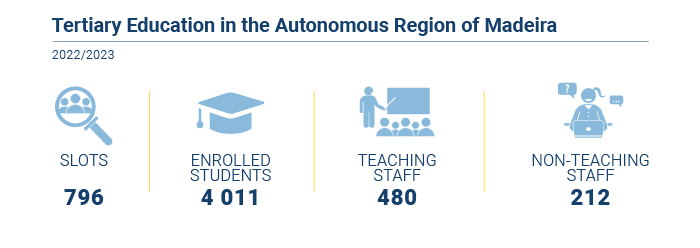
- The number of available slots for Tertiary Education candidates fluctuated over the last decade, ranging from 759 slots in the academic year 2019/2020 to 868 slots in the academic year 2021/2022. In 2022/2023, there was an 8.3% decrease in the number of slots compared to the previous academic year, totalling 796 slots for the ARM. The Science areas accounted for 39.8% of the available slots for the academic year 2022/2023.
- The number of students enrolled in tertiary education institutions in the Region increased by 26.5% between the academic years 2013/2014 and 2022/2023, with a more significant growth in private education (+64.8%) compared to a 23.1% increase in public education.
- By study cycle, between the academic years 2013/2014 and 2022/2023, there were increases of 26.7% in the number of students enrolled in Integrated Master's programs (plus 20 students) and 17.6% in the number of students enrolled in bachelor’s programs 1st cycle (plus 420 students). The number of students enrolled in Master's 2nd cycle and Doctorate 3rd cycle programs decreased by 12.2% (minus 71 students) and 26.3% (minus 26 students), respectively. Higher Professional Technical Courses started in public education in 2015/2016 with 72 enrolled students. Over the period analysed, successive increases were observed, reaching 547 enrolments in the academic year 2021/2022 and 488 in the academic year 2022/2023.
- The Science areas accounted for 36.1% of students enrolled in higher education in the ARM in the academic year 2022/2023.
- The number of enrolled women was higher, constituting 53.1% of the total enrollees in the academic year 2022/2023. The education and training area with the highest number of enrolled women was "Health and Social Protection," representing 22.3% of enrolments. On the other hand, men showed a preference for the "Engineering, Manufacturing, and Construction" area, with 27.8% of enrolments.
- In the academic year 2022/2023, there were 480 teachers in Tertiary Education, with 417 in public education and 63 in private education. By institutional nature, there was a higher presence of doctorates in public education (48.4%) and Masters in private education (38.1%) in 2022/2023.
- In 2022/2023, the teaching staff in Tertiary Education was predominantly male (56.3%). Most teachers belonged to the categories of Assistants or Assistant Professors, constituting 40.6% and 26.3% of teachers in this academic year, respectively.
- In the academic year 2022/2023, 212 non-teaching staff were counted performing functions in Tertiary Education establishments in the ARM.
For more information, please click on:
International Statistical Cooperation
 |
International Statistical Cooperation
|
Statistical Literacy
 |
Statistical Literacy
|
|
|
|
|
 |
 |
|



 |
|
|
 |

Copyright © 2026 Direção Regional de Estatística da Madeira. All rights reserved.
Privacy policy | Cookie Notice
Address: Calçada de Santa Clara 38, 9004-545 Funchal, Madeira Island
Phone: +351 291 145 110 (National landline call)