









Newsletters
Subscribe to our newsletter and get statistical data as soon as it is available!...
In the 2024/2025 academic year
Number of students enrolled in higher education institutions in the Region increased by 0.4% compared with the previous academic year
The Regional Directorate of Statistics of Madeira (DREM) has today updated on its website the Time Series of Education Statistics of the Autonomous Region of Madeira (ARM), with data concerning Tertiary Education for the 2024/2025 academic year. The data presented are sourced from the Directorate-General for Education and Science Statistics (DGEEC).
The following indicators are highlighted:
- In the 2024/2025 academic year, the Autonomous Region of Madeira (ARM) had eight higher education institutions, comprising four universities (all public) and four polytechnics (two public and two private).
- The tertiary education enrolment rate stood at 15.7% in the 2024/2025 academic year, representing a decrease of 0.1 percentage points compared with the previous academic year.
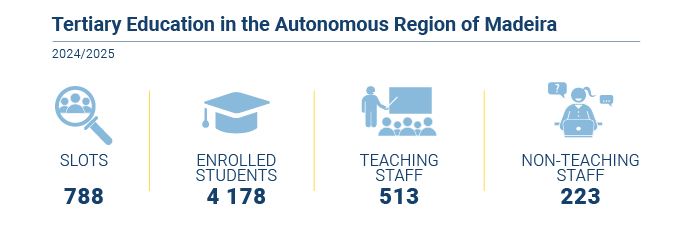
- Under the general access regime, 788 places were made available in the ARM for candidates to tertiary education in 2024/2025 (750 for 1st cycle Bachelor’s degrees and 38 for integrated Master’s programmes), maintaining the same number as the previous year. Science fields accounted for 39.0% of available places and Engineering for 17.1%. Of the total, 675 places were allocated to public tertiary education through the national access competition (85.7%) and 113 to private institutional competitions (14.3%).
- In the 2024/2025 academic year, 1 577 new students were enrolled in tertiary education for the first time, corresponding to 37.7% of all students enrolled in the Region’s tertiary education establishments. Compared with the previous year, there was a 5.2% decline (87 fewer students). This decrease occurred in polytechnic education, where there were 93 fewer students (-16.8%). University education recorded a slight increase of 0.5% (6 more students than in 2023/2024). By sex, 54.3% of new enrollees were women (856) and 45.7% were men (721).
- By study cycle, the number of new students enrolled in 2nd cycle master’s programmes increased by 14.1% (41 more students), totalling 331. 1st cycle bachelor’s programmes and Higher Professional Technical Courses recorded decreases of 55 (-5.3%) and 66 (-25.8%) new students, totalling 979 and 190 new students, respectively.
- Regarding the distribution by field of education and training, Sciences accounted for 33.0% of all new tertiary education students in the ARM in 2024/2025, followed by Services (15.1%) and Engineering (14.3%).
- The total number of students enrolled in higher education institutions in the Region was 4 178, representing an increase of 0.4% (17 more students) between the 2023/2024 and 2024/2025 academic years. This growth was recorded in university education, with 79 more students (+2.8%), while polytechnic education registered a decline of 4.7% (62 fewer students than in the previous year).
- The number of students enrolled in 2nd cycle master’s and 3rd cycle doctoral programmes rose by 14.4% and 3.3%, respectively, whereas enrolments in specialisation programmes declined by 10.7% (three fewer students in public universities). Enrolments in Higher Professional Technical Courses decreased by 44 students (-9.5%), totalling 421 students.
- In terms of distribution by field of education and training, Sciences accounted for 32.0% of all tertiary education students in the ARM in 2024/2025, followed by Engineering (15.4%), Health and Social Protection (14.5%), and Services (13.8%).
- Female students represented 54.0% of total enrolments in 2024/2025, corresponding to a decrease of 0.5 percentage points compared with the previous academic year. Considering the study cycle, only in Higher Professional Technical Courses, Specialisation Programmes, and 3rd cycle Doctorates did the proportion of female students fall below that of male students (32.5%, 48.0%, and 47.4%, respectively). Among women, the preferred education field was Health and Social Protection, representing 21.6% of female enrolments (487 students). Conversely, male students favoured Engineering, Manufacturing and Construction, accounting for 29.1% of their enrolments (559 students).
- The teaching staff in tertiary education in 2024/2025 totalled 513 teachers (445 in public institutions and 68 in private), representing an increase of 54 compared with the previous academic year. This rise was observed in both public and private sectors (44 and 10 more, respectively), as well as in both university and polytechnic education (29 and 25 more lecturers, respectively).
- By institutional nature, in the same academic year, a higher share of doctoral degree holders was observed in public institutions (49.4%). In private education, the proportions of doctoral and bachelor’s degree holders were quite similar (29.4% and 30.9%, respectively).
- In 2024/2025, most teachers belonged to the categories of Assistant (39.8%) or Assistant Professor (27.9%).
- A total of 223 non-teaching staff were employed in higher education institutions in the ARM in 2024/2025 (200 in public and 23 in private institutions), representing an increase of 4.2% (nine more persons) compared with 2023/2024. Approximately 35.0% of non-teaching staff held a bachelor’s degree, and 26.0% had completed secondary education.
For more information, please click on:
International Statistical Cooperation
 |
International Statistical Cooperation
|
Statistical Literacy
 |
Statistical Literacy
|
|
|
|
|
 |
 |
|



 |
|
|
 |

Copyright © 2026 Direção Regional de Estatística da Madeira. All rights reserved.
Address: Calçada de Santa Clara 38, 9004-545 Funchal, Madeira Island
Phone: +351 291 145 110 (National landline call)