








Newsletters
Subscribe to our newsletter and get statistical data as soon as it is available!...
In the 2024/2025 school year
Number of students enrolled in non-tertiary education decreased across all levels/cycles of study, except in the 1st cycle
The Regional Directorate of Statistics of Madeira (DREM) today publishes preliminary data on non-tertiary education statistics for the Autonomous Region of Madeira (ARM) for the 2024/2025 school year, provided by the Education Observatory of the Autonomous Region of Madeira (OERAM), as the core unit of the Regional Directorate of School Administration (DRAE), within the Regional Secretariat for Education, Science and Technology.
Madeira had 136 non-tertiary education institutions in the 2024/2025 school year
In the 2024/2025 school year, considering the type of institutions, the ARM had a total of 136 educational establishments, three fewer than in the previous school year. This change resulted from the merger of three primary schools in the public education system. Of the total establishments, 76 were public and 60 were private, covering levels from kindergartens to vocational schools.
Non-tertiary education had 707 fewer students in the last school year
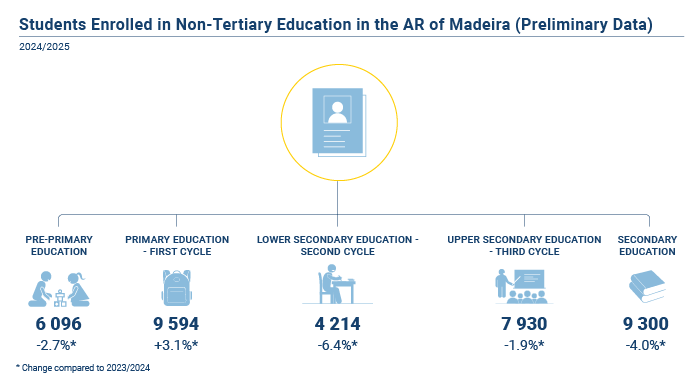
The ARM recorded a total of 37 134 students enrolled in pre-school, primary, and secondary education levels in the 2024/2025 school year, representing a decrease of 707 students (-1.9%) compared with the previous school year. By institutional nature, public education accounted for 77.0% of enrolments and private education for 23.0%, similar proportions to those observed in 2023/2024. It should be noted that the total number of students was the lowest since the beginning of the series, which dates back to the 1999/2000 school year.
In terms of sex distribution, it was almost equal, with 18 599 male students and 18 535 female students.
In pre-school education, the number of enrolled children decreased by 2.7% compared with the previous school year (171 fewer children), covering a total of 6 096 children. This decline interrupts the continuous growth observed from 2018/2019 until the previous school year, approaching the levels recorded in 2020/2021, when 6 003 children were enrolled.
In the 2024/2025 school year, 21 738 students were enrolled in primary education, representing a decrease of 0.7% (153 fewer students) compared with the previous year, marking the lowest figure since the beginning of the series. In the 1st cycle, as in the previous school year, there was an increase of 3.1% in the number of enrolled students (+288). Conversely, in the 2nd and 3rd cycles, enrolments decreased by 6.4% (-287 students) and 1.9% (-154 students), respectively.
In secondary education, the number of enrolled students also decreased compared with the previous school year, with 383 fewer students, totalling 9 300 students in 2024/2025.
Regarding adult-oriented education and training programmes, 1 524 students were enrolled in 2024/2025, reflecting a decrease of 9.0% compared with the previous school year. Of these, 775 students were enrolled in primary education programmes and 749 in secondary education programmes.
Number of teachers in the ARM slightly decreased
The Autonomous Region of Madeira had 5 715 teachers in active service in the 2024/2025 school year, 45 fewer (-0.8%) than in 2023/2024, distributed across the different levels/cycles of education, from pre-school to secondary education and vocational schools. This decrease mainly resulted from a reduction in teaching staff in the 3rd cycle of primary education and secondary education (-60 persons), despite a slight increase in the number of teachers in the 1st cycle (+13) and 2nd cycle (+10). Other levels observed minor decreases, totalling 8 persons (6 fewer in vocational schools and 2 fewer in pre-school education).
Data show a predominance of teachers in public educational establishments, representing 89.0% of the total (5 087), while private institutions had 628 teaching staff.
Regarding sex distribution, women continued to constitute the majority of the teaching workforce, with 4 271 female teachers (74.7%), while men totalled 1 444 (25.3%).
Among teachers, 460 had specialisation and were active in special education, distributed across different teaching cycles, 7 of whom belonged to the recruitment group of Portuguese Sign Language.
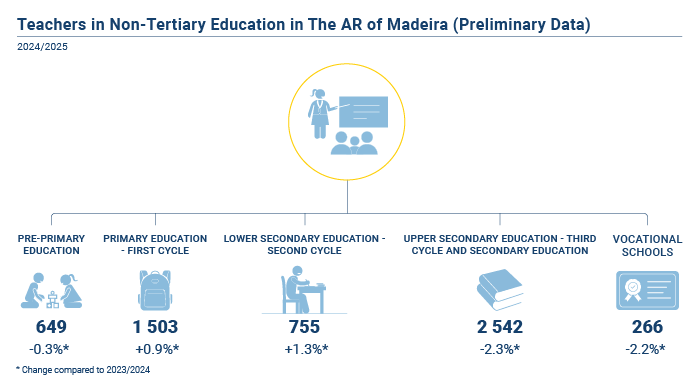
The number of non-teaching staff in pre-school, primary, and secondary education increased by 0.6%, rising from 3 784 in 2023/2024 to 3 807 in 2024/2025. Of these, 2 918 were assigned to the public education network, representing 76.6%.
For more information, please click on:
International Statistical Cooperation
 |
International Statistical Cooperation
|
Statistical Literacy
 |
Statistical Literacy
|
|
|
|
|
 |
 |
|



 |
|
|
 |

Copyright © 2026 Direção Regional de Estatística da Madeira. All rights reserved.
Address: Calçada de Santa Clara 38, 9004-545 Funchal, Madeira Island
Phone: +351 291 145 110 (National landline call)