

- HomeHome
- DREMDREM
-
Statistical InformationStatistical Information
-
Economic
- Government
- Agriculture, Forestry and Fishing
- Construction and housing
- Trade
- Economic Accounts
- Enterprises
- Industry and energy
- Innovation and knowledge
- Prices
- Monetary and Financial Sector
- Short-term trends
- Transports and Communications
- Tourism
-
Social
- Culture, Sport and Recreation
- Education
- Health
- Justice
- Labour market
- Population and Social Standards
- Social protection
- Territory
- Multithemes
- Indicators System
-
Economic
- Dissemination CalendarDissemination Calendar
- MetadataMetadata
- LinksLinks
- Site MapSite Map
- Press release
- Dashboards
- Contact usContact us
- RAMStats 2.0









Notícias (GB)
In 2025, the number of divorces increased compared to the previous year (Read more...)
In August 2026, the overnight stays in tourist accommodation in the Region increased by 3.3% year-on-year (Read more...)
In the 2nd quarter of 2026, the median rental value of new lease agreements increased by 17.4% year-on-year, while the number of new agreements increased by 8.8% (Read more...)
In August 2026, seven meteorological stations recorded tropical nights on every day of the month (Read more...)
In August 2026, passenger movement at the Autonomous Region of Madeira airports recorded a year-on-year increase of 3.7% (Read more...)
In 2025, food donations in the Autonomous Region of Madeira increased by 31.5% compared with 2024, reaching 949.0 tonnes (Read more...)
In August 2026, the median value of bank appraisals for housing in the Autonomous Region of Madeira rose to 2 625 euros/m2 (Read more...)
In 2025, 69.8% of the resident population consulted a general practitioner or family doctor in the 12 months prior to the interview (Read more...)
For the year 2025, the Regional Directorate of Statistics of Madeira (DREM) today makes available on its website the publication of Construction and Housing Statistics for the Autonomous Region of Madeira (Read more...)
DREM releases revised data on the main aggregates of the Regional Public Administration of Madeira for 2024 and 2025 (Read more...)
Notícias (GB)
In 2025, the number of divorces increased compared to the previous year (Read more...)
In August 2026, the overnight stays in tourist accommodation in the Region increased by 3.3% year-on-year (Read more...)
In the 2nd quarter of 2026, the median rental value of new lease agreements increased by 17.4% year-on-year, while the number of new agreements increased by 8.8% (Read more...)
In August 2026, seven meteorological stations recorded tropical nights on every day of the month (Read more...)
In August 2026, passenger movement at the Autonomous Region of Madeira airports recorded a year-on-year increase of 3.7% (Read more...)
In 2025, food donations in the Autonomous Region of Madeira increased by 31.5% compared with 2024, reaching 949.0 tonnes (Read more...)
In August 2026, the median value of bank appraisals for housing in the Autonomous Region of Madeira rose to 2 625 euros/m2 (Read more...)
In 2025, 69.8% of the resident population consulted a general practitioner or family doctor in the 12 months prior to the interview (Read more...)
For the year 2025, the Regional Directorate of Statistics of Madeira (DREM) today makes available on its website the publication of Construction and Housing Statistics for the Autonomous Region of Madeira (Read more...)
DREM releases revised data on the main aggregates of the Regional Public Administration of Madeira for 2024 and 2025 (Read more...)
Newsletters
Subscribe to our newsletter and get statistical data as soon as it is available!...
In the last three quarters of 2020
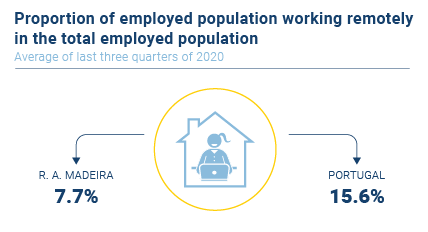
7.7% of the employed population of Madeira worked remotely
The Regional Directorate of Statistics of Madeira (DREM) releases a few more results for the Autonomous Region of Madeira (ARM) of the 2020 “Working from Home” ad-hoc module of the Labour Force Survey (LFS). In the 2nd quarter 2020 a set of questions were added to the LFS, with the main goal of estimating the number of employed persons working from home and, among these, how many worked remotely. The target population of this module is the employed population of the ARM, estimated at 122.7 thousand in the last three quarters of 2020 (on average).
Between April and December 2020, 7.7% of the employed population of the Region worked remotely, a lower percentage than the country’s (15.6%) and the lowest among the 7 NUTS2 regions. Área Metropolitana de Lisboa (27.9%) had the highest proportion and was the only region above the national average. The Autonomous Region of Azores had the second lowest proportion (8.3%). Norte (12.2%), Centro (10.6%), Algarve (10.3%) and Alentejo (10.0%) also stood below the country’s average.
The employed population of the ARM that worked remotely in the last three quarters of 2020 represented only 1.3% of the country’s, the same percentage as the Autonomous Region of Azores. Together, Área Metropolitana de Lisboa (47.8%) and Norte (27.9%) concentrated three quarters of the employed population working remotely in the country.
In this period, 8.3% of the urban employed population of the ARM worked remotely, significantly lower than the national average (18.9%) and the lowest compared to the other NUTS2 regions. That proportion was 0.6 percentage points higher than the total of the Region (7.7%).
For more information, please click on:
International Statistical Cooperation
 |
International Statistical Cooperation
|
Statistical Literacy
 |
Statistical Literacy
|
|
|
|
|
 |
 |
|



 |
|
|
 |

Copyright © 2026 Direção Regional de Estatística da Madeira. All rights reserved.
Address: Calçada de Santa Clara 38, 9004-545 Funchal, Madeira Island
Phone: +351 291 145 110 (National landline call)