









Newsletters
Subscribe to our newsletter and get statistical data as soon as it is available!...
For the period 2021-2023
DREM releases the characterisation of the employed population of the Autonomous Region of Madeira
The Regional Directorate of Statistics of Madeira (DREM) has released today on its website the characterisation of the employed population of the Autonomous Region of Madeira (RAM) for the period 2021-2023.
This release focuses on information obtained through the Labour Force Survey, analysing the employed population and the employment rate in terms of quarterly and annual values. Different segments of employees are detailed, covering variables such as sex, age group, level of completed education, sector of activity, secondary activity, main profession, occupational status, duration of work, type of contract, underemployment of part-time workers, effective hours of work, and work from home.
With this release, DREM extends the time series of the Labour Force Survey, including the effective hours of work (average weekly and volume) and, for the 2021 series, the characterisation of the employed population according to the exercise of secondary activity. Considering the data revision that occurred with the release of the 3rd quarter of 2023, the website also provides quarterly and year-on-year changes of the population according to work condition and underutilization of work, as well as their respective rates, for the period 2020-2023.
An extension of the series related to the Labour Force Survey module "Working from Home", conducted since the 2nd quarter of 2021, with revised estimates for the entire period, is also available, highlighting the dissemination of information regarding the frequency of working from home, use of Information and Communication Technologies (ICT), and equipment necessary for working from home for the period from the 2nd quarter of 2022 to the 4th quarter of 2023.
From the analysis conducted, the following results are highlighted:
-
-
-
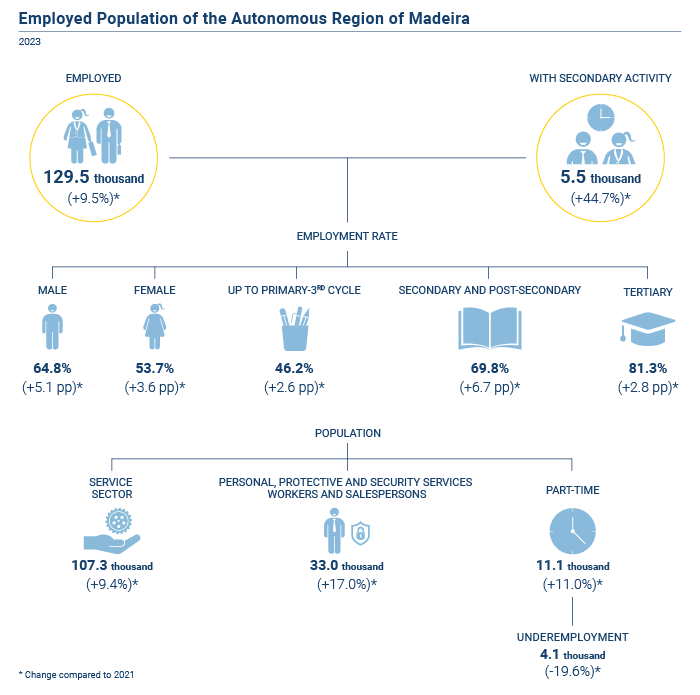
- The employed population has shown a growing trend over the years, on average, above the population change in the ARM. In 2023, the number of employees in the ARM amounted to 129.5 thousand persons.
-
-
-
-
-
- The employment rate for men has always been higher than that for women. In 2023, the rates were 64.8% for men and 53.7% for women.
-
-
-
-
-
- Persons aged 16 to 24 and 65 to 89 had the lowest employment rates (29.6% and 11.9%, respectively, in 2023). The age group of 25 to 34 was characterised by an increase in employment rates for both sexes and a decrease in the difference between men and women (81.7% and 80.7%, respectively, in 2023). The group aged 35 to 44 had the highest employment rates (86.0% in 2023).
-
-
-
-
-
- The employment rate for persons with the education level "Up to primary- 3rd cycle" was always the lowest in the period under analysis, while the rate for persons with the complete education level "Tertiary" was always the highest, maintaining a growing trend. In 2023, the rates were 46.2% for persons "Up to primary - 3rd cycle," 69.8% for those with "Secondary and post-secondary" education, and 81.3% for those with "Tertiary" education.
-
-
-
-
-
- The "Services" sector was the largest employer, followed by the "Industry, construction, energy, and water" sector and, finally, the "Agriculture, animal production, hunting, forestry, and fishery" sector. In 2023, 107.3 thousand persons were employed in the "Services" sector, 18.3 thousand in the "Industry, construction, energy, and water" sector, and 4.0 thousand in the "Agriculture, animal production, hunting, forestry, and fishery" sector (82.8%, 14.1%, and 3.1%, respectively).
-
-
-
-
-
- In the last year, about one in every 24 employed persons had a secondary activity. In 2023, out of 129.5 thousand employees, there were 5.5 thousand persons with a secondary activity.
-
-
-
-
-
- Among those with a secondary activity, 4 out of 5 employees worked in the "Services" sector both in the main and secondary activities. In 2023, there were 4.4 thousand employees in this situation.
-
-
-
-
-
- The group of "Skilled workers in industry, construction, and artisans" experienced the highest increase in workers during the period under analysis. In 2023, the group of "Workers in personal, protective and security services, and salespersons" was the one with the most employees, around 33 thousand persons (25.5%).
-
-
-
-
-
- During the period under analysis, more than 90% of employees worked full-time. In 2023, 118.5 thousand persons were in this situation, representing 91.5% of the employed population.
-
-
-
-
-
- Between 2021 and 2023, there was a decrease in the proportion of employees in the conditions of underemployment of part-time workers. In 2023, 4.1 thousand persons were in these conditions, accounting for 3.2% of the employed population.
-
-
-
-
-
- More than half of the employees who worked from home needed a computer and a smartphone. In the 4th quarter of 2023, out of the 14.3 thousand employees who worked from home, 8.4 thousand (corresponding to 58.7%) needed a "Computer and smartphone".
-
-
For more information, please click on:
International Statistical Cooperation
 |
International Statistical Cooperation
|
Statistical Literacy
 |
Statistical Literacy
|
|
|
|
|
 |
 |
|



 |
|
|
 |

Copyright © 2026 Direção Regional de Estatística da Madeira. All rights reserved.
Address: Calçada de Santa Clara 38, 9004-545 Funchal, Madeira Island
Phone: +351 291 145 110 (National landline call)