






Newsletters
Subscribe to our newsletter and get statistical data as soon as it is available!...
In 2023
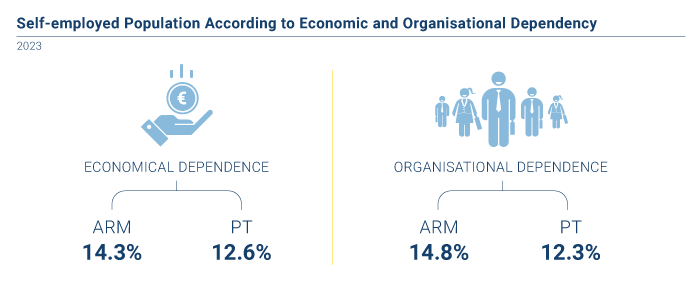
14.3% of self-employed workers in the Autonomous Region of Madeira were in economical dependence, and 14.8% were in organisational dependence
The Regional Directorate of Statistics of Madeira (DREM) released today information for the period 2021-2023 from the Labour Force Survey regarding self-employed workers in the Autonomous Region of Madeira (ARM), categorised by economical and organisational dependence.
Within the scope of the Labour Force Survey, a person aged between 16 and 89 years is considered employed if, during the reference period, they were in one of the following situations:
- worked for at least one hour for a wage or salary, in cash or in kind (including unpaid family work);
- had a formal attachment to his/her job but was not at work temporarily;
- was in early retirement but working in the reference week.
This survey evaluates persons' situations in their primary profession. This situation is distinct from the person's "tax situation" (which is not the subject of inquiry in this survey). The situation in the profession is defined as the degree of dependence or independence of a person in the exercise of their profession, based on the economic risks they face and the nature of the control they exert in the enterprise. Persons can be classified into three main categories: employees, self-employed workers (as self-employed workers or employers), and unpaid family workers. Self-employed workers (SEW) are persons who engage in independent occupations, with or without associates, benefiting from a remuneration that is directly linked to profits (gained or potential) from goods or services produced. The associates may or may not be immediate family members. Independent activity can be carried out in various contexts: an enterprise, professional office, agricultural operation wholly or partially owned by the person, or any other business activity with or without employees.
Therefore, a SEW has a relationship of independence regarding the control they exercise in the enterprise/institution/activity – they own or co-own the economic unit where they work, meaning they have ownership of the share capital and means of production (e.g., machinery and other equipment), giving them control over the management of the enterprise's activities. Consequently, the remuneration for their work is directly dependent on the value earned (profit) from the sale of goods or services produced. A client is considered to be any person or organisation to whom the individual, within the scope of their economic activity, provides goods or services. Thus, the term "client" should be understood broadly: customer, buyer, user, patient, etc.
In 2023, it is estimated that in the ARM, 12.8 thousand persons between 16 and 89 years of age were self-employed workers (SEWs), accounting for 9.9% of total employment. Approximately 8.1 thousand of these workers were SEWs as self-employed workers, and 4.8 thousand were SEWs as employers. In 2022, SEWs represented 10.8% of the employed population, indicating a decrease of 0.9 percentage points (pp) in this indicator in 2023.
Nationally, SEWs were more prevalent than in the ARM, accounting for 14.0% of total employment in 2023 and 14.4% in 2022, representing a difference of 0.4 pp between these two years.
In assessing the impact of clients on SEWs' activities, the existence of clients who alone represented a high percentage of the worker's income and had the ability to set their working hours is analysed. In cases where the worker had only one client or, having two or more clients, one client was dominant, it is considered that there was economical dependence. On the other hand, despite expecting a high level of flexibility regarding the determination of working hours by SEWs, this is not always the case, as clients often determine the worker's schedule. In this case, in analysing the impact of clients on SEWs' activities regarding the determination of daily working hours, it is considered that there was organisational dependence.
In the ARM, in 2023, of the total SEWs, 74.2% had, in the last 12 months, "10 or more clients and none of them dominant". Compared to 2022, this represents an increase of 5.6 pp (68.6%). It is also noted that in 2022, 10.5% of SEWs had "Only one client," with no data available broken down for the ARM in this way in 2023. Consequently, in the past year, in the ARM, 14.3% of SEWs were in a situation of "economical dependence," representing a decrease of 3.7 pp compared to 2022. Thus, there has been an increase in SEWs in a situation of economical independence, reaching 85.7% in 2023.
In the country, in 2023, the percentage of SEWs with "10 or more clients and none of them dominant" was lower than in the Region, standing at 72.3% (68.3% in 2022). In this year, SEWs who had "Only one client" represented 6.9% of the total SEWs nationwide (8.4% in 2022). In a situation of "economical dependence", 12.6% of SEWs were national, 1.7 pp lower than observed in the ARM.
Regarding the determination of working hours, 14.8% of SEWs in the Region indicated that their working hours are set by clients, and 71.8% indicated that the working hours are determined by themselves without restrictions (62.3% in 2022). Thus, in 2023, 14.8% of SEWs were in a situation of "organisational dependence," and 85.2% were in a situation of "organisational independence." For 2022, it was only possible to ascertain that 90.8% of SEWs were in a situation of "organisational independence," indicating a decrease of 5.6 pp in this indicator between 2022 and 2023.
At the national level, in 2023, 12.3% of SEWs were in a situation of "organisational dependence" and 87.7% were in a situation of "organisational independence," resulting from a lower proportion of SEWs whose working hours are determined by clients (12.3%).
For more information, please click on:
International Statistical Cooperation
 |
International Statistical Cooperation
|
Statistical Literacy
 |
Statistical Literacy
|
|
|
|
|
 |
 |
|



 |
|
|
 |

Copyright © 2026 Direção Regional de Estatística da Madeira. All rights reserved.
Address: Calçada de Santa Clara 38, 9004-545 Funchal, Madeira Island
Phone: +351 291 145 110 (National landline call)